

Nearly 30% of your Microsoft 365 budget is likely evaporating into thin air right now. With the July 2026 price hikes pushing Microsoft 365 E5 costs to $60 per user, implementing microsoft 365 cost optimization for executives is no longer optional. This invisible waste isn't just an IT oversight. It's a direct hit to your bottom line that requires a vigilant, proactive response.
You probably recognize that SaaS sprawl is draining your margins, yet getting a straight answer from a three-week IT audit feels nearly impossible. It's frustrating to sign off on massive license renewals when you lack clarity on which seats are actually being used. Your capital belongs in growth, not in unassigned subscriptions or underutilized premium features.
This guide reveals how to stop the drain by transforming SaaS management into a high-yield governance strategy. You'll learn how to implement a continuous, automated system for license oversight that provides immediate recovery of wasted capital. We explore how a digital auditor approach, powered by a real-time Health Score, turns organizational disorder into total financial clarity.
Key Takeaways
- Understand why microsoft 365 cost optimization for executives is a high-yield financial governance strategy rather than a standard IT inventory task.
- Identify how the 35% waste trap impacts your margins and why right-sizing is your single largest SaaS recovery opportunity in 2026.
- Learn to use a License Health Score as a primary KPI to maintain continuous visibility over software assets and eliminate invisible sprawl.
- Discover the 5-step playbook to transition from manual spreadsheets to automated governance workflows that recover wasted capital in minutes.
- See how the LicenseIQ platform provides instant, dollar-value recommendations to stop the drain on corporate resources immediately.
What is Microsoft 365 Cost Optimization for Modern CEOs?
Microsoft 365 cost optimization for executives is the active process of recovering capital from underutilized software assets. It's no longer enough to simply manage an inventory. In 2026, the cost of doing business has shifted. With Microsoft 365 E5 prices reaching $60 per user and E3 at $39, every unassigned or underused seat represents a leak in your corporate treasury. Optimization is a competitive necessity for maintaining lean, agile operations.
SaaS Spend Optimization is a fiscal governance strategy that eliminates waste and reallocates capital to innovation. It transforms a recurring expense into a controlled financial asset. By treating software with the same rigor as physical inventory, you ensure that every dollar spent contributes directly to productivity or security.
Management vs. Optimization: A Strategic Distinction
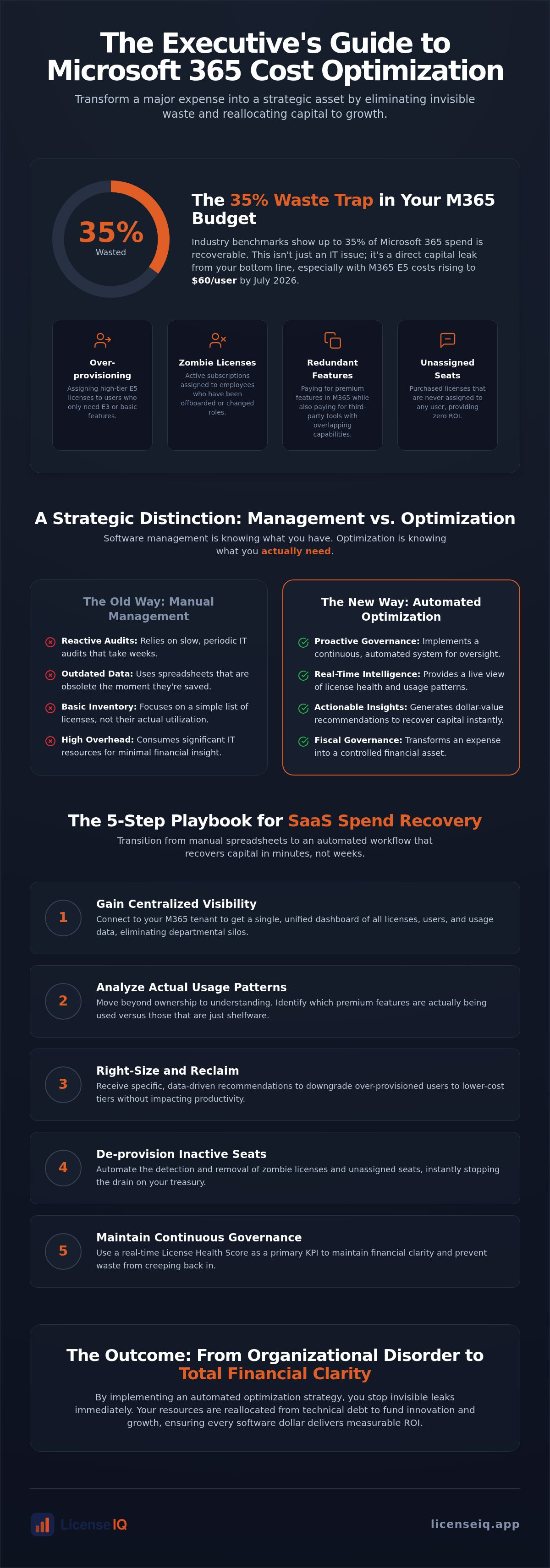
Software management is knowing what you have. Optimization is knowing what you actually need. While traditional Software Asset Management (SAM) provides a foundation for inventory, it often stops at visibility. Executives need more than a list of licenses. You need to know if your team is actually utilizing the high-value features you're paying for.
Tracking Shadow IT covers only half the battlefield. Even authorized software becomes a liability when it's poorly utilized. The shift in 2026 is away from manual spreadsheets that are outdated the moment they're saved. Modern leadership relies on AI-native software intelligence to provide a real-time view of license health. This allows for proactive adjustments rather than reactive audits that take weeks to produce results.
The Fiscal Impact of Unchecked SaaS Sprawl
Decentralized buying creates a fragmented environment where redundant license types exist across different departments. Without a centralized view, you might pay for premium security features in one business unit while another unit buys third-party overlaps. This sprawl is an invisible drain on your margins.
Zombie licenses are perhaps the most preventable waste. These are subscriptions assigned to employees who have long since offboarded or moved to different roles. To learn more about how the Humae platform helps manage these workforce transitions, read more. In 2026, software waste is the most significant preventable drain on your EBITDA. By implementing microsoft 365 cost optimization for executives, you stop these leaks immediately. You move from a state of organizational disorder to total financial clarity, ensuring your resources fund growth instead of technical debt.
For the majority of SMBs in 2026, Microsoft 365 is the single largest line item in the SaaS budget. It's the foundation of productivity, but it's also where financial oversight often fails. Industry benchmarks consistently show that up to 35% of M365 spend is recoverable through strategic right-sizing. This isn't just about cutting costs. It's about ensuring every dollar assigned to your digital workspace generates measurable value through microsoft 365 cost optimization for executives. Inactive users and unassigned seats aren't just technical artifacts; they represent a direct, monthly capital leak that erodes your margins.
When you ignore this waste, you're essentially subsidizing unused features that provide zero ROI. In an era of rising subscription costs, where Microsoft 365 E5 has reached $60 per user, allowing a third of your budget to vanish is a failure of fiscal governance. Reclaiming this capital requires moving beyond basic inventory to active, data-driven recovery.
Identifying Redundant and Over-Provisioned Licenses
The most common driver of waste is over-provisioning. Many organizations default to high-tier E5 licenses for their entire workforce, regardless of individual role requirements. While E5 offers advanced security and analytics, a significant portion of your team likely never touches these features. They may only require the core productivity tools found in E3 or even basic web-based access. Microsoft 365 license optimization requires a granular audit of actual usage patterns rather than broad assumptions. By aligning license tiers with actual work habits, you protect your budget without sacrificing operational capability.
Optimizing SaaS at this level requires precision and a refusal to accept "one size fits all" defaults. For example, a frontline worker doesn't need the same suite as a data analyst, yet they often end up on the same expensive plan. Identifying these discrepancies allows you to downgrade users to appropriate tiers, instantly lowering your monthly burn without impacting their ability to work.
The Inactive User Problem
Inactivity is a silent margin killer. If a user hasn't logged in for 30 days, that license should trigger an automatic reclamation workflow. Ghost accounts, often left behind by former employees or contractors, create a dual threat. They are a source of significant financial waste and a massive security vulnerability. Effective microsoft 365 cost optimization for executives links spend recovery directly to an Office 365 offboarding checklist. This ensures that the moment an employee leaves, their license is harvested and returned to the pool.
This proactive stance turns your IT environment into a lean, secure asset rather than a growing liability. Maintaining this level of oversight manually is impossible in a dynamic organization. You need a system that identifies these discrepancies in minutes, not weeks. Utilizing a Spend Recovery Dashboard allows you to visualize these leaks in real-time and take immediate corrective action. This transparency is the cornerstone of modern financial governance in 2026.
A 5-Step CEO Playbook for SaaS Spend Recovery
Many executives believe SaaS optimization requires months of committee meetings and procurement overhauls. It doesn't. In 2026, microsoft 365 cost optimization for executives is about rapid, data-driven execution. You can transition from invisible waste to total clarity in a single business week by following a structured playbook. This approach prioritizes immediate wins to justify the broader governance initiative.
- Step 1: Conduct a 5-minute automated audit to establish your baseline waste.
- Step 2: Review your License Health Score to prioritize high-value recovery targets.
- Step 3: Reclaim spend from inactive users and redundant tiers immediately.
- Step 4: Implement automated governance workflows to prevent future sprawl.
- Step 5: Review real-time spend recovery dashboards monthly to ensure continuous hygiene.
Establishing the License Health Score
A License Health Score provides a single, quantifiable metric for operational discipline. For a CEO, this score acts as a vital KPI that measures the efficiency of IT and Finance departments. It moves software from a black-box expense to a transparent asset. If your score is "Critical," it signals a lack of oversight. By identifying specific dollar-value leaks, you can move your organization to an "Optimized" rating within one billing cycle. This transformation ensures that your corporate resources are fueling growth rather than subsidizing inefficiency.
Automating Governance for Long-Term Accuracy
Manual audits are obsolete before they're even finished. In a dynamic organization, license usage shifts daily. Relying on quarterly spreadsheets ensures you're always three months behind your waste. AI-native platforms are now essential for mastering the microsoft 365 license management lifecycle. These systems provide the oversight needed to maintain accuracy without constant human intervention.
Automated governance sets firm guardrails. It notifies leadership the moment spend exceeds predetermined usage benchmarks. Instead of wondering where the money went, you receive proactive alerts. This vigilance allows you to maintain lean operations and prevents the slow creep of SaaS sprawl from ever returning. Efficiency becomes the default state, not a one-time project.
The ROI of Software Intelligence vs. Manual Tracking
Relying on manual spreadsheets for license tracking is a high-stakes gamble. When your IT and Finance leaders spend hours reconciling seat counts, the opportunity cost is immense. You're paying executive-level salaries for administrative data entry. Implementing microsoft 365 cost optimization for executives through automated intelligence replaces this friction with surgical precision. This move toward automation is a broader trend, with specialized firms like iHustle Media Group providing the AI-driven diagnostics and solutions necessary to keep modern business infrastructures lean and productive. While a manual rationalization project can take three months to complete, AI-native scanning delivers results in minutes.
Human error in license audits often costs more than the software itself. A single missed department or a misunderstood feature set can lead to thousands in wasted spend. The cost of a LicenseIQ platform subscription is a fraction of the typical 35% recovery realized through active microsoft 365 cost optimization for executives. Speed to value is the primary differentiator in 2026 operations. You can't afford to wait for a quarterly report to fix a monthly billing leak.
Modern governance removes the administrative burden from your leadership team. It empowers your Finance department with clear, dollar-value recommendations they can act on without needing a technical degree. This clarity bridges the gap between technical operations and fiscal responsibility. By utilizing a microsoft 365 cost optimization process driven by real-time data, you eliminate the guesswork that traditionally plagues SaaS procurement.
Your teams move from being reactive "firefighters" to proactive strategists. Instead of debating usage statistics, they execute on verified recovery opportunities. This shift ensures that your most valuable human capital is focused on growth initiatives rather than chasing ghost accounts. You gain a vigilant system that works in the background, providing total transparency into your software estate.
Continuous Monitoring vs. One-Time Audits
One-time audits provide a snapshot of a moving target. The moment the audit ends, your data begins to decay. Set-it-and-forget-it governance is the only viable way to prevent SaaS sprawl from returning to your organization. Real-time alerts for unassigned or redundant licenses ensure that waste is captured as it occurs, not months later during a budget review. This constant oversight maintains the financial health of your organization without manual intervention.
Effective 2026 budget forecasting must be based on actual usage, not just seat counts. Monitoring usage patterns allows you to predict future needs with accuracy. This continuous oversight protects your margins and ensures your digital resources are always right-sized. To begin reclaiming your budget today, access your Spend Recovery Dashboard and see your immediate savings potential.
Recovering Your Spend with LicenseIQ
LicenseIQ acts as your digital auditor. It provides the immediate clarity required to execute microsoft 365 cost optimization for executives without the typical administrative friction. The platform connects to your Microsoft 365 tenant in minutes to scan every user account across your entire organization. You receive an immediate Health Score and specific, actionable recovery recommendations. This platform is specifically designed for SMB CEOs who demand transparency and rapid results. It automates the reclamation of wasted spend to protect your company margins from the invisible drain of SaaS sprawl. You don't have to wait for IT to produce a manual report; the data is available when you need it.
The 5-Minute Audit: From Waste to Clarity
The AI-native scan identifies inactive and redundant users without any manual input from your IT team. It utilizes advanced automation to uncover licenses that haven't been touched in 30 days. It bypasses the need for complex technical scripts that often lead to human error and data decay. You can visualize your potential savings directly on the Spend Recovery Dashboard, which displays exact dollar amounts for every recovery opportunity. This is the critical first step toward reducing M365 subscription costs. By aligning your licenses with actual usage patterns, you ensure that high-tier E5 plans are only assigned to those who utilize their premium features. The system identifies exactly who can be downgraded to E3 or Business Basic without impacting productivity.
Join the Optimized Enterprise
Automated Governance Workflows ensure that waste doesn't creep back into your tenant after the initial recovery. These workflows set firm guardrails that notify leadership when spend exceeds usage benchmarks. Implementing LicenseIQ positions your company as a leader in digital operational efficiency. It transforms software from a hidden expense into a managed financial asset. You gain the peace of mind that comes from total software spend transparency. Your 2026 budget forecasting becomes a data-driven exercise rather than a series of assumptions. The Health Score serves as a permanent KPI for your executive dashboard, ensuring that operational discipline remains high across all departments. By integrating microsoft 365 cost optimization for executives into your monthly governance, you ensure your resources always fund innovation instead of waste. Start your 5-minute license audit with LicenseIQ today.
Secure Your 2026 Margins Through Software Intelligence
Reclaiming the 35% waste trap within your Microsoft 365 environment is no longer a suggestion; it's a fiscal imperative for the modern enterprise. By transitioning from manual spreadsheets to AI-native automated governance, you eliminate the invisible drain on your company margins. This strategic shift ensures that every dollar spent on your digital workspace contributes directly to productivity and innovation rather than technical debt. You don't have to tolerate the financial fog of unassigned licenses or redundant tiers any longer.
Implementing microsoft 365 cost optimization for executives transforms your SaaS stack into a lean, high-yield asset. You gain total transparency through a continuous License Health Score and specific dollar-value recovery recommendations. This vigilant oversight protects your resources from sprawl while freeing your leadership team to focus on strategic growth. It's time to replace organizational disorder with precise, data-driven decision-making that prioritizes your bottom line and operational health.
Discover your wasted M365 spend in 5 minutes with LicenseIQ. You're just moments away from total software spend transparency and immediate capital recovery. Take control of your corporate resources today and join the ranks of truly optimized organizations.
Frequently Asked Questions
How much can a typical SMB save on SaaS spend optimization?
A typical SMB can identify up to 35% savings on their software subscriptions through active optimization. In 2026, with Microsoft 365 E5 costs reaching $60 per user, these savings translate into significant capital recovery. Most organizations find that a third of their budget is trapped in unassigned seats or underutilized premium features. Reclaiming this capital requires moving beyond basic spreadsheets to a system that provides specific dollar-value recommendations for immediate action.
What is the difference between SaaS spend management and optimization?
Management focuses on inventory and visibility, while optimization focuses on financial recovery and right-sizing. Management tells you how many licenses you own. Optimization tells you how many you actually need based on real-time usage patterns. For those implementing microsoft 365 cost optimization for executives, the goal is to eliminate the gap between paid entitlements and actual employee requirements. This distinction ensures your digital resources fund growth instead of technical debt.
How long does it take to see ROI from a spend recovery tool?
You can see potential ROI within minutes of connecting your tenant to an AI-native scan. The platform identifies wasted spend immediately, providing a clear roadmap for recovery. Actual financial recovery typically occurs within a single billing cycle as you downgrade redundant tiers and reclaim inactive licenses. This rapid speed to value is essential for CEOs who demand transparent results without the long lead times associated with manual IT audits.
Is Microsoft 365 license optimization safe for our company data?
Yes, modern optimization platforms utilize secure, read-only API connections to analyze metadata rather than sensitive content. These systems connect to your Microsoft 365 tenant using industry-standard protocols to scan license assignments and activity logs. Your company data remains protected while the platform identifies financial leaks. This approach provides the security and confidence leadership requires when implementing microsoft 365 cost optimization for executives across complex operational environments.
What are the most common signs of wasted SaaS spend?
The most frequent indicators include a high volume of inactive users, redundant premium tiers, and unassigned licenses sitting in your pool. If your organization defaults to E5 licenses for all roles, you're likely over-provisioning users who only need basic tools. Other signs include zombie accounts from offboarded employees and a lack of visibility into feature utilization. Identifying these obscured details is the first step toward restoring the financial health of your software estate.
Can we optimize Microsoft 365 licenses without an IT department?
Automated platforms allow business managers to optimize licenses without extensive technical expertise. While IT input is valuable, AI-native tools provide clear, dollar-value recommendations that any executive can interpret and act upon. These systems remove the need for complex manual data reconciliation. By using a Spend Recovery Dashboard, leadership can maintain oversight and ensure fiscal discipline without burdening technical staff with administrative license tracking tasks.
What is a License Health Score?
A License Health Score is a vital KPI that measures the efficiency of your software asset utilization. It quantifies the gap between what you pay for and what your team actually uses. A Critical score indicates high levels of waste and SaaS sprawl, while an Optimized score reflects lean, disciplined operations. This metric allows CEOs to monitor software health at a glance, ensuring that digital resources are always aligned with actual organizational needs.
How does automation prevent SaaS sprawl from returning?
Automation prevents sprawl by replacing one-time audits with continuous, real-time monitoring. Automated Governance Workflows set firm guardrails that notify leadership the moment license usage deviates from established benchmarks. This proactive stance ensures that waste is captured as it occurs, not months later. By maintaining constant vigilance, these systems ensure that your 2026 budget remains protected and that your software environment stays right-sized indefinitely without manual intervention.


