

What if your most dangerous security vulnerability isn't a sophisticated external threat, but a forgotten E5 license assigned to an employee who left six months ago? You've likely felt the sting of the 2026 price hikes while struggling to track seat usage across your remote teams. It's frustrating to pay for resources that nobody uses. However, the security risks of over-provisioned m365 licenses go far beyond wasted capital. These unmonitored accounts create silent backdoors that attackers use to bypass detection and access sensitive corporate data.
You deserve total visibility into your digital environment. This guide shows you how to replace organizational disorder with absolute clarity and reclaim your budget. You'll discover an automated framework to audit your tenant, eliminate ghost accounts, and recover up to 35% of your subscription spend. We'll walk through the steps to establish a precise License Health Score and deploy proactive governance workflows that keep your organization lean and secure.
Key Takeaways
- Identify and mitigate the security risks of over-provisioned m365 licenses by closing unmonitored entry points created by "zombie" accounts.
- Recover up to 35% of your subscription budget by identifying structural underutilization and oversized license tiers.
- Implement a five-step reclamation framework to establish a clear Health Score and secure your tenant before NCE renewals.
- Eliminate shadow IT proliferation by gaining total visibility into high-tier feature usage across remote teams.
- Deploy automated governance workflows to transform operational opacity into immediate, data-driven spend recovery.
The Hidden Connection Between M365 License Waste and Security
Many organizations view unassigned Microsoft 365 licenses as a simple line-item expense. This is a dangerous oversight. Over-provisioning occurs when you pay for unassigned seats, keep users on oversized tiers like E5 when E3 suffices, or neglect "zombie" accounts. These security risks of over-provisioned m365 licenses turn your tenant into an active target. Shelfware isn't just a budget leak. It represents an unmonitored entry point that frequently bypasses standard security audits. By failing to adhere to the principle of least privilege, you grant potential attackers more surface area than your operations require.
Oversized tiers present a specific governance failure. When users are assigned high-level licenses like E5 but only utilize basic Office features, you're opening doors to advanced tools that aren't being monitored. Features like Power BI or advanced compliance modules become vectors for shadow IT and accidental data leakage when left in the hands of untrained users. Security and financial health are inextricably linked. A cluttered tenant is a vulnerable tenant.
What is a "Zombie" Account?
A "zombie" account is a licensed seat tied to a user who is disabled in Entra ID but still possesses active service assignments. These accounts often retain access to legacy data, sensitive SharePoint sites, and historical email archives. Because they aren't "active" in the eyes of HR, they often fall outside the scope of routine security reviews. IT teams frequently disable users during offboarding but forget to reclaim the license, leaving a lingering identity that consumes resources and appears in directory searches. Zombie accounts provide a valid target for credential stuffing because they remain persistent within the tenant without active oversight.
The 2026 Microsoft Pricing Impact
The July 1, 2026 price hikes across Business and Enterprise plans have transformed license management into a strategic priority. Paying a premium for unused seats compounds the financial impact of your security negligence. Every dollar spent on unmonitored licenses is capital that isn't protecting your core infrastructure. To combat this, elite organizations now use a License Health Score to measure tenant hygiene. This metric provides immediate clarity on where your vulnerabilities lie. The LicenseIQ Platform generates this score automatically, identifying the security risks of over-provisioned m365 licenses before they escalate into breaches. Total transparency is the only defense against the dual threat of rising costs and obscured vulnerabilities. You don't have to manage this complexity manually. Automated oversight ensures your tenant remains lean, secure, and compliant.
3 Critical Security Risks of Over-Provisioned Licenses
Every active license represents a managed identity. If that identity isn't being used, it isn't being monitored. This lack of oversight is the root of most security risks of over-provisioned m365 licenses. Unused licenses are prime targets for phishing and MFA fatigue attacks. Attackers target these "quiet" accounts because alerts are less likely to trigger an immediate internal investigation. When an account has no legitimate user activity, malicious behavior blends into the background noise of your tenant.
The Offboarding Security Gap
Employee turnover is constant. When a team member leaves, disabling the account in Entra ID is only the first step. If the license remains attached, the associated mailbox and cloud storage often remain accessible through legacy protocols or misconfigured sync tools. This gap creates a significant window for data exfiltration. You can secure these transitions by following a comprehensive Office 365 Offboarding Checklist 2026. Automated reclamation ensures that once a user is gone, their digital footprint and the associated risk are erased instantly.
Tier-Overlicensing and Privilege Creep
Precision matters in software governance. Assigning an E5 license to a front-line worker who only requires F3 features isn't just expensive. It's a violation of the principle of least privilege. High-tier licenses unlock powerful features like advanced eDiscovery and unmanaged app integrations. If a user doesn't need these tools, they shouldn't have them. Unmonitored access to advanced compliance features can be misused to scrape sensitive data without raising typical mass-download red flags. Aligning your tenant with the NIST Cybersecurity Framework requires strict identity and access governance to prevent this type of privilege creep.
Over-provisioning also triggers regulatory friction. GDPR and industry-specific mandates require organizations to minimize data exposure. Holding active licenses for non-existent or inactive users means you're maintaining "live" data repositories longer than necessary. This increases the security risks of over-provisioned m365 licenses during a regulatory audit. A cluttered tenant makes passing a clean compliance review nearly impossible because it signals a lack of data control.
You need a vigilant system to uncover these obscured details. Using a platform to generate a License Health Score provides the transparency required to close these gaps before they're exploited. It transforms your tenant from an unmanaged liability into a lean, secure asset.
The Financial Toll: Why Operational Opacity Costs You 35%
Operational opacity is expensive. The average SMB loses 22-35% of their M365 budget to structural underutilization. This waste isn't just a line item; it's a systemic failure of oversight. The "NCE Commitment Trap" exacerbates this issue. Microsoft's New Commerce Experience (NCE) locks you into annual or multi-year contracts. If you don't audit your tenant before the renewal window, you're legally committed to paying for that waste for the next year. There's no room for error when your budget is on the line.
Direct costs are only half the story. Subscription fees are predictable. The indirect costs of a breach are not. Mitigating the security risks of over-provisioned m365 licenses is a core financial strategy. Every unmonitored account is a potential liability that could result in millions in forensic costs and legal fees. Manual spreadsheets fail to provide the visibility required for modern FinOps accuracy. They're static, prone to error, and outdated the moment they're saved. You can't manage what you can't see.
Shelfware: The Silent Budget Killer
Shelfware consists of unallocated licenses sitting idle in your billing console. IT leaders often "buffer" licenses to prevent onboarding friction. This is a strategic mistake. It creates a pool of unmonitored assets that drain capital without providing utility. A thorough SaaS license health check uncovers these hidden costs by mapping assignments to actual user activity. It transforms "just-in-case" spending into precise, "just-in-time" allocation, ensuring every dollar supports an active contributor.
Manual Audits vs. AI-Native Governance
Traditional auditing is a massive productivity drain. A manual audit typically requires 5 hours of cross-referencing Entra ID exports with HR records. An AI-native scan performs this task in 5 minutes with higher accuracy. Human error is a significant risk during manual license reclamation. One mistake can lead to persistent budget leaks or accidental service interruptions for critical staff. You don't have time for manual guesswork in a 2026 technical environment.
Modern governance requires a Spend Recovery Dashboard. This tool provides real-time oversight and a specific dollar-value for potential savings. By using the LicenseIQ Platform, you replace administrative guesswork with a vigilant digital auditor. This level of transparency ensures your tenant remains lean while protecting your organization from the security risks of over-provisioned m365 licenses. Efficiency and security aren't competing goals. They're two sides of the same coin.
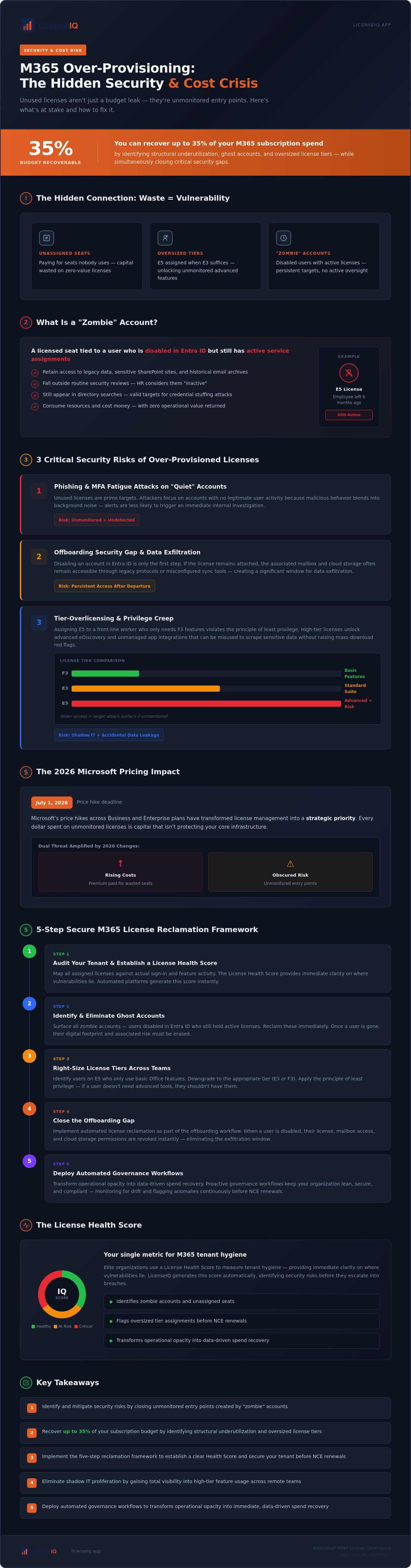
A 5-Step Framework for Secure M365 License Reclamation
Establishing a secure tenant requires a structured approach. You can't rely on manual spot-checks to mitigate the security risks of over-provisioned m365 licenses. This 5-step framework provides the clarity needed to reclaim your budget while hardening your environment against identity-based threats.
- Scan and Score. Connect your tenant to an automated auditor to establish a baseline License Health Score. This metric exposes the gap between what you pay for and what your team actually uses.
- Identify Inactive Users. Filter your directory for accounts with zero interactive sign-ins over the last 30 days. These "ghost" accounts are the primary targets for credential stuffing.
- Right-Size Tiers. Compare actual feature usage against current license levels. Most users don't need the full suite of E5 capabilities to perform their daily tasks.
- Execute Automated Governance Workflows. Use a platform like LicenseIQ to reclaim or downgrade licenses instantly. This ensures you remove risk without the danger of manual data loss.
- Continuous Monitoring. Set real-time alerts for new license assignments and unassigned inventory growth. Governance is a perpetual loop, not a quarterly event.
Defining "Inactive" for Your Organization
Reclamation isn't a one-size-fits-all process. Most organizations adopt a 30-60-90 day rule to manage their digital footprint. At 30 days of inactivity, the account is flagged. At 60, the license is removed. At 90, the account is archived. You must handle users on extended leave, such as maternity or medical leave, by converting their mailboxes to shared status. This preserves data without consuming a paid seat. Awareness of the M365 license management lifecycle ensures your offboarding remains compliant and secure.
Right-Sizing: E5 to E3 or F3?
Tier downgrades offer the fastest path to spend recovery. Many users assigned E5 licenses never touch advanced analytics or eDiscovery tools. You can often move these users to E3 or even F3 plans while maintaining core security features like MFA and conditional access. Consult the Microsoft 365 License Types 2026 Guide to map your specific feature requirements. Precision right-sizing eliminates the security risks of over-provisioned m365 licenses by removing access to advanced features that unmonitored users don't need.
Efficiency is the byproduct of total visibility. Start your first scan today and get your License Health Score in minutes to see exactly where your budget is leaking.
Automating M365 Governance with LicenseIQ
Manual oversight is no longer viable in a high-speed technical environment. You need a vigilant system that operates with the precision of a digital auditor. The LicenseIQ Platform connects to your tenant in minutes, deploying an AI-native engine to uncover obscured details. It doesn't just list users; it analyzes behavior to identify the security risks of over-provisioned m365 licenses. By converting complex activity logs into a single License Health Score, it provides immediate clarity on your organizational hygiene.
Efficiency drives the "Discover and Recover" cycle. LicenseIQ provides specific dollar-value recommendations, allowing you to see exactly how much capital is tied up in inactive or redundant seats. This isn't a passive report. It's a roadmap for Automated Governance Workflows that allow you to reclaim resources without disrupting your operations. You eliminate operational opacity and ensure your M365 tenant remains lean and secure. It's about moving from administrative guesswork to data-driven decision-making.
The Spend Recovery Dashboard
Visual clarity is the cornerstone of effective management. The Spend Recovery Dashboard categorizes wasted spend by user and license type, highlighting structural underutilization at a glance. These insights are vital for board-level reporting. You can present a data-driven case for budget adjustments, proving that your security posture is directly aligned with financial health. Proactive governance replaces reactive panic, ensuring that your resources are always optimized for current needs. It's the visual solution to the chaos of unmanaged subscriptions.
Continuous Financial Accuracy
Software governance isn't a quarterly event. LicenseIQ acts as an active participant in your company's growth by maintaining persistent oversight of your tenant. It allows you to forecast next year's M365 budget with precision, eliminating the surprises that typically follow price hikes or team expansions. You gain a vigilant partner that monitors for the security risks of over-provisioned m365 licenses every day. This level of oversight ensures that your digital environment scales efficiently without creating new vulnerabilities.
Total transparency is the only way to safeguard your corporate resources in the long term. You can stop the budget leaks and close the security gaps with a single scan. Scan your tenant and get your Health Score now to see the immediate impact of automated governance.
Secure Your Tenant and Reclaim Your Budget
Operational disorder is a choice you can't afford to make in 2026. You've seen how unmanaged seats and "zombie" accounts create silent backdoors that bypass traditional audits. Mitigating the security risks of over-provisioned m365 licenses is the most direct path to hardening your digital perimeter while improving your financial health. By following the 5-step reclamation framework, you replace guesswork with a vigilant system of oversight.
Total transparency is now a strategic requirement for every organization. You don't need manual spreadsheets to find your vulnerabilities. Our AI-native platform connects in minutes to provide a precise License Health Score and a clear roadmap for spend recovery. You can recover up to 35% of your SaaS spend while ensuring that every active license is monitored and necessary. It's time to transform your M365 environment into a lean, secure asset that supports your company's growth.
Discover and recover your wasted M365 spend with LicenseIQ in less than 5 minutes. Take the first step toward absolute operational clarity today.
Frequently Asked Questions
What are the main security risks of having too many M365 licenses?
Every unassigned or unmonitored license is a potential entry point for attackers. These "ghost" accounts often bypass multi-factor authentication reviews and standard security audits. The security risks of over-provisioned m365 licenses include an expanded attack surface and increased vulnerability to phishing or credential stuffing. Unused licenses represent unmanaged identities that turn your tenant into a liability. Oversight is the only way to close these silent backdoors.
How do inactive M365 user accounts lead to data breaches?
Inactive accounts often fall outside the scope of routine security reviews, making them ideal targets for persistent threats. If an account remains licensed after a user departs, it provides a valid target for attackers to bypass detection. Malicious actors use these credentials to access sensitive cloud storage or email archives without triggering behavioral alerts. Because the account has no legitimate user activity, the breach can remain undetected for months.
What is the "Health Score" for Microsoft 365 licenses?
The License Health Score is a proprietary metric generated by the LicenseIQ Platform to measure your tenant hygiene. It establishes a baseline by comparing your current license assignments against actual user activity. A high score represents a lean, secure environment with minimal waste. A low score signals significant security risks of over-provisioned m365 licenses and potential budget leaks. This score provides specialized leadership with immediate clarity for data-driven decision-making.
Can I reclaim M365 licenses without losing user data?
You can reclaim licenses safely by implementing structured workflows. Converting mailboxes to shared status or utilizing cloud-to-cloud backups allows you to preserve information while detaching the paid license. Automated Governance Workflows handle these transitions with precision, ensuring that no seat is reclaimed before data is secured. This approach allows you to maintain the principle of least privilege without losing critical business intelligence or historical records. It's about precision, not deletion.
How much can a typical SMB save by optimizing M365 licenses in 2026?
A typical SMB can recover up to 35% of their subscription costs through precise optimization. This waste usually stems from unallocated shelfware, oversized license tiers, and abandoned seats from former employees. Identifying these structural inefficiencies allows you to reclaim capital and reinvest it into core operations. The Spend Recovery Dashboard provides a real-time, dollar-value view of these savings. Precision optimization ensures you only pay for the resources your team actually utilizes.
How often should I conduct a Microsoft 365 license audit?
Continuous monitoring has replaced the traditional annual or quarterly audit. The speed of the 2026 SaaS environment requires real-time oversight to prevent budget leaks and security gaps. Waiting months to review your tenant leads to the "NCE Commitment Trap," locking you into expensive, unused contracts for an entire year. Automated governance ensures your score remains high by flagging inactive users and unassigned inventory the moment they appear in your billing console.
What is the difference between a manual audit and automated governance?
Manual audits rely on static spreadsheets and hours of administrative labor. They're prone to human error and provide only a snapshot of the past. Automated governance uses the LicenseIQ Platform to scan your tenant in less than five minutes. It provides an AI-native digital auditor that is always one step ahead. This proactive system identifies obscured details and executes workflows to recover spend, ensuring total clarity and operational transparency across your environment.
How do the 2026 Microsoft price increases affect license over-provisioning?
The 2026 price hikes compound the financial penalty of every unused seat. Paying more for unmonitored accounts creates a dual threat to your budget and your security posture. Higher subscription fees make it vital to mitigate the security risks of over-provisioned m365 licenses immediately. Automated spend recovery ensures your organization stays lean despite rising costs. You can't afford to let price increases compound the cost of organizational disorder and obscured vulnerabilities.


