

An IDC audit in 2026 revealed a staggering reality: 49% of organizations carry at least 10% of their Microsoft Copilot licenses as completely unused shelfware. At $30 per user every month, these idle seats represent a direct leak in your operational budget. You're likely struggling to quantify the microsoft copilot license roi while facing pressure to justify rising AI spending to your board. It's difficult to translate minutes saved into hard currency when your data remains siloed and opaque.
We understand that managing license sprawl feels like a losing battle against hidden costs. This guide provides a definitive framework to calculate your true financial impact and recover up to 35% of your investment through automated license governance. We will preview the LicenseIQ Health Score methodology, show you how to use the Spend Recovery Dashboard to reclaim wasted spend, and establish a repeatable ROI model that satisfies the most meticulous CFO. This process transforms your AI deployment from a speculative expense into a monitored, high-performance asset.
Key Takeaways
- Master the 2026 Microsoft Copilot cost structure to move beyond initial AI hype and justify every dollar of your subscription spend.
- Quantify tangible productivity gains across high-impact roles like sales and engineering to calculate a precise microsoft copilot license roi.
- Eliminate "License Leakage" by identifying underutilized seats and redundant assignments for inactive or departed employees.
- Deploy a 4-step measurement framework that uses specific data baselines to track adoption rates and feature-specific usage.
- Reclaim up to 35% of your total investment using the Spend Recovery Dashboard and automated governance workflows.
The Microsoft Copilot Investment: Cost vs. Potential Value in 2026
The initial excitement surrounding generative AI has cooled into a period of intense fiscal accountability. In 2026, specialized leadership no longer accepts "innovation" as a line item without a corresponding revenue impact. For a foundational understanding of the tool's capabilities, this Microsoft Copilot overview details the platform's integration within the M365 ecosystem. However, technical utility is only half the story. The other half is the "Copilot Premium" tax. This is a significant addition to software budgets that demands a clear microsoft copilot license roi.
The 2026 Cost of AI Adoption
Deploying Copilot is not a standalone expense. It's an add-on strategy. For Enterprise users, the standard rate is $30 per user per month with an annual commitment. This cost stacks on top of required base licenses like Microsoft 365 E3 or E5. Factoring in these prerequisites, the total all-in cost per user ranges from $69 to $90 monthly. Enterprise volume discounts expired on June 30, 2026, making cost optimization even more critical for large-scale deployments.
- For a 100-seat organization, the add-on alone creates a $36,000 annual commitment.
- At 500 seats, the figure climbs to $180,000 for the AI layer alone.
This "Copilot Premium" can consume up to 40% of a department's software budget. Hard ROI, characterized by direct cost savings or headcount efficiency, must now outweigh soft metrics like employee satisfaction. You need precise data to justify these renewals during the next budget cycle.
Why Traditional ROI Models Fail for AI
Many organizations fall into the "time-saved" fallacy. If a marketing manager saves 30 minutes a day but spends that time in unproductive meetings, the ROI is zero. Time saved only generates value if it's reallocated to revenue-generating or cost-reducing activities. Measuring "quality of output" is equally elusive. AI-generated drafts still require human verification and refinement, which adds hidden labor costs that traditional models often ignore.
Before scaling your deployment, conduct a SaaS license health check. This audit identifies where licenses are assigned but unutilized. Without this visibility, you risk funding "shelfware" that drains your budget without contributing to your microsoft copilot license roi. Efficiency starts with oversight. You can't manage what you don't monitor.
Calculating Tangible ROI: Time, Productivity, and Quality
Quantifying the value of AI requires moving beyond vague sentiment. You need hard data to justify the recurring expense of a premium seat. According to a UK government trial, users saved an average of 26 minutes per day by utilizing Copilot features. For a marketing department, this translates to faster content cycles. In sales, it means automated CRM updates and quicker lead qualification. Engineers use Copilot to summarize complex codebases, reducing the time spent on manual documentation. Copilot ROI is the net financial gain after accounting for both license costs and operational efficiency.
Speed to market is a critical metric for 2026. By using Copilot Studio to build custom AI agents, organizations are slashing the time required to launch internal procurement workflows or customer-facing support bots. These gains are compounded by the reduction in meeting fatigue. Automated transcripts and action items in Teams allow stakeholders to skip non-essential syncs without losing context. This recovered time is the raw material for high-value innovation. To ensure these calculations reflect active usage rather than theoretical potential, organizations should use a License Health Score to validate their baseline data.
The Productivity Multiplier Framework
A standard microsoft copilot license roi calculation must include labor cost reallocation. Use this formula to establish your baseline: (Weekly Hours Saved x Fully Loaded Hourly Rate) + (Third-party Tool Savings) - (Monthly License Cost). If your team replaces standalone AI writing tools or specialized summarization software, those cancelled subscriptions count as direct ROI. In financial roles, Copilot in Excel and PowerPoint accelerates reporting cycles by automating data visualization and slide generation. This reduces the "drudge work" that typically delays quarterly reviews.
Measuring Quality and Innovation Gains
Productivity is not just about speed; it's about the standard of output. Microsoft's early-user studies found that 68% of participants reported an improvement in the quality of their work. You can track this through internal NPS scores or by monitoring the reduction in errors within technical documentation. Faster customer response times directly correlate with increased satisfaction and retention. While these qualitative metrics seem "soft," they manifest as hard revenue through reduced churn and higher referral rates. Proactive monitoring ensures these quality gains aren't offset by the cost of underutilized seats. Every minute saved is a resource reclaimed for your organization's growth.
The Hidden ROI Killer: Identifying Copilot License Leakage
Productivity gains mean nothing if they are offset by systemic waste. While most organizations focus on the "upside" of AI, they ignore the financial drain of license leakage. License leakage occurs when premium Copilot seats are paid for but remain unactivated or underutilized. In a complex operational environment, these obscured details quickly erode your microsoft copilot license roi. Efficiency requires more than just deployment; it demands relentless oversight to ensure every dollar supports active work.
Relying on the M365 Admin Center for manual tracking is insufficient for modern SMBs. The data is often delayed, and the interface doesn't provide the immediate clarity needed to spot trends in real-time. You risk assigning premium AI licenses to departed employees or users who haven't opened an Office app in weeks. True software intelligence acts as a digital auditor, uncovering these hidden costs before they compound. You must treat your AI budget as a dynamic resource that requires constant tuning, not a "set and forget" subscription.
The Cost of Inactivity
Inactivity is the primary driver of budget waste. If a 500-seat organization carries a 20% inactivity rate, they're losing $3,000 every month on Copilot add-ons alone. This doesn't include the cost of the underlying base licenses. You can use a License Health Score to measure deployment efficiency and identify exactly which users aren't engaging with the tool. It's essential to reclaim M365 licenses from inactive users the moment they stop providing value. A vigilant system ensures your resources are always allocated to high-impact contributors.
Redundant Licenses and Tier Overlap
AI sprawl often leads to "double licensing," where users hold a Copilot seat while maintaining standalone subscriptions for writing or coding assistants. These redundant tools create organizational disorder and fragmented data. During a license audit, you should look for tier overlap that inflates your total cost of ownership. It's vital to focus on reducing M365 subscription costs by consolidating these features into the Microsoft ecosystem. Eliminating these overlaps is a direct path to a healthier microsoft copilot license roi. Transparency is the cornerstone of corporate resource management; if you can't see the overlap, you can't stop the waste.
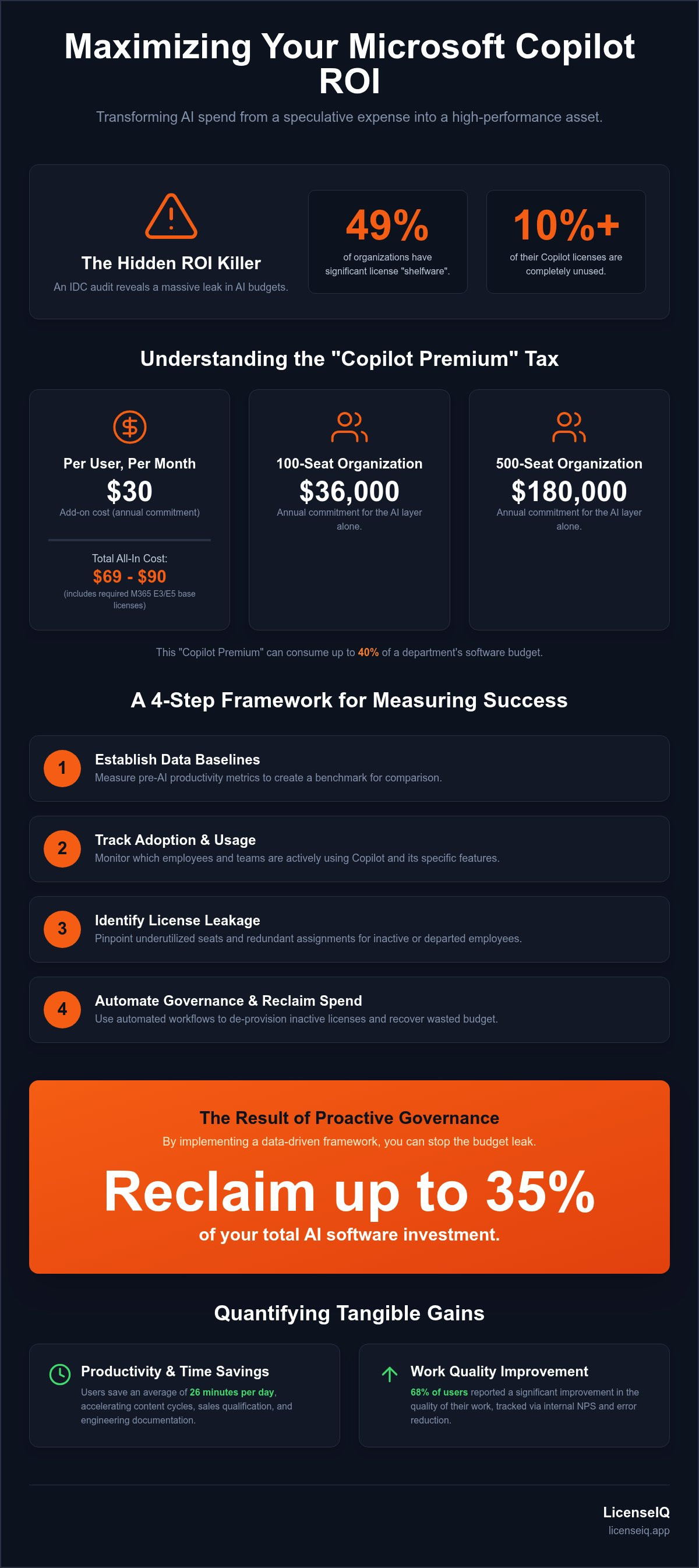
A 4-Step Framework for Measuring Copilot Success Metrics
Proving microsoft copilot license roi requires a structured approach to data. You cannot manage what you do not measure. In 2026, specialized leadership demands real-time visibility into AI performance. This framework ensures your investment remains aligned with operational goals while aggressively eliminating waste. It moves beyond theoretical productivity into verified financial health. Success is not defined by the number of seats assigned but by the value those seats generate.
Step 1: Establish a baseline. Record the duration of manual tasks across key departments before activating licenses. Step 2: Monitor adoption rates. Track which features, such as Copilot in Teams or Excel, see the highest engagement. High adoption in Engineering might justify seat expansion, while low usage in HR indicates a need for training or license reclamation. Step 3: Conduct a monthly spend recovery audit. This audit uncovers license leakage from departed employees or users who only use basic M365 features. Step 4: Reallocate budget. Shift licenses from underperforming users to high-growth departments that demonstrate clear output gains.
Establishing the Baseline
A baseline provides the foundation for every ROI claim. You must track specific KPIs, such as the average time to draft a technical proposal or the speed of resolving internal support tickets. Setting realistic targets for the first 90 days prevents premature scaling and budget bloat. During this phase, focus on M365 cost optimization to ensure you aren't building an AI layer on top of a bloated subscription. A clean foundation is essential for accurate measurement. You must eliminate existing waste before introducing premium AI costs.
The Continuous Optimization Loop
ROI is not a static figure. It's a dynamic metric that requires constant tuning to remain accurate. You must review usage reports every 30 days to right-size your seat count based on actual employee behavior. Stagnant deployments quickly become "shelfware," draining resources without delivering a single cent of value. By implementing automated license governance, you can trigger workflows that reclaim licenses from inactive users immediately. This vigilant oversight keeps your License Health Score high and your operational costs low.
Stop guessing about your AI expenditure. You can gain total clarity into your tenant and identify every dollar of wasted spend in minutes. Secure your corporate resources and maximize your microsoft copilot license roi by connecting to the LicenseIQ Platform today.
Automating Governance: How LicenseIQ Secures Your Copilot ROI
Manual governance is a relic of the pre-AI era. It creates organizational disorder and allows budgets to bleed through obscured details. The microsoft copilot license roi you've calculated remains theoretical until you implement a system of relentless oversight. LicenseIQ acts as your digital auditor, transforming passive data into a proactive strategy for financial health. It provides the immediate clarity required to manage complex operational environments without the cognitive load of manual spreadsheets.
The LicenseIQ Platform connects to your M365 tenant in minutes. It immediately generates a License Health Score, providing a transparent view of your deployment's efficiency. Unlike the native Microsoft Copilot Dashboard, which focuses primarily on usage patterns, LicenseIQ prioritizes spend recovery. It identifies the exact delta between what you pay and what your team actually uses. This makes it an essential layer for FinOps teams who need to justify AI spending to specialized leadership.
Real-Time Spend Recovery
Efficiency starts with the Spend Recovery Dashboard. This tool provides specific dollar-value recommendations for every seat in your tenant. You no longer have to guess which licenses are redundant; the system identifies them for you. You receive automated alerts the moment a premium license becomes inactive or assigned to a departed employee. Organizations using these Automated Governance Workflows have recovered up to 35% of their license costs by aggressively reclaiming wasted seats. This is direct, hard ROI that satisfies the most meticulous CFO.
Continuous Accuracy with AI-Native Intelligence
AI deployments move fast, and your governance must keep pace. LicenseIQ uses AI-native intelligence, including the Model Context Protocol, to maintain total accuracy in license tracking. This ensures that your Microsoft 365 license management lifecycle remains healthy as your organization scales. The platform doesn't just report on the past; it anticipates future waste by monitoring adoption trends in real-time. It's a vigilant guardian of your corporate resources, ensuring that your microsoft copilot license roi stays positive month after month.
Stop allowing underutilized licenses to drain your budget. You can secure your investment and uncover every hidden cost in your tenant right now. Start your 5-minute license audit with LicenseIQ today and take total control of your AI expenditure.
Securing the Future of Your AI Investment
Securing your AI investment requires a shift from speculative hype to rigorous financial oversight. You've seen how quantifying productivity and identifying license leakage are essential steps in protecting your budget. Without a repeatable framework, your deployment risks becoming a series of unmonitored costs rather than a high-performance asset. Effective management of your microsoft copilot license roi demands real-time visibility and the ability to act on data immediately.
Transparency is the only path to sustainable growth in the AI era. You don't have to manage this complexity manually. By scanning your tenant in minutes, you can uncover obscured details and reclaim resources that are currently being wasted on inactive seats. Automated governance ensures your M365 environment remains lean, secure, and focused on high-impact work.
Take the first step toward total clarity. Recover your wasted Copilot spend with LicenseIQ and identify up to 35% in potential savings today. Your organization deserves a digital auditor that is always one step ahead.
Frequently Asked Questions
What is the average ROI for Microsoft Copilot in 2026?
The average microsoft copilot license roi is estimated at 116% over a three-year period, according to a Forrester Total Economic Impact study. This calculation assumes a net present value of approximately $19.7 million for a composite organization. Individual results vary based on how effectively a company manages its license health. Maximizing this figure requires a balance of high user adoption and the aggressive elimination of underutilized seats.
How do I identify which employees are actually using their Copilot licenses?
You can identify active users by reviewing the Copilot Dashboard in Viva Insights or by connecting your tenant to the LicenseIQ Platform. Our system provides immediate clarity by scanning for specific activity markers across the M365 ecosystem. Unlike basic usage reports, we highlight the delta between assigned licenses and actual engagement. This visibility allows you to spot "shelfware" before it drains your monthly software budget.
Can I recover the cost of a Copilot license if a user is inactive?
You can recover the cost by identifying inactive users and reallocating their seats to departments with higher demand. While Microsoft requires an annual commitment for most Enterprise licenses, reclaiming a seat prevents the need to purchase additional licenses for new hires. Using the Spend Recovery Dashboard helps you visualize these specific dollar-value recommendations. It ensures you aren't paying for premium AI capabilities that remain unactivated.
Does LicenseIQ work with all Microsoft 365 license types?
LicenseIQ is designed to scan and optimize all qualifying Microsoft 365 base plans required for Copilot, including Business Standard, Business Premium, E3, and E5. Our AI-native platform provides a comprehensive Health Score regardless of your organization's specific license mix. We monitor the entire tenant to ensure that both your base subscriptions and your AI add-ons are performing at peak financial efficiency.
What are the most common pitfalls that reduce AI ROI?
The most common pitfalls include license leakage, where seats are assigned to departed employees, and the "time-saved" fallacy. Organizations often fail to reallocate saved time into revenue-generating activities. Additionally, poor data governance can lead to security risks that offset productivity gains. Avoiding these traps requires a structured framework that combines automated oversight with clear operational goals for every AI seat in your deployment.
Is it possible to automate the offboarding of Copilot licenses?
It is possible to automate offboarding through LicenseIQ’s Automated Governance Workflows. These workflows trigger immediately when a user leaves the organization or meets your predefined inactivity threshold. By automating this process, you eliminate the risk of human error in the M365 Admin Center. This proactive approach secures your corporate resources and ensures that your microsoft copilot license roi isn't eroded by administrative oversight.
How does a License Health Score help with Copilot ROI?
A License Health Score provides a definitive benchmark for your deployment's financial efficiency. It aggregates data on user activity, license redundancy, and subscription costs into a single, actionable metric. This score allows specialized leadership to see at a glance if their resources are being utilized effectively. By maintaining a high score, you ensure that your AI investment is consistently delivering the value promised during the initial pilot phase.
Should I buy Copilot for my entire organization or start with a pilot?
You should start with a targeted pilot to establish a baseline of productivity and identify high-impact use cases. This approach allows you to refine your training and data governance before scaling. Use the pilot phase to calculate a preliminary return on investment for specific roles like Sales or Engineering. Once you prove the financial impact in these departments, you can expand with the confidence that your resources are monitored.


