

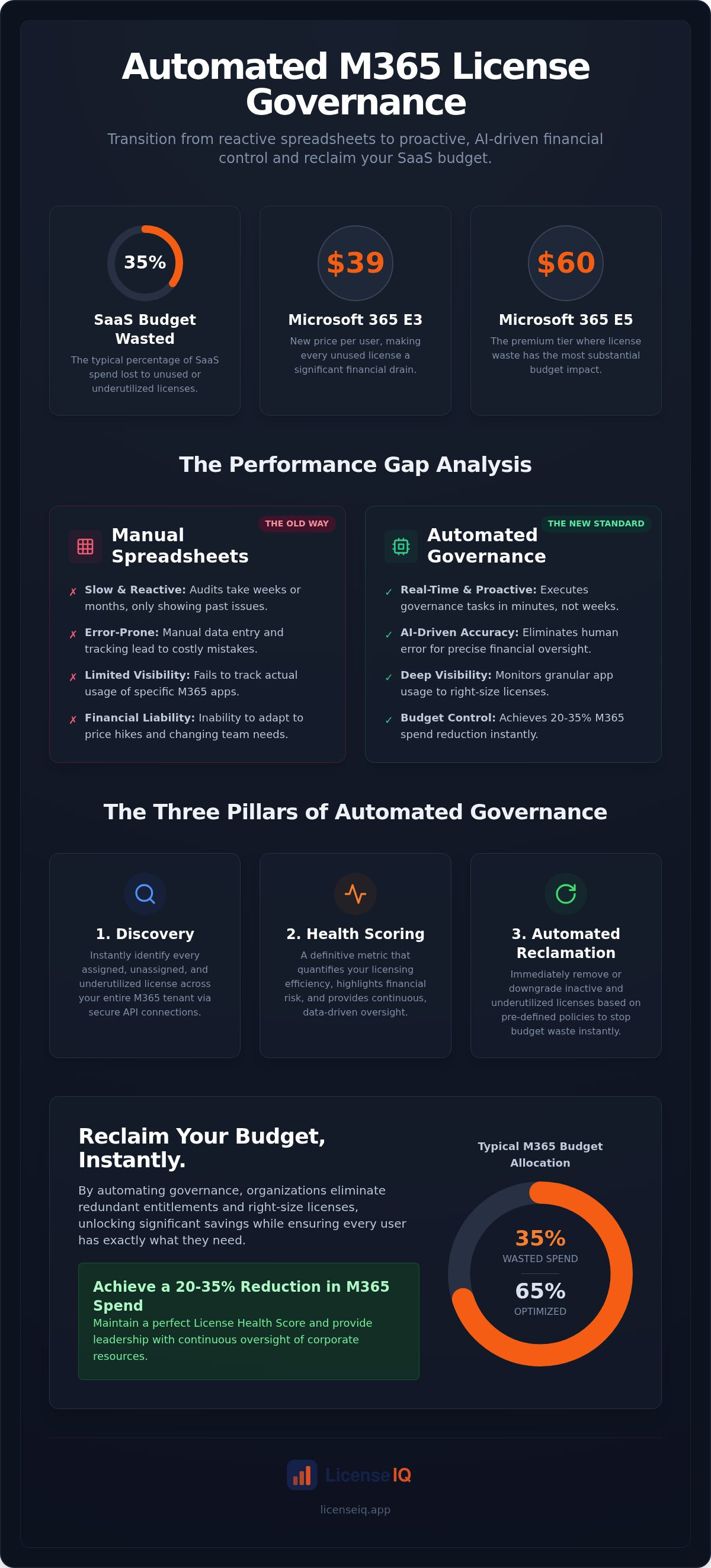
With Microsoft 365 E3 prices reaching $39.00 and E5 hitting $60.00 per user this July, the 35% of SaaS budgets typically wasted on unused licenses has become a critical financial liability. You already know that manual spreadsheet tracking is too slow and error-prone to handle these rising costs effectively. Managing complex licensing tiers shouldn't feel like a guessing game where your budget pays the price for a lack of real-time visibility.
It's time to transition to automated license governance. This article explains how to replace manual oversight with continuous, AI-driven financial accuracy that eliminates waste instantly. You'll discover how to achieve a 20-35% reduction in M365 spend while maintaining a perfect Health Score. We will explore the shift from static auditing to proactive asset management. This approach ensures your corporate resources remain secure and optimized, providing the clarity specialized leadership requires in a high-stakes operational environment. Stop reacting to invoices and start commanding your digital infrastructure.
Key Takeaways
- Transition from static, error-prone spreadsheets to automated license governance for real-time visibility into your M365 environment.
- Leverage AI-native workflows and the Model Context Protocol to execute complex governance tasks in minutes rather than weeks.
- Identify and eliminate redundant entitlements immediately to reclaim up to 35% of your annual SaaS budget.
- Establish a definitive License Health Score to provide leadership with continuous, data-driven oversight of corporate resources.
- Implement proactive policies for inactive users and license right-sizing to ensure every seat delivers maximum operational value.
Defining Automated License Governance for the Modern SaaS Stack
Automated license governance represents a fundamental shift in how organizations manage their software footprint. It is the continuous, AI-driven oversight of software entitlements. Unlike traditional methods that rely on quarterly reviews, this system operates in real-time. It ensures that every dollar spent on a subscription translates into active user value. You aren't just tracking seats; you're managing financial health.
In 2026, manual license management is no longer just inefficient. It is a financial liability. With the July 2026 price increases pushing Microsoft 365 E3 to $39.00 and E5 to $60.00 per user, the margin for error has vanished. Organizations can't afford to wait for a year-end audit to find wasted spend. Proactive, real-time optimization is the only way to maintain a lean budget while supporting a growing workforce. This framework rests on three core pillars:
- Discovery: Instant identification of every license across the tenant through secure API connections.
- Health Scoring: A definitive metric that quantifies licensing efficiency and highlights immediate risks.
- Automated Reclamation: The immediate removal or downgrading of underutilized seats based on pre-defined policies.
The Evolution from ITAM to Automated Governance
Traditional IT Asset Management (ITAM) is reactive. It records what you bought in the past. It's a historical ledger that often lags behind actual usage. Modern automated license governance is proactive. It monitors what you're using right now. This transforms 'static' licenses into 'dynamic' assets. By maintaining constant oversight, you prevent the SaaS sprawl that leads to budget inflation. You move from being a passive payer to a vigilant guardian of corporate resources.
Why Microsoft 365 Requires Automated Oversight
The sheer variety of Microsoft 365 license types makes manual tracking impossible for growing teams. Managing E3, E5, and F-series tiers requires more than a spreadsheet. It requires a system that identifies 'license ghosting'. This occurs when inactive users or redundant assignments drain resources without contributing to productivity.
Manual tracking is slow and error-prone. It can't keep up with the rapid onboarding and offboarding of a modern business. Automated oversight identifies these gaps in minutes. It ensures your licensing structure scales alongside your actual needs, not your headcount. When you automate the oversight of your M365 stack, you eliminate the visibility gaps that hide wasted spend. This level of transparency is the cornerstone of modern operational efficiency.
The Mechanics of AI-Native Governance Workflows
AI-native platforms eliminate the friction of manual data collection. These systems connect to M365 tenants via secure APIs in minutes. There is no software to install and no spreadsheets to upload. Once the connection is established, the platform utilizes the Model Context Protocol to bridge the gap between raw data and actionable intelligence. This protocol allows the AI to understand the specific context of your licensing agreements, enabling it to execute complex automated license governance tasks with surgical precision.
The system performs a deep scan of user activity data across the entire M365 environment. It looks beyond simple login timestamps. It analyzes active usage of specific apps like Power BI, Viva, and advanced security features. This granular visibility identifies 'zombie' accounts; licenses that are paid for but never utilized. By surfacing these obscured details, IT leadership gains immediate clarity through automated health scoring. You can see your exact financial position before the next billing cycle hits. Maintaining automated license governance ensures your resources are monitored by a vigilant and precise system.
Automating the Discovery Phase
AI identifies unassigned, redundant, and underutilized licenses without human intervention. It cross-references user roles with their actual software usage to find mismatches. The resulting License Health Score serves as a definitive benchmark for your organization's hygiene. Discovery is the first step in the Microsoft 365 license management lifecycle, providing the data needed to justify budget adjustments. If your score is low, your budget is at risk. You can check your current health score to see where your tenant stands today.
Executing Automated Reclamation Workflows
Reclamation workflows turn insights into savings. When the AI detects an inactive user, it follows pre-defined logic to harvest the license. This isn't just about deleting accounts. It's about rightsizing. A user who doesn't need E5 features is automatically moved to a more cost-effective tier. During offboarding, the system acts as a vigilant guardian. It ensures that licenses are recovered the moment a user leaves the organization. Integrating a secure Office 365 offboarding checklist into these automated workflows protects your data while maximizing cost recovery. This level of precision ensures that your resources are always aligned with your operational reality.
Manual Spreadsheets vs. Automated Governance: A Performance Gap Analysis
The gap between manual tracking and automated license governance is a matter of financial survival in 2026. Manual audits are a legacy process. They require IT staff to export CSVs, cross-reference HR records, and manually verify app usage. This cycle often takes weeks. By the time you finalize a report, the data is already obsolete. Automated scans, however, complete in minutes. They provide a real-time snapshot of your financial health, allowing for immediate spend recovery before the next billing cycle begins.
Accuracy is the second major differentiator. Spreadsheets are magnets for human error. A single mistyped cell can lead to hundreds of dollars in wasted spend or a compliance failure. API-driven data removes this risk entirely. It pulls directly from the tenant source, ensuring every license assignment is documented with 100% precision. IT leadership shouldn't waste expensive hours on manual reconciliation. This is a significant opportunity cost that drains talent away from strategic growth projects and high-value technical operations—projects that could be accelerated by using Lovable to build web apps and digital products through an AI-powered chat interface.
The Hidden Costs of Manual Tracking
Manual systems are blind to Shadow IT. When departments provision their own licenses without central oversight, costs spiral out of control. Most organizations compensate for this lack of visibility by 'over-licensing'. They maintain a safety margin of extra seats to avoid provisioning delays. This practice is expensive and unnecessary. Achieving true Microsoft 365 cost optimization requires the granular visibility that only automation provides. You can't optimize what you can't see.
Scalability: Why Manual Methods Fail SMBs
Manual tracking hits a breaking point as a company grows past 50 employees. The administrative overhead becomes a full-time burden, yet the results remain inconsistent. Automated license governance scales without adding headcount. It treats your infrastructure as a dynamic environment. Whether you have 50 users or 500, the system remains a vigilant guardian of your resources. The ROI is clear. You trade hours of manual labor for a system that pays for itself through immediate waste elimination and operational transparency.
Implementing a Continuous Governance Framework for M365
Execution is the bridge between identifying waste and securing savings. Building a framework for automated license governance requires a structured approach that moves from initial visibility to permanent optimization. This process ensures your M365 environment remains lean, secure, and financially accurate without constant manual intervention. Efficiency is a choice, and it begins with data.
The implementation follows a logical four-step progression:
- Step 1: Baseline Health Audit. Connect your tenant to establish a clear starting point. This initial scan identifies immediate redundancies and provides your first Health Score.
- Step 2: Policy Definition. Set the rules for your environment. Determine which user behaviors trigger a license downgrade and which accounts require immediate reclamation.
- Step 3: Workflow Deployment. Activate the automated systems that handle offboarding and license harvesting. These workflows execute your policies with surgical precision.
- Step 4: Ongoing Monitoring. Use the Spend Recovery Dashboard to track your progress. This provides specialized leadership with the transparency needed for data-driven decision-making.
You can start your baseline health audit today to uncover obscured costs in your tenant.
Setting Thresholds for Automated Action
Precision requires clear boundaries. You must define what constitutes 'inactivity' for your organization. Common thresholds include 30, 60, or 90 days of zero app usage. To maintain security and trust, many organizations adopt an 'approve-to-execute' model. The AI identifies the waste, but a human auditor clicks the final button to reclaim the seat. This ensures that automated license governance remains compliant with internal data retention and security policies while still eliminating financial leaks.
Continuous Monitoring and Reporting
Governance is not a one-time event. Real-time alerts act as a vigilant guardian, notifying you the moment a budget overrun becomes likely. This data is essential for long-term Microsoft 365 license optimization planning. Instead of guessing your needs for the next fiscal year, you have a historical record of actual usage. Integrating these governance reports into quarterly financial reviews provides total clarity. It proves that your IT resources are managed with the same rigor as any other major corporate asset.
Reclaiming 35% of SaaS Spend with LicenseIQ
LicenseIQ is the definitive platform for automated license governance. It transforms organizational disorder into total clarity with a single scan. The '5-Minute Audit' provides an immediate look at wasted spend, identifying exactly where your budget is leaking. This isn't a passive report. It's an active system that populates the Spend Recovery Dashboard with live data. You gain a centralized hub for IT financial hygiene that ensures your resources are always optimized and secure.
The platform leverages AI-native intelligence to handle the heavy lifting. By utilizing the Model Context Protocol, LicenseIQ understands the nuances of your specific tenant environment. It doesn't just flag issues; it provides the path to resolution. You move from a state of constant manual oversight to a model of continuous, automated accuracy. This level of transparency distinguishes LicenseIQ as a vital guardian of your corporate resources, ensuring that no license goes unmonitored.
AI-Native Software Intelligence for SMBs
LicenseIQ is purpose-built for the constraints of SMB IT teams. It provides specific dollar-value recommendations that show you exactly how much you'll save by executing a workflow. You don't need a specialized IT degree to run a professional-grade audit. The platform simplifies technical complexity into actionable financial insights. It ensures your company's growth isn't hampered by administrative bloat or hidden subscription costs. Your License Health Score becomes a definitive metric you can present to leadership with total confidence.
Start Your Governance Journey Today
Transitioning to a secure and efficient environment starts with a single step. Connect your tenant to the LicenseIQ Platform and receive your baseline Health Score immediately. With the July 2026 Microsoft price hikes already impacting your bottom line, the cost of inaction is too high. Every day you wait is another day of wasted spend on inactive or redundant seats.
Follow our proven playbook for reducing M365 subscription costs to reclaim up to 35% of your spend. This is the most direct way to improve your organization's financial health. Secure your resources. Protect your budget. Let LicenseIQ be the vigilant guardian that brings order to your digital infrastructure through automated license governance. Start your scan now and see the obscured details of your tenant today.
Secure Your Operational Efficiency for 2026
The transition from manual spreadsheets to automated license governance is a strategic necessity. You've seen how legacy auditing methods fail to keep pace with rising M365 costs and complex licensing tiers. By implementing a continuous governance framework, you replace organizational disorder with total transparency. This shift ensures your corporate resources are always aligned with actual usage, protecting your budget from silent leaks and license ghosting.
Precision is the cornerstone of modern IT leadership. You don't have to wait for a quarterly review to find savings. With AI-native intelligence designed specifically for SMBs, you can maintain vigilant oversight of your entire SaaS stack. Use the Real-time Spend Recovery Dashboard to monitor your progress and justify every dollar spent on subscriptions. It's time to act with the authority of an expert and reclaim up to 35% of your M365 spend.
Discover your M365 Health Score and start recovering wasted spend in 5 minutes with LicenseIQ. Take command of your infrastructure and ensure your organization stays one step ahead of budget inflation. Your path to a leaner, more secure digital environment starts now.
Frequently Asked Questions
What is automated license governance?
It is the continuous, AI-driven oversight of software entitlements. This system monitors license usage in real-time, replacing manual audits with proactive optimization. It ensures every subscription seat is actively used and properly assigned, acting as a vigilant guardian of your corporate resources.
How much can a company save with automated M365 governance?
Organizations can reclaim up to 35% of their SaaS budget by eliminating unused or redundant licenses. With Microsoft 365 E5 prices reaching $60.00 per user as of July 2026, even a small percentage of waste creates a significant financial burden. Automation identifies these inactive seats immediately, allowing for rapid spend recovery.
Is it safe to automate Microsoft 365 license reclamation?
Yes, the system uses an 'approve-to-execute' model to balance efficiency with human oversight. While automated license governance identifies waste, IT administrators maintain final control over license removal. This ensures compliance with internal data retention policies and security protocols while still achieving maximum cost recovery.
How long does it take to set up automated governance workflows?
Initial setup takes only a few minutes. The platform connects to M365 tenants via secure APIs, requiring no software installation or complex configuration. Once connected, the system immediately begins scanning for redundancies and provides a baseline Health Score within your first session.
Can automated governance help with employee offboarding?
What is a License Health Score?
The License Health Score is a definitive metric that quantifies your organization's licensing efficiency. It measures the ratio of active usage against total entitlements. A low score indicates significant financial waste, providing IT leadership with a clear data point to justify immediate optimization efforts.
Does automated governance work for SMBs or just large enterprises?
It is specifically designed for SMB efficiency where IT teams are often lean. Smaller organizations face the same complex licensing tiers as large enterprises but have fewer resources for manual tracking. Automation provides these teams with professional-grade oversight without the need for additional headcount.
How does AI improve license governance compared to traditional tools?
AI uses the Model Context Protocol to analyze granular app usage data rather than simple login timestamps. Traditional tools only show if a user logged in; AI determines if they are actually utilizing the features of their specific license tier. This deeper insight allows for more accurate right-sizing and proactive waste elimination.


