

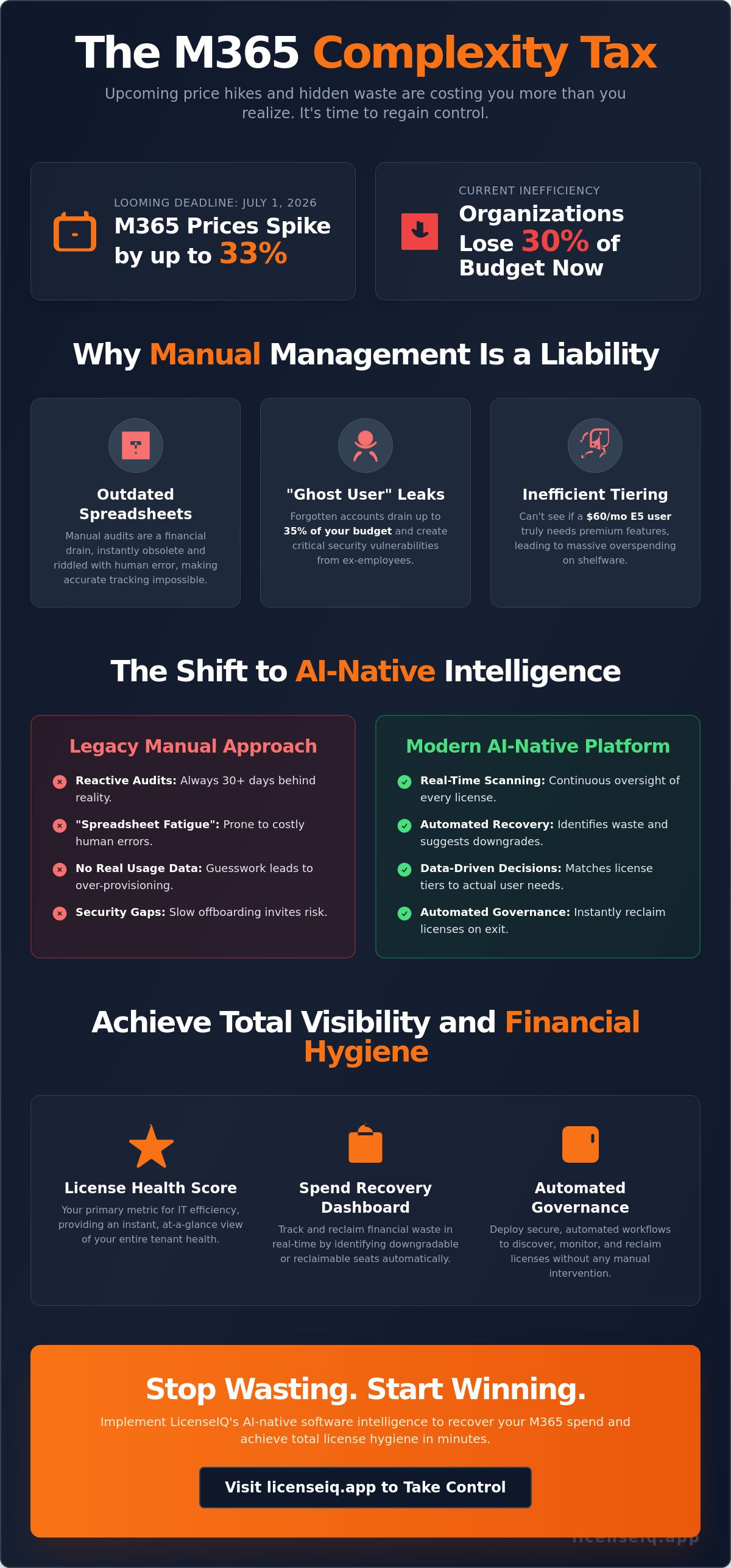
On July 1, 2026, Microsoft 365 prices will spike by as much as 33% for certain tiers, yet most organizations are already losing 30% of their budget to the "M365 Complexity Tax." This waste stems from unmonitored SaaS sprawl and licenses assigned to users who haven't logged in for months. Relying on manual spreadsheets is a financial liability; they're outdated the moment you hit save. You need a more precise way to monitor your stack. Implementing dedicated microsoft 365 license management software is no longer optional for lean technical operations.
We understand the difficulty of distinguishing between truly inactive users and those who only need occasional access. It's a drain on resources that clouds your operational transparency. This guide provides a roadmap to eliminate that disorder. You'll discover how to use AI-native software intelligence to gain instant visibility into license health and automate offboarding workflows. We'll show you how to leverage the LicenseIQ Platform to recover your spend and maintain total license hygiene in a complex, high-stakes environment.
Key Takeaways
- Eliminate license hoarding by shifting from manual tracking to AI-native software intelligence that identifies inactive users with precision.
- Establish a License Health Score as your primary metric for IT efficiency and use a Spend Recovery Dashboard to track financial waste in real time.
- Deploy modern microsoft 365 license management software to automate the discovery, monitoring, and reclamation of seats across your entire organization.
- Connect the LicenseIQ Platform via secure API to launch automated governance workflows and gain total visibility into your tenant health in minutes.
Why Manual Microsoft 365 License Management Fails in 2026
Managing your Microsoft 365 environment manually is a losing strategy in 2026. With commercial plan prices increasing by up to 33% on July 1, 2026, every unoptimized seat represents a direct hit to your bottom line. Most growing SMBs fall into the trap of "license hoarding," where IT teams provision licenses "just in case" or fail to reclaim them when roles change. The Microsoft 365 Admin Centre exacerbates this issue. It's built as a delivery mechanism for rapid assignment, not as a cost-control engine designed for granular optimization.
The "Ghost User" problem is the most significant financial leak in modern technical operations. Inactive accounts or users who have left the company often retain their licenses because there's no automated trigger to reclaim them. These forgotten seats can drain up to 35% of your total subscription budget. Beyond the financial waste, unmonitored licenses create critical security vulnerabilities. An active license assigned to a former employee is a high-value target for credential harvesting. Without dedicated microsoft 365 license management software, these gaps remain invisible until an audit or a security incident occurs.
The Limitations of Manual Audits
Monthly manual audits are inherently flawed; they're always 30 days behind reality. By the time an IT manager compiles a spreadsheet, the usage data is already obsolete. Human error in license tracking leads to "spreadsheet fatigue," making it nearly impossible to cross-reference actual app usage with complex license tiers. You can't easily see if a user on a $60 per month E5 plan actually utilizes the advanced features or if they should be downgraded to a more cost-effective tier. Manual oversight simply cannot scale with the pace of modern SaaS environments.
Financial Impact of SaaS Sprawl
Unassigned E3 and E5 licenses are the most expensive form of shelfware in your stack. As organizations grow, shadow IT and self-service purchases complicate the billing landscape, leading to duplicate subscriptions and fragmented oversight. To regain control, you must transition from reactive accounting to proactive governance. Learning how to reduce M365 subscription costs requires a level of precision that manual tools can't provide. Implementing microsoft 365 license management software ensures your financial health isn't compromised by organizational disorder or obscured billing details.
What is Microsoft 365 License Management Software?
Modern microsoft 365 license management software is a specialized platform designed to automate the discovery, monitoring, and reclamation of your M365 seats. It doesn't just list your users; it audits their behavior. This technology represents a fundamental shift from traditional IT Asset Management (ITAM), which often relies on static records and reactive updates. In 2026, organizations are moving toward AI-native software intelligence that operates in real time. This ensures your license count matches your actual operational requirements every second of the day. It transforms a passive inventory into an active financial asset.
These platforms bridge the gap between IT operations and FinOps. While IT traditionally focuses on provisioning and uptime, FinOps demands strict cost-efficiency and ROI. A dedicated management tool aligns these two departments by providing a single source of truth for license health. The core promise is continuous financial hygiene. You no longer need to wait for a quarterly review or an annual audit to find waste. The system acts as a vigilant digital auditor, identifying obscured details that lead to overspending and correcting them without manual intervention. By translating technical usage logs into financial data points, this software empowers leadership to make data-driven decisions that protect corporate resources.
Core Capabilities of Modern Management Tools
- Real-time tenant scanning: Constant oversight of every user activity and license assignment ensures your data is never 30 days behind.
- Automated spend recovery recommendations: The software provides immediate identification of downgradable or reclaimable seats based on verified usage data rather than guesswork.
- Centralized dashboards: A unified view for multi-tenant or multi-department oversight provides total clarity across complex organizational structures.
Who Needs Dedicated License Management?
Manual tracking becomes unsustainable once an organization passes the 50-user threshold. At this scale, the volume of license movements, joiners, movers, and leavers, outpaces human capacity for accurate record-keeping. Companies experiencing rapid hiring or high employee turnover are particularly vulnerable to license leakage. Additionally, Finance teams now require granular visibility into SaaS ROI to justify tech spend in a tightening market. If your goal is to maintain 100% license hygiene and eliminate organizational disorder, exploring the LicenseIQ Platform is the next logical step for your operational roadmap. Using dedicated microsoft 365 license management software allows your team to focus on growth while the system handles the meticulous task of spend recovery.
AI-Native vs. Legacy Tools: Choosing the Right Platform
The year 2026 marks the end of "consultant-led" license audits. Traditional audits are reactive and expensive. They provide a static snapshot that becomes obsolete the moment the consultant leaves the room. Modern leadership demands real-time intelligence. AI-native platforms utilize the Model Context Protocol (MCP) to understand the unique nuances of your environment. This protocol allows the software to function as a digital auditor that never sleeps. While legacy enterprise tools often require weeks of professional services for configuration, modern microsoft 365 license management software integrates in minutes. You gain immediate clarity without the overhead of long-term implementation projects.
Many SMB IT leaders hesitate because they believe advanced governance is "too complex" for lean teams. The reality is the opposite. Legacy systems are complex because they require manual rule-building and constant maintenance. AI-native software removes this administrative burden. It handles the technical complexity behind the scenes. It delivers clear, actionable insights through a simplified interface. This shift allows your team to focus on strategic growth rather than fighting organizational disorder in a spreadsheet. Efficiency is the new standard for specialized leadership.
The Power of Automated Governance Workflows
Traditional rule-based engines frequently miss redundant licenses. They look for binary "on/off" states. AI-native intelligence analyzes usage patterns to identify deeper inefficiencies. It spots users who have the correct license type but the wrong tier based on their actual feature engagement. You can implement automated license governance to reclaim these seats automatically. This process happens without disrupting user productivity or requiring manual intervention. The system maintains your financial health while you scale operations.
Integration and Security Requirements
Security is the cornerstone of organizational trust. "Read-Only" API access is the gold standard for modern integrations. It allows the management software to audit usage data without the risk of unauthorized write-actions within your tenant. When evaluating a platform, prioritize SOC2 compliance and rigorous data privacy standards. Ensure the tool integrates seamlessly with Microsoft Entra ID and utilizes modern authentication protocols. This level of oversight ensures your microsoft 365 license management software acts as a vigilant guardian of your corporate resources. You get total transparency without compromising your security posture.
Key Metrics for M365 License Health and Spend Recovery
Raw usage data lacks utility without a structured framework for interpretation. To maintain financial hygiene, you must transition from viewing total license counts to analyzing efficiency metrics. Specialized leadership requires a dashboard that uncovers obscured details within the tenant. By utilizing modern microsoft 365 license management software, you can move beyond the basic assignment logs found in the standard Admin Centre. You need metrics that drive action, not just observation. These indicators serve as the cornerstone of a proactive governance strategy.
The primary metric for operational efficiency is the License Health Score. This single value represents the delta between your provisioned licenses and actual employee engagement. A score above 90% indicates a lean, optimized environment. Conversely, a score below 70% is a critical signal of systemic waste. This metric allows IT leaders to justify budget requests to the board with empirical evidence. It transforms technical oversight into a business-aligned KPI that resonates with financial stakeholders.
Understanding the License Health Score
The score is calculated by cross-referencing assignment data with real-time activity logs. It ignores "ghost users" who haven't logged in for over 30 days. By setting benchmarks for different departments, you can identify which areas of the company are prone to license hoarding. High-performing teams maintain high scores by reclaiming seats the moment a project ends or a role changes. Using this score as a baseline, you can establish a vigilant system that prevents organizational disorder from taking root in your SaaS stack.
Alongside health scores, Finance teams must track Recoverable Spend. This represents the immediate dollar value available for reclamation through unassignment or right-sizing. The "Inactive 30/60/90" rule is the most effective framework for this. Users inactive for 30 days are flagged for monitoring. At 60 days, they become candidates for downgrading. By 90 days, the system triggers an automated workflow to reclaim the seat entirely. This structured approach ensures you aren't paying for E5 features when a user only requires the basic functionality of an F3 or Business Basic plan.
Operationalizing Spend Recovery
Success requires a consistent monthly cadence. You should review automated recommendations and map recovery insights directly to departmental cost centers. This transparency holds managers accountable for their resource consumption. With the July 2026 price increases approaching, right-sizing is your most potent defense against rising costs. Moving a user from an E5 plan at $60 per month to an E3 plan at $39 per month saves $21 per user, per month. You can consult our Microsoft 365 License Types Guide to determine which tiers best fit your specific user personas.
Implementing these metrics manually is a financial liability. To gain instant visibility into your organization's efficiency, check your License Health Score today using the LicenseIQ Platform. Our microsoft 365 license management software provides the precision needed to protect your corporate resources and ensure 100% license hygiene.
Implementing LicenseIQ: Automated Governance in Minutes
Speed is the ultimate differentiator in modern technical operations. While legacy enterprise tools often cite a two-week implementation window, the LicenseIQ Platform delivers results in five minutes. You connect your tenant via a secure, read-only API. There are no agents to install and no complex scripts to run. Our AI-native engine begins scanning every user and license instantly. It provides immediate clarity where there was once organizational disorder. This rapid deployment ensures your resources are protected without delaying other critical IT projects.
The transition from raw data to dollar-value recommendations is seamless. LicenseIQ doesn't just present a list of active users; it identifies specific financial recovery opportunities based on real-time engagement. By automating the Office 365 offboarding checklist, you ensure that every departing employee's license is reclaimed immediately. This prevents the license hoarding that typically drains corporate resources. It's a vigilant, proactive approach to microsoft 365 license management software that prioritizes your organization's financial health through relentless data-driven decision-making.
From Discovery to Recovery
You will view your first Spend Recovery Dashboard within one hour of setup. This interface highlights obscured details like duplicate assignments and over-provisioned tiers that manual audits frequently miss. You can execute reclamation workflows with a single click, moving from insight to action instantly. This isn't a one-time audit; it's a system of continuous monitoring. The platform ensures that waste doesn't creep back into your environment as you scale. You maintain 100% license hygiene through automated governance workflows that act as a digital auditor for your SaaS stack.
Designed for the Modern SMB
LicenseIQ prioritizes operational clarity over enterprise complexity. We've stripped away the unnecessary weight of legacy tools to provide a fast-paced, results-first experience for lean IT teams. Our tiered pricing scales with your growth, ensuring you only pay for the oversight you need. It's time to replace manual spreadsheets with a meticulous, tech-savvy problem-solver that stays one step ahead of your licensing needs. Start your free M365 license audit with LicenseIQ today and discover how our microsoft 365 license management software can secure your budget against unmonitored costs.
Secure Your Organization’s Financial Health
Manual oversight is a liability that your bottom line cannot sustain, especially with the July 1, 2026 price increases approaching. You've seen how "ghost users" and unoptimized tiers can drain 35% of your total subscription budget. Transitioning to microsoft 365 license management software is the only way to maintain 100% license hygiene in a complex operational environment. It replaces organizational disorder with total transparency, allowing you to move from reactive accounting to proactive governance.
Efficiency is no longer a luxury; it's a requirement for specialized leadership. LicenseIQ provides the precision needed to protect your corporate resources while your team focuses on growth. You can connect to your tenant in under 5 minutes and launch AI-native automated governance workflows immediately. Stop the financial leak before the next billing cycle and gain the clarity your organization deserves. Discover your M365 Health Score and start recovering spend with LicenseIQ. You're now ready to transform technical complexity into a streamlined financial asset.
Frequently Asked Questions
Is Microsoft 365 license management software safe for my data?
Modern platforms prioritize security by using read-only API access to your tenant. This ensures the system can audit usage without the ability to modify sensitive data or bypass your existing security protocols. Leading solutions maintain SOC2 compliance to guarantee your information is protected by industry-standard privacy controls and rigorous data-handling practices.
How much can I realistically save on my Microsoft 365 subscription?
Organizations typically identify a 20% to 30% reduction in costs by eliminating the "M365 Complexity Tax" waste. By implementing microsoft 365 license management software, you can recover up to 35% of your total subscription spend through the automated reclamation of inactive seats and the right-sizing of over-provisioned users who don't utilize premium features.
Does the software automatically delete user accounts?
The software reclaims the license seat but doesn't delete the underlying user account from your directory. This distinction is vital for data retention and security. It allows you to stop paying for the monthly subscription while maintaining access to the user's historical data, files, and mailbox for compliance or internal transition purposes.
Can I manage multiple Microsoft 365 tenants in one tool?
Yes, centralized dashboards are designed specifically for multi-tenant oversight from a single pane of glass. This capability is essential for organizations with multiple subsidiaries or departments that operate under separate tenants. It provides a unified view of your entire SaaS footprint, ensuring consistent financial hygiene across the whole enterprise.
What is the difference between a license audit and license management?
A license audit is a reactive, static snapshot that's often outdated the moment it's saved to a spreadsheet. In contrast, microsoft 365 license management software provides continuous, proactive governance. It acts as a vigilant digital auditor that monitors your environment in real time to ensure your license count always matches your actual operational needs.
How does AI-native management differ from the Microsoft Admin Centre?
The Microsoft Admin Centre is a delivery tool built for rapid license assignment and basic user management. It lacks the deep usage analytics and spend recovery logic required for cost optimization. AI-native platforms bridge this gap by analyzing user behavior patterns to provide dollar-value recommendations that the standard Admin Centre isn't designed to generate.
Will my users notice if I change or reclaim their licenses?
Users won't notice a change if they're correctly right-sized based on their actual feature engagement. Automated governance workflows ensure that licenses are only reclaimed from truly inactive accounts or downgraded when advanced features remain untouched. This meticulous approach preserves employee productivity while eliminating the financial waste of unused software tiers.
How long does it take to see ROI from a license management platform?
ROI is typically realized within the first hour of setup. Unlike legacy enterprise tools that take weeks to configure, modern AI-native platforms scan your tenant instantly. You'll see immediate spend recovery opportunities on your dashboard as soon as the initial discovery phase is complete, allowing for rapid decision-making and cost reclamation.


