

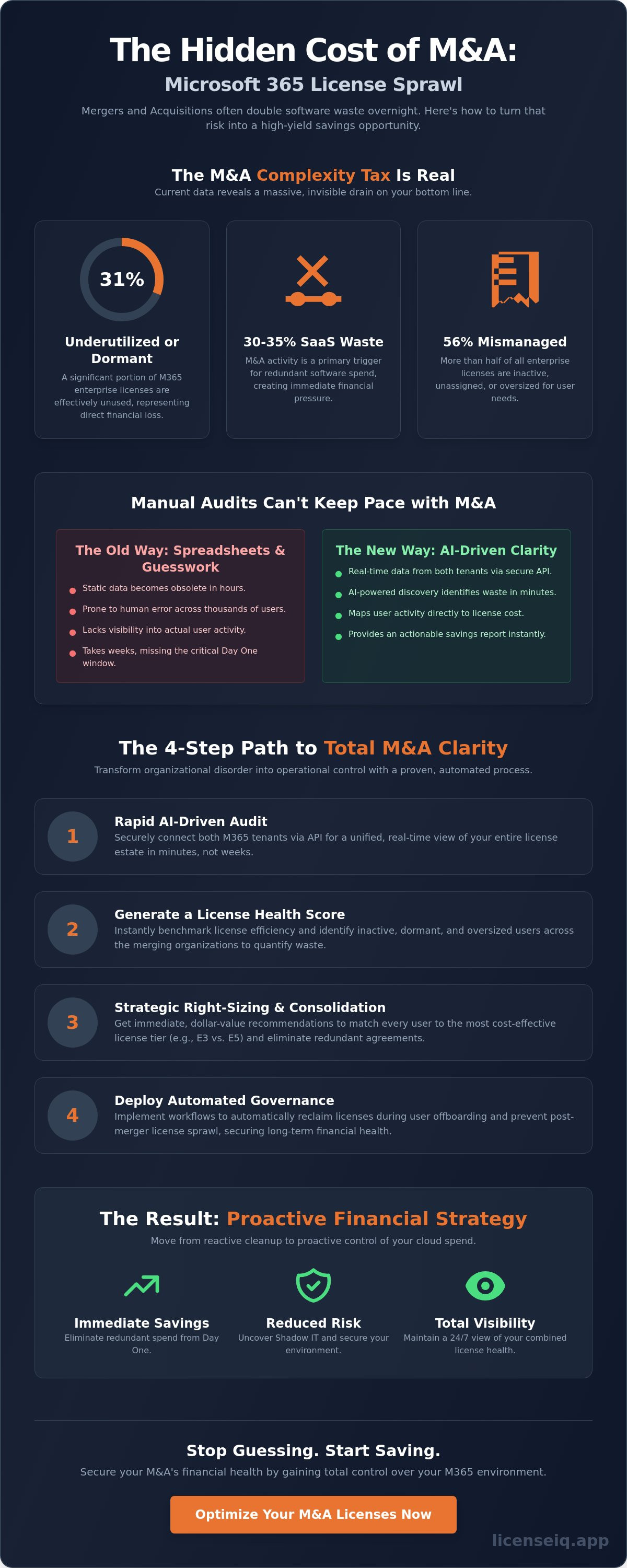
Current data shows that 31% of Microsoft 365 enterprise licenses are underutilized or dormant in 2026. With Microsoft 365 E3 prices increasing by 8% to $39.00 per user on July 1, every unassigned seat is a direct hit to your bottom line. M&A activity often doubles this waste overnight. You're likely struggling with duplicate licenses across merged entities and a lack of visibility into the acquired company's inactive users. Optimizing m365 licenses during mergers and acquisitions is now a high-yield FinOps priority that demands immediate action.
Consolidating complex EA and CSP agreements shouldn't take months of manual auditing. We agree that the "M365 Complexity Tax" is an unnecessary burden on your organization's growth. You'll discover how to eliminate redundant software spend and consolidate your environments in minutes. This article previews the path to a clear health score for both tenants, immediate dollar-value savings recommendations, and automated workflows to handle user transitions with precision. We will show you how to transform organizational disorder into total operational clarity.
Key Takeaways
- Identify how M&A transitions trigger 30-35% software waste and uncover hidden "Shadow IT" risks within the acquired entity.
- Execute a rapid license audit using AI-driven discovery to gain a unified view of spend recovery opportunities across both tenants.
- Streamline the process of optimizing m365 licenses during mergers and acquisitions by matching every user to the most cost-effective license tier.
- Deploy Automated Governance Workflows to instantly reclaim licenses during user offboarding and prevent post-merger license sprawl.
- Secure long-term financial health with the LicenseIQ Platform by monitoring your combined tenant's License Health Score 24/7.
The Invisible Cost of M&A: Microsoft 365 License Sprawl
M&A activities typically trigger 30-35% wasted SaaS spend. This isn't just a rounding error. It's a structural failure in visibility. During Mergers and acquisitions (M&A), organizations often find themselves paying for two separate Enterprise Agreements (EAs). This redundancy is expensive. With Microsoft 365 E3 prices reaching $39.00 and E5 hitting $60.00 in 2026, holding onto duplicate licenses for months is a massive financial leak. Redundant licenses often hide in unassigned pools or forgotten test accounts that should've been decommissioned years ago.
Shadow IT adds another layer of risk. When you merge two disparate organizational structures, IT loses oversight of software access. You aren't just merging cultures; you're merging messy digital footprints. Research indicates that 56% of enterprise Microsoft 365 licenses are currently inactive, unassigned, or oversized. Without total transparency, your organization continues to pay for "ghost" users who left the acquired company long ago. Optimizing m365 licenses during mergers and acquisitions requires uncovering these obscured details before they compound into a permanent "complexity tax."
Why Manual Audits Fail During Mergers
Spreadsheets are static. They become obsolete the moment the merger moves to the next phase. Human error is inevitable when you try to identify "zombie" accounts across thousands of users manually. M&A moves fast. You need real-time data to make decisions, not week-old reports that don't reflect current tenant states. Manual audits lack the precision required for high-speed transitions. They fail to flag the 31% of licenses that remain underutilized or dormant across the new entity, leading to massive overspending on Day One.
Common M&A Licensing Pitfalls
Many leadership teams over-provision licenses "just in case" during the transition period. This cautious approach creates immediate waste. They often ignore the mix-and-match potential of E3 and E5 licenses. Not every user needs a premium $60.00 E5 license. Failing to reclaim licenses from departing employees of the acquired firm is another common drain. By the time you realize the sprawl exists, you've already lost thousands in unrecoverable spend. The LicenseIQ Platform allows you to see these gaps immediately. It turns organizational disorder into total clarity, ensuring that optimizing m365 licenses during mergers and acquisitions becomes a proactive financial strategy rather than a reactive cleanup project.
Conducting a Rapid M365 License Audit Pre- and Post-Close
A rapid M365 audit isn't a manual project. It's a high-speed AI scan that identifies spend recovery opportunities in minutes. You connect to both parent and target tenants via secure API. This provides a unified view of the entire digital estate. When optimizing m365 licenses during mergers and acquisitions, you cannot afford to wait for manual data collection. You need immediate clarity to prevent Day One waste. The API connection ensures security while providing total oversight. It removes the friction of requesting reports from the target company's IT team. This proactive approach eliminates organizational disorder before it takes root.
The audit generates a License Health Score. This score benchmarks the efficiency of the acquired company against industry standards. It identifies inactive users who haven't logged in for 30, 60, or 90 days. Since 31% of enterprise licenses are dormant in 2026, this step is critical. You stop paying for "ghost" users before the merger is even finalized. Monitoring these metrics through a Spend Recovery Dashboard ensures your Day One transition is financially sound. By benchmarking both tenants, you create a roadmap for consolidation that prioritizes financial health and operational transparency.
The 5-Minute Discovery Process
AI-native platforms bypass global admin manual exports. You map user activity directly to license costs. This reveals the exact dollar-value of wasted spend. You can present a baseline report to the board immediately. This justifies the integration costs by showing exactly how much you will recover. This automated approach is the only way to scale the process of optimizing m365 licenses during mergers and acquisitions across massive, multi-tenant environments. It turns a week-long administrative burden into a 5-minute strategic win.
Evaluating Acquired License Tiers
Acquired firms often suffer from license inflation. They might have every employee on E5 licenses without using the advanced security or compliance features. You also find redundant add-ons like Visio or Project that aren't being utilized. These costs add up fast when E3 prices are $39.00 and E5 is $60.00 per user. Consult the Microsoft 365 License Types: The Comprehensive 2026 Reference Guide to identify tier-down opportunities. Using the LicenseIQ Platform makes this right-sizing a predictable, automated process. It ensures your new workforce is equipped with exactly what they need, eliminating the "Complexity Tax" from your balance sheet.
Strategic Consolidation: Right-Sizing the New Workforce
Consolidating multiple tenants into a single agreement is the most effective way to leverage volume discounts. It eliminates the administrative overhead of managing disparate renewal dates and contract terms. Optimizing m365 licenses during mergers and acquisitions requires a meticulous look at your combined user base to prevent over-licensing. You must match every user in the merged company to the lowest-cost license they actually need. This proactive approach stops financial waste before it becomes a permanent part of your operational budget. License right-sizing is the alignment of software features to actual employee job functions.
Beyond Microsoft's own stack, consolidation reveals redundant third-party SaaS tools. Many acquired firms use separate subscriptions for security, storage, or communication that your existing M365 E3 or E5 licenses already cover. Eliminating these overlaps provides immediate spend recovery. By auditing the combined stack, you remove the "SaaS creep" that often follows a merger. It's about ensuring every dollar spent contributes to the organization's technical health and financial efficiency. This level of oversight turns a chaotic transition into a streamlined operational success.
E3 vs. E5: Making the Call for the Merged Entity
Not every department requires the full suite of E5 features. You must analyze which users actually require Advanced Analytics or eDiscovery. Moving frontline workers to F3 licenses can yield significant savings without sacrificing essential connectivity. For a detailed breakdown of these strategies, review the How to Reduce M365 Subscription Costs: The 2026 Spend Recovery Playbook. This ensures your licensing strategy remains benefit-driven and precise, avoiding the 5-8% price hikes affecting E3 and E5 tiers in 2026.
Handling Duplicate Licenses and Overlaps
Duplicate accounts are a common M&A friction point. A single user often ends up with active licenses in both merging organizations. You need a clear strategy for bridge licensing during the migration phase to avoid paying twice for the same individual. Identifying these overlaps early is essential for optimizing m365 licenses during mergers and acquisitions. It prevents the new entity from inheriting a bloated, inefficient license pool. Using the LicenseIQ Platform provides the transparency needed to resolve these conflicts in real-time, ensuring your resources are monitored by a vigilant system.
Implementing Automated Governance for Day One Readiness
Day One readiness requires more than technical connectivity. It demands immediate financial control. You must automate the offboarding of users from the acquired company to reclaim licenses instantly. Manual processes are too slow for the pace of modern M&A. Setting up Automated Governance Workflows prevents the new entity from regressing into sprawl. This is the cornerstone of optimizing m365 licenses during mergers and acquisitions. You need a system that acts as an active participant in your company's growth, not a passive observer. Speed is critical because the New Commerce Experience (NCE) only allows a seven-day cancellation window for prorated refunds.
Proactive alerts are vital for maintaining oversight. You should receive a notification whenever unassigned licenses exceed a specific dollar threshold. This ensures continuous financial hygiene as two cultures and IT systems merge. Industry benchmarks show that organizations overspend by 20-30% due to the "M365 Complexity Tax." Automation eliminates this waste by enforcing license policies in real-time. It provides the oversight needed to maintain total clarity in a complex operational environment. This vigilant approach ensures that dormant licenses are purged before they drain your budget.
Automating License Reclamation
Integrate your HR data with the Model Context Protocol to trigger license removal automatically. This ensures that when an employee leaves the acquired firm, their license returns to the pool immediately. You must balance this with strict data retention policies. Reclaiming a license shouldn't mean losing critical corporate data. Follow a structured process like the Office 365 Offboarding Checklist 2026: Secure Data and Reclaim Spend to maintain compliance while recovering costs. This level of meticulous precision protects your resources and your legal standing during the transition.
Setting Up the Spend Recovery Dashboard
A Spend Recovery Dashboard visualizes your total M&A savings in a single pane of glass. It allows you to track License Health Score trends during the critical first 100 days of integration. Stakeholders need real-time ROI on the M&A technology integration to justify the merger's success. This transparency distinguishes a vital guardian of corporate resources from a standard IT department. To secure your organization's financial future, you should implement Automated Governance Workflows to manage your combined environment with total oversight and data-driven precision.
Securing Long-Term FinOps Accuracy with LicenseIQ
The deal is closed. Integration is underway. However, the risk of "SaaS creep" increases significantly as new departments form and legacy habits resurface. Departments often procure "best of breed" third-party tools that duplicate features already available in your M365 E5 or E3 suites. Continuous oversight is the only way to maintain the financial gains achieved during the initial transition. Optimizing m365 licenses during mergers and acquisitions isn't a one-time project; it's a permanent FinOps discipline. The LicenseIQ Platform provides a License Health Score that monitors your combined tenant 24/7. This ensures that the 31% of enterprise licenses that typically remain dormant in 2026 don't reappear on your balance sheet.
Automated governance acts as a vital guardian of your corporate resources. It uncovers obscured details that manual audits miss, such as forgotten service accounts or over-provisioned developer tenants. You can recover up to 35% of wasted spend by identifying inactive users in real-time. This proactive stance transforms IT from a cost center into a driver of operational transparency. By maintaining a relentless focus on data-driven decision-making, you protect the organization's financial health long after the legal documents are signed. Optimizing m365 licenses during mergers and acquisitions becomes the benchmark for all future software procurement.
Continuous Monitoring vs. One-Time Audits
A "one and done" approach to M&A audits is a recipe for future waste. Environments are fluid. New hires, role changes, and departures happen daily. AI plays a critical role here by predicting license needs based on growth patterns and historical usage data. It flags potential overspending before the next billing cycle. This prevents the "M365 Complexity Tax" from creeping back into your budget after the initial cleanup. To stay ahead of the curve, you must adopt a lifecycle-based approach. Read more on this in our guide: Mastering the Microsoft 365 License Management Lifecycle in 2026.
Next Steps for M365 Integration
Total clarity is within reach. You don't need to guess about your license efficiency. Connect your tenants to LicenseIQ today to receive a free License Health Score. Our system will identify your top 5 spend recovery opportunities in under 5 minutes. This is the fastest way to validate your post-merger integration strategy and secure immediate dollar-value savings. Don't let organizational disorder drain your resources. Optimize your M365 licenses with LicenseIQ to ensure your new entity is built on a foundation of precision and waste elimination.
Secure Your Post-Merger Financial Health
M&A transitions don't have to result in permanent software waste. By shifting from manual spreadsheets to AI-native discovery, you gain immediate clarity over your combined digital estate. This proactive approach ensures that optimizing m365 licenses during mergers and acquisitions becomes a high-yield financial event rather than an administrative burden. You've seen how automated governance workflows and strategic right-sizing eliminate the "Complexity Tax" that drains corporate resources. Maintaining this oversight is the only way to protect your balance sheet from recurring sprawl and hidden redundancies.
It's time to transform organizational disorder into total operational transparency. You can save up to 35% on M365 subscriptions and uncover your top savings opportunities with AI-native discovery in under 5 minutes. Our platform delivers the automated governance required for precise SMB FinOps management in complex environments. Take the first step toward a leaner, more efficient enterprise today. Get Your Free M365 License Health Score and secure your organization's resources with the vigilance they deserve. Your path to a waste-free digital environment starts with data-driven precision.
Frequently Asked Questions
How long does it take to audit M365 licenses during an M&A?
A full AI-native audit takes less than five minutes per tenant. Traditional manual audits often take weeks of spreadsheet analysis and manual data collection. By connecting via secure API, you gain immediate visibility into the combined license estate. This speed is essential for optimizing m365 licenses during mergers and acquisitions before the seven-day NCE cancellation window closes. Rapid discovery ensures you don't pay for redundant seats during the critical transition phase.
Can I merge two different Microsoft Enterprise Agreements?
You cannot technically merge two separate legal Enterprise Agreements mid-term, but you can consolidate users into a single tenant. This allows you to leverage volume discounts on a single agreement during your next renewal cycle. Managing two separate EAs simultaneously leads to the "M365 Complexity Tax" and redundant overhead. Consolidating your licensing strategy into one agreement provides the total oversight needed for long-term financial health and operational transparency.
What happens to M365 licenses of employees who leave during a merger?
Licenses remain active and billable until they are manually or automatically reclaimed from the user profile. Under the New Commerce Experience (NCE), you cannot reduce seat counts on annual commitment plans mid-term. However, you can instantly reassign those licenses to new hires or bridge accounts. Reclaiming these licenses promptly is vital for optimizing m365 licenses during mergers and acquisitions and preventing the 30-35% waste typically seen in unmanaged M&A environments.
Is it better to use E3 or E5 licenses for a newly merged company?
The choice depends on specific departmental needs rather than a blanket company-wide decision. Microsoft 365 E5 costs $60.00 per user, while E3 is $39.00 following the 2026 price updates. Most organizations find that only a small percentage of users require the advanced security and analytics features of E5. Right-sizing ensures that frontline or administrative staff remain on lower-cost tiers like E3 or F3, maximizing your immediate spend recovery.
How does LicenseIQ identify inactive users in an acquired tenant?
The LicenseIQ Platform uses secure API connections to scan user activity logs across both tenants. It identifies accounts that haven't logged in for 30, 60, or 90 days. This discovery process uncovers obscured details like "zombie" accounts and forgotten test users. By visualizing this data in a Spend Recovery Dashboard, you see the exact dollar-value of licenses that should be reclaimed or downgraded to prevent financial leaks.
Will consolidating M365 licenses cause downtime for my users?
Consolidating licenses does not cause downtime for end-users when handled through the admin center or automated platforms. The transition involves reassigning the license SKU to the user's existing identity. While data migration between tenants is a separate technical process, license optimization is an administrative task. It happens in the background, ensuring your workforce stays productive while you eliminate redundant software spend and organizational disorder throughout the merger.
What is a License Health Score in the context of M&A?
A License Health Score is a metric that benchmarks the efficiency of your combined Microsoft 365 environment. It calculates the ratio of active users to paid licenses and flags oversized tiers. During M&A, this score provides a clear baseline for both the parent and target tenants. It serves as a vital guardian of corporate resources, helping leadership track integration ROI and maintain financial hygiene during the first 100 days of integration.
Can I automate M365 license reclamation across two different tenants?
You can set up Automated Governance Workflows to manage multiple tenants simultaneously. This system triggers license removal based on HR data or inactivity thresholds across the entire merged entity. Automation ensures that waste is eliminated as soon as it's detected. It removes the human error associated with manual audits and guarantees that your resources are being monitored by a vigilant and precise digital auditor at all times.


