

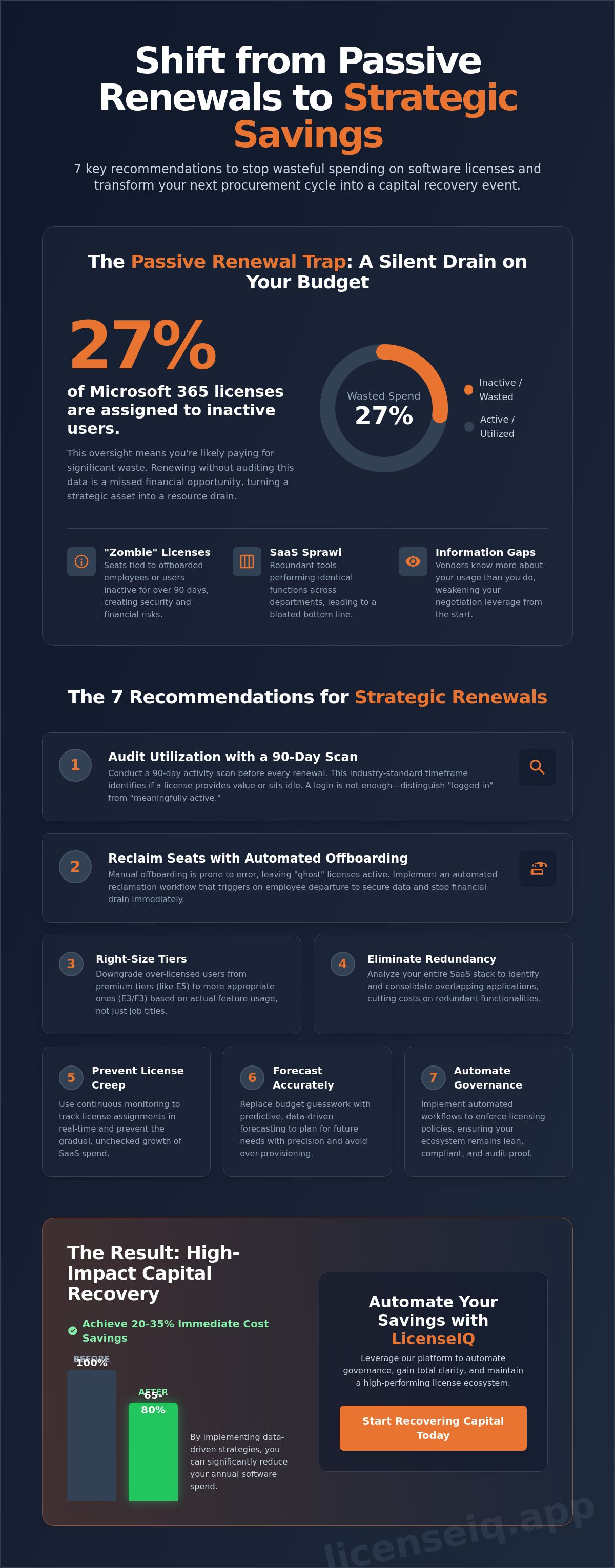
Did you know that 27% of Microsoft 365 licenses are currently assigned to inactive users? This oversight turns your annual contract into a drain on corporate resources rather than a strategic asset. You likely feel the friction between IT and Finance every time a renewal cycle approaches, especially with the shift to uniform list pricing that took effect in late 2025. It's time to stop the cycle of passive spending. Implementing these Seven Renewal Recommendations Your Procurement Team Will Thank You For will transform your next negotiation into a high-impact capital recovery event.
We agree that manual tracking is no longer viable in a landscape where software vendors hold all the telemetry. You deserve total clarity into your operational environment to prevent future waste. This guide provides a roadmap to immediate cost savings of 20-35% through precise utilization analysis. We will explore how to leverage a Spend Recovery Dashboard and Automated Governance Workflows to reclaim control. You'll learn how to improve your License Health Score and eliminate the disorder that plagues typical renewal cycles through data-driven decision making and meticulous oversight.
Key Takeaways
- Stop paying for shelfware by implementing a 90-day activity scan and establishing automated reclamation workflows for offboarded employees.
- Recover capital by downgrading over-licensed users from E5 to E3 or F3 tiers and eliminating redundant applications across your SaaS stack.
- Prevent "License Creep" through continuous monitoring and replace budget guesswork with predictive data for accurate future forecasting.
- Master these Seven Renewal Recommendations Your Procurement Team Will Thank You For to shift from passive contract management to strategic software intelligence.
- Leverage the LicenseIQ Platform to automate governance and maintain a lean, high-performing license ecosystem that survives every audit.
Shifting from Passive Renewals to Strategic Spend Recovery
Passive renewals are a silent drain on corporate capital. Most organizations fall into the "Passive Renewal Trap," paying for approximately 30% waste because they treat renewals as administrative deadlines rather than financial opportunities. Research indicates that 27% of Microsoft 365 licenses are assigned to inactive users. When you renew without auditing this data, you're effectively gifting your budget back to the vendor. In 2026, the landscape has evolved beyond simple date tracking. With Microsoft's shift to uniform list pricing and the unbundling of Teams, the era of relying on tiered volume discounts is over. Success now requires a transition from basic contract management to true Software Intelligence. This is where Strategic sourcing meets forensic data analysis.
Your procurement team must act as the primary driver of financial hygiene. They aren't just signing papers; they're recovering lost resources. Visibility is the only tool that provides genuine negotiation leverage in a market dominated by vendor telemetry. If the vendor knows more about your usage than you do, you've already lost the negotiation. These Seven Renewal Recommendations Your Procurement Team Will Thank You For will bridge that information gap and restore your advantage.
The True Cost of 'Good Enough' Licensing
Small and mid-sized businesses lose thousands every month on unassigned or "zombie" licenses. These are seats tied to offboarded employees or users who haven't logged in for 90 days. The psychological friction of "just-in-case" provisioning often leads to massive SaaS sprawl, where redundant tools perform identical functions. This lack of oversight creates a bloated bottom line. You can't manage what you can't see, and "good enough" licensing is a recipe for compounded financial waste.
Setting the 2026 Standard for Procurement Excellence
We are establishing a new benchmark for operational transparency. It starts with assigning a License Health Score to every vendor in your stack. This metric provides immediate clarity on whether a subscription is delivering value or merely consuming cash. Manual spreadsheets are obsolete and prone to error. To stay ahead, you must implement Automated Governance Workflows that monitor activity in real-time. This proactive approach ensures your organization remains lean and agile. These Seven Renewal Recommendations Your Procurement Team Will Thank You For serve as the foundation for a modern, data-driven procurement strategy that prioritizes capital recovery over passive spending.
Recommendations 1 & 2: Audit Utilization and Reclaim Inactive Seats
The most common source of procurement waste is the "assigned vs. used" gap. Many organizations pay for premium tiers based on headcounts that don't reflect actual daily operations. To bridge this gap, your first two Seven Renewal Recommendations Your Procurement Team Will Thank You For focus on immediate seat reclamation. Recommendation 1 is to conduct a 90-day activity scan before every renewal cycle. This timeframe is the industry standard for identifying whether a license is providing value or simply sitting idle. If a user hasn't engaged with the software in three months, the license is a candidate for removal or downgrading.
Recommendation 2 involves establishing an automated reclamation workflow for offboarded employees. Manual offboarding is prone to human error, often leaving "ghost" licenses active long after an employee has departed. This oversight creates a security risk and a financial drain. Using an Office 365 Offboarding Checklist ensures that every departure triggers an automatic license release. By automating these Automated Governance Workflows, you ensure that your license count remains lean and synchronized with your active workforce.
Defining 'Inactive' in a Hybrid Work Era
A login is not a sign of productivity. In a hybrid environment, many users may log in to check a single notification but never utilize the core features of an expensive E5 suite. You must distinguish between "logged in" and "meaningfully active" users to find real savings. Keeping licenses active for former employees or low-activity users is a liability. The LicenseIQ platform automates the discovery of these users, providing a clear view of who is actually driving value. This level of oversight turns obscured details into actionable recovery data.
The 5-Minute Audit Framework
You don't need weeks of manual data entry to find waste. A modern audit framework allows you to scan a Microsoft 365 tenant in minutes to identify unassigned licenses that are still being billed. This rapid assessment highlights exactly where your budget is leaking. Reclaiming a single E5 seat can recover hundreds of dollars in annual spend that would otherwise be lost to vendor profit. By identifying these unassigned seats immediately, you gain the transparency needed to enter your next renewal with total confidence.
Recommendations 3, 4 & 5: Tier Right-Sizing and Redundancy Elimination
Efficiency doesn't stop at reclaiming empty seats. True capital recovery requires a forensic look at the specific tiers you're paying for. Recommendation 3 focuses on downgrading "over-licensed" users from premium E5 plans to more appropriate E3 or F3 options. Many employees possess features they never touch. Recommendation 4 targets the elimination of redundant applications across your entire SaaS stack. It's common for departments to pay for niche tools that overlap with existing enterprise capabilities. Finally, Recommendation 5 involves consolidating fragmented individual subscriptions into unified enterprise tiers. These steps form a core part of the Seven Renewal Recommendations Your Procurement Team Will Thank You For, ensuring your budget aligns with actual operational requirements.
Procurement teams often lack the granular data to challenge "standard" provisioning. This results in a bloated subscription list where every user receives the most expensive package by default. By auditing specific feature usage, you can identify where to trim the fat without impacting productivity. This shift from generic licensing to precise tiering is the hallmark of a high-performing organization. It transforms the renewal process into a strategic audit of value rather than a rubber-stamp expense. It's about ensuring every dollar spent translates into a utilized feature.
E3 vs. E5: Stop Paying for Features No One Uses
The price gap between E3 and E5 is significant. You must analyze which users actually require advanced security protocols or PowerBI Pro. Often, a large percentage of your workforce only needs basic productivity tools. For frontline workers, the M365 F-series provides an even more cost-effective alternative. Right-sizing based on job function prevents the waste associated with blanket provisioning. For a detailed breakdown of what each tier includes, consult our Microsoft 365 License Types Reference. This guide helps you match user needs to the correct license, ensuring you don't overpay for unused capabilities.
The 'Shadow IT' Cleanup
Shadow IT is a primary driver of redundancy. Departments often purchase individual tools like Zoom or Slack while the organization already pays for Microsoft Teams. Identifying these duplicate tools allows you to consolidate fragmented billing into a single renewal. Aggregating departmental spend into an enterprise agreement provides much better leverage. You can negotiate more effectively when you present a unified front to vendors. Using the LicenseIQ Platform helps uncover these obscured details, allowing you to clean up your stack and eliminate the financial drag of redundant software. This level of oversight is essential for maintaining a healthy License Health Score across your entire vendor ecosystem.
Recommendations 6 & 7: Automate Governance and Forecast Future Needs
Manual oversight is a relic of the past. To maintain the savings discovered in previous steps, you must automate your vigilance. Recommendation 6 requires implementing continuous monitoring to prevent "License Creep." This is the slow, unauthorized accumulation of seats that erodes your margins between renewal cycles. Recommendation 7 shifts your focus forward. By using predictive data for budget forecasting, you replace guesswork with financial precision. These final entries in our Seven Renewal Recommendations Your Procurement Team Will Thank You For ensure your recovery efforts aren't a one-time event but a permanent operational standard. AI-native tools now provide real-time alerts for new waste, ensuring you never pay for a "ghost" user for more than a few billing cycles.
Your procurement team acts as a vital guardian of corporate resources. By moving away from reactive management, they become proactive participants in the company's growth. This transition requires tools that offer total clarity. When you implement the right systems, you eliminate the organizational disorder that typically precedes a major renewal. This approach builds trust with leadership while ensuring every dollar in the IT budget is justified by actual user activity.
Moving from Annual Audits to Continuous Governance
Annual audits are insufficient for fast-growing organizations. By the time you conduct a yearly review, thousands of dollars have already leaked through inactive accounts and redundant tiers. You need real-time oversight. Setting up Automated Governance Workflows allows the system to trigger reclamation alerts the moment waste is detected. This creates a "Zero-Waste" culture within procurement. Instead of cleaning up a year's worth of disorder, you maintain a lean environment every single day. Your team gains the ability to see obscured details before they become expensive liabilities. For a deeper dive into maintaining this efficiency, review our guide on How to Reduce M365 Subscription Costs.
Data-Driven Budgeting for 2027 and Beyond
Stop reacting to vendor invoices. "Renewal panic" happens when procurement teams lack visibility into future needs until the contract is already on the desk. Predictive analytics solves this by using historical usage patterns to project headcount requirements six months in advance. This foresight allows you to negotiate from a position of total clarity. Predictive data eliminates over-budgeting by providing an accurate roadmap of your software trajectory. You can confidently commit to the exact number of seats required, ensuring no capital is tied up in unused capacity. The Spend Recovery Dashboard acts as your primary interface, turning complex telemetry into a simple, actionable forecast.
Total transparency is the cornerstone of corporate resource protection. You can see your potential for recovery right now by accessing the LicenseIQ Platform.
Implementing LicenseIQ: The Secret to Effortless Renewals
LicenseIQ is the AI-native engine designed to execute the Seven Renewal Recommendations Your Procurement Team Will Thank You For. It transforms complex M365 telemetry into a clear, actionable recovery strategy. The Spend Recovery Dashboard serves as your central command center. It uncovers obscured details about user activity and license allocation that manual audits miss. You no longer have to dig through disparate reports to find waste. Instead, the platform presents a prioritized list of recovery opportunities. Every recommendation is backed by forensic data. This gives you the security that your resources are being monitored by a precise and vigilant system.
Executive reporting becomes instantaneous with the License Health Score. This single, high-level metric quantifies the efficiency of your entire software estate. It provides specialized leadership with immediate clarity on the financial health of the organization. A high score confirms that your governance is working. A low score identifies exactly where the system needs adjustment. This transparency distinguishes the LicenseIQ Platform as a vital guardian of corporate resources, moving your team from reactive tasks to proactive growth.
The 5-Minute Setup for Instant ROI
Manual spreadsheet work takes months. It's often obsolete by the time it's finished. LicenseIQ offers a non-invasive connection to your M365 tenant that takes less than five minutes to configure. Once connected, the platform identifies specific dollar-value savings immediately. It scans for inactive seats, redundant tiers, and unassigned licenses without disrupting your operations. You get a results-first view of your recovery potential. This speed allows you to take action before your next billing cycle. It turns a passive expense into a strategic win. Optimize your M365 renewals with LicenseIQ to start your recovery today.
Why Procurement Teams Love Automated Governance
Automated Governance Workflows eliminate the friction between IT and Finance. These departments often play a "blame game" when software costs spike. LicenseIQ provides the objective, raw data needed to align both teams. Procurement receives the leverage required for aggressive vendor negotiations. You aren't guessing about your needs; you're presenting a data-driven case for the exact number of licenses required. This ensures every dollar spent on M365 is a dollar utilized. By following these Seven Renewal Recommendations Your Procurement Team Will Thank You For, you establish a meticulous standard of operational excellence that lasts well beyond 2026. The result is a leaner organization with total spend transparency.
Secure Your Fiscal Future with Data-Driven Renewals
Passive renewals are no longer an option in a landscape defined by uniform pricing and increasing vendor telemetry. You now have the tools to transform every contract into a strategic win. By implementing these Seven Renewal Recommendations Your Procurement Team Will Thank You For, you eliminate organizational disorder and reclaim control over your software stack. You've learned how to audit utilization forensically, right-size tiers based on actual activity, and automate governance to prevent future waste. This shift ensures your resources are always optimized and your budget is protected.
The LicenseIQ Platform provides the total transparency needed to manage complex operations with confidence. You can connect to your tenant in minutes and access an AI-native Spend Recovery Dashboard that highlights immediate opportunities. Organizations often save up to 35% on M365 subscriptions by eliminating inactive seats and redundant tiers. It's time to stop overpaying for shelfware and start prioritizing financial hygiene.
Discover your M365 Health Score and start recovering spend today. Take the first step toward a leaner, more efficient procurement process that leadership will value for years to come.
Frequently Asked Questions
How much can a procurement team typically save using these recommendations?
Procurement teams can typically expect immediate cost reductions of 20% to 35% by implementing these strategies. These savings come from identifying inactive seats and right-sizing tiers to match actual usage. By following these Seven Renewal Recommendations Your Procurement Team Will Thank You For, you move from passive spending to strategic capital recovery. This data-driven approach ensures your budget is allocated only to active, productive users.
What is the difference between license management and license optimization?
License management focuses on tracking renewal dates and seat counts to ensure compliance. License optimization goes deeper by analyzing telemetry to ensure every assigned seat is utilized at the correct tier. While management prevents legal risk, optimization prevents financial waste. It turns a static list into a dynamic, lean ecosystem that reflects the true needs of your operational environment.
How do I identify inactive Microsoft 365 users without manual reporting?
You can identify inactive users by connecting the LicenseIQ Platform directly to your Microsoft 365 tenant. The system automatically scans for users who haven't logged in or performed meaningful actions within the last 90 days. This eliminates the need for manual spreadsheet exports and human error. You get immediate visibility into "ghost" accounts that are draining your budget without providing any value.
Is it possible to downgrade users from E5 to E3 without losing data?
Yes, you can downgrade users from E5 to E3 without losing core data like emails or documents. The primary change involves losing access to premium features like PowerBI Pro or advanced security protocols. If a user doesn't utilize these specific E5 tools, moving them to E3 is a risk-free way to recover capital. Always audit feature usage before making the switch to ensure productivity remains unaffected.
What is a 'License Health Score' and why does it matter for renewals?
A License Health Score is a metric that quantifies the efficiency of your software spend. It measures the ratio of active users to assigned licenses and identifies tier mismatches. This score is vital for renewals because it provides a quick-glance view of your recovery potential. A low score indicates significant waste, giving you a clear mandate to optimize and right-size your contract before signing.
Can LicenseIQ automate the offboarding process for departing employees?
LicenseIQ uses Automated Governance Workflows to streamline the offboarding process. When an employee leaves, the system can automatically flag their license for reclamation. This prevents seats from remaining active and billed long after a departure. By automating this oversight, you close the "assigned vs. used" gap and maintain a secure, cost-effective environment without the need for manual intervention.
How far in advance should we start the software renewal audit process?
You should start your renewal audit at least 90 days in advance. This timeframe allows you to conduct a full activity scan and identify long-term usage patterns. It also provides enough lead time to implement these Seven Renewal Recommendations Your Procurement Team Will Thank You For before the vendor deadline. Starting early ensures you negotiate from a position of total clarity rather than last-minute panic.
Does automating license governance require a large IT team?
No, automating license governance actually reduces the administrative burden on your IT team. The LicenseIQ Platform handles the forensic data analysis and reporting automatically. This allows a small team or even a single procurement manager to maintain total oversight of the software stack. You don't need a large technical staff to eliminate waste when you have a precise, automated system monitoring your resources.


