

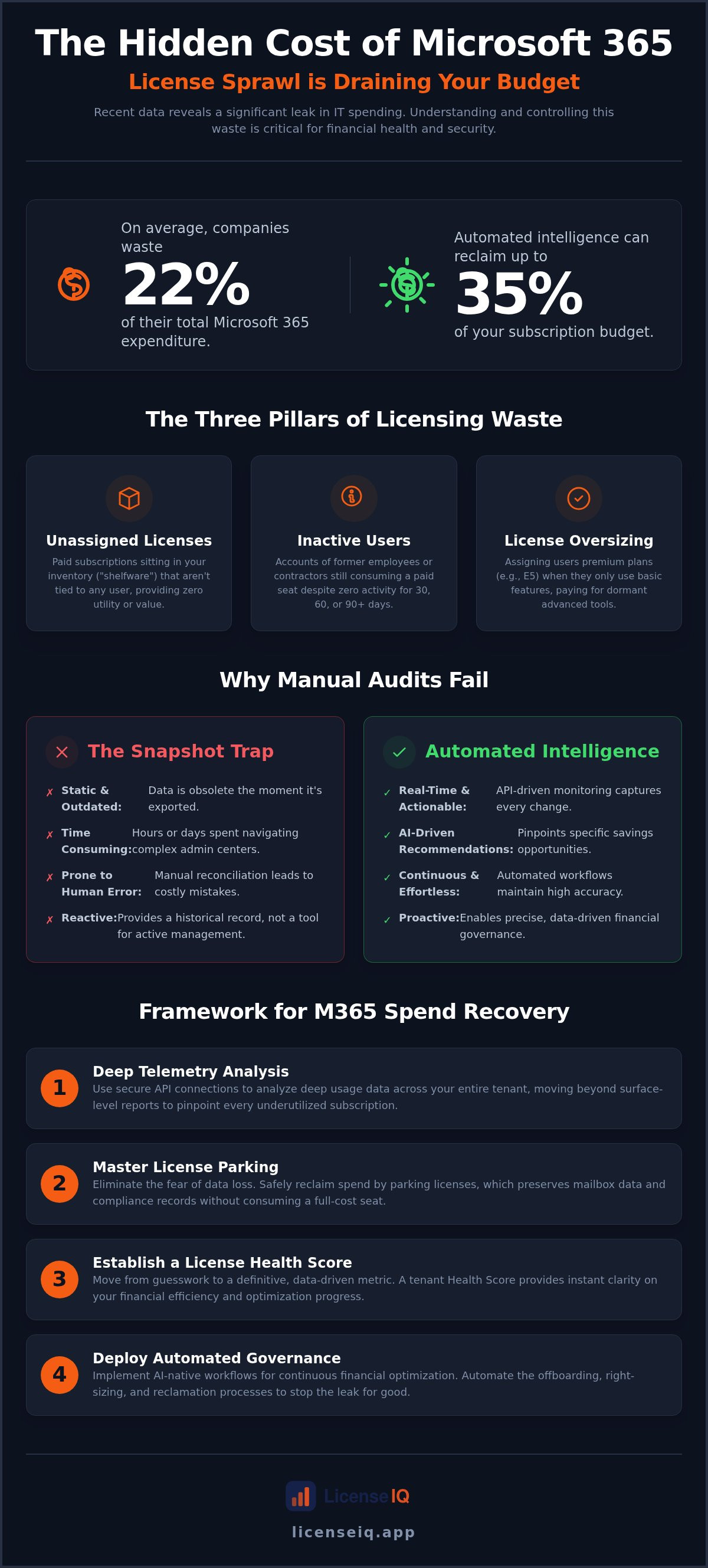
Did you know that 22% of your total Microsoft 365 expenditure is currently vanishing into cloud waste? Recent 2026 data confirms that dormant assignments and unassigned inventory are draining IT budgets at an unprecedented rate. With Microsoft 365 E5 seats now costing $60.00 per month, the financial stakes of inefficiency have never been higher. You cannot manage what you cannot see.
You likely suspect your billing cycles are opaque. It's difficult to track inactive users across remote teams, and the fear of deleting a license required for compliance often leads to expensive administrative paralysis. This lack of oversight creates a state of microsoft 365 license sprawl that quietly erodes your operational health. You deserve total clarity rather than manual spreadsheets and guesswork.
We'll show you how to reclaim up to 35% of your subscription budget by shifting to automated software intelligence. This guide details how to establish a definitive Health Score for your tenant, deploy automated governance workflows, and secure your environment through precise offboarding. It's time to stop the leak and regain control of your digital resources.
Key Takeaways
- Identify the primary drivers of microsoft 365 license sprawl, including improper offboarding and shadow upgrades that inflate your monthly bill.
- Move beyond manual spreadsheets to avoid the Snapshot Trap, ensuring your usage data remains accurate and actionable in real-time.
- Use secure API connections to perform deep usage telemetry analysis and pinpoint every underutilized subscription across your tenant.
- Eliminate the fear of data loss by mastering license parking strategies that reclaim spend without compromising compliance or mailbox access.
- Leverage AI-native software intelligence to establish a License Health Score and automate governance workflows for continuous financial optimization.
What is Microsoft 365 License Sprawl?
License sprawl is the gap between purchased seats and actual value delivered. Within the complex ecosystem of Microsoft 365, this phenomenon manifests as the accumulation of unassigned, redundant, or underutilized subscriptions. It isn't just an administrative mess. It's a direct leak in your operational budget. When left unchecked, microsoft 365 license sprawl turns a streamlined cloud environment into a graveyard of wasted capital.
In 2026, the primary drivers of this waste include rapid hiring cycles, improper offboarding procedures, and "shadow" license upgrades. These upgrades often happen when departments purchase high-tier features without central oversight. We distinguish between "active" sprawl, which involves paying for accounts that serve no one, and "latent" sprawl. Latent sprawl is more subtle. It occurs when you provision advanced features that users never touch. For SMBs without dedicated FinOps teams, this is a silent budget killer that compounds every billing cycle.
The Three Pillars of Licensing Waste
To reclaim your budget, you must identify where capital is trapped. Licensing waste typically falls into three specific categories that require different remediation strategies:
- Unassigned Licenses: These are subscriptions you pay for monthly that aren't tied to any user identity. They sit in your inventory as "shelfware," providing zero utility.
- Inactive Users: These accounts belong to former employees or contractors who haven't logged in for 30, 60, or 90 plus days. They're still consuming a paid seat despite zero activity.
- License Oversizing: This occurs when users are assigned premium E5 plans but only utilize Basic features. You're paying for advanced security and analytics tools that remain dormant.
The Cost of Inaction in 2026
Ignoring your tenant's health has measurable consequences. Industry data suggests that SMBs often overpay by 25% to 35% on their total subscription costs. On an annual scale, this represents thousands of dollars in reclaimed capital that could fund actual growth initiatives. You don't have to accept these losses as the cost of doing business.
Beyond the financial impact, sprawl creates significant security vulnerabilities. Ghost accounts and dormant mailboxes are prime targets for credential harvesting and unauthorized access. A lean tenant is a secure tenant. By using tools like the LicenseIQ Platform, organizations gain the visibility needed to close the gap between cost and utility. Total clarity is the only solution to organizational disorder.
Why Manual M365 Audits Fail to Tame Sprawl
Manual audits are a reactive tactic for a dynamic financial problem. Most organizations fall into the "Snapshot Trap." You spend hours or days exporting CSV files and reconciling user lists. By the time the spreadsheet is saved, it's already obsolete. New hires join, contractors depart, and licenses shift. This static approach cannot keep pace with the fluid nature of modern cloud environments. It provides a historical record rather than a tool for active management.
Navigating the M365 Admin Center for usage telemetry is a notorious time sink. Data is buried under nested menus. The interface is built for technical configuration, not financial oversight. This complexity leads to significant human error when mapping usage patterns to license tiers. IT managers often struggle to distinguish if a user truly needs an E5 plan or if an E3 would suffice. Additionally, the lack of synchronization between HR and IT creates a dangerous lag. When a contractor is terminated, their license often remains active for weeks because the ticket was never filed. This administrative friction is a core catalyst for microsoft 365 license sprawl. Stop relying on manual exports and start using a Spend Recovery Dashboard for instant clarity.
The Spreadsheet vs. Automated Governance
The difference between manual tracking and automated governance is the difference between guesswork and precision. Spreadsheets rely on static, outdated data points. In contrast, automated governance utilizes real-time API-driven monitoring to capture every change. This logic of automation and precision applies to all operational data; for example, to streamline field documentation, you can check out PHOTO iD for automated photo labeling and organization. Manual audits involve subjective "best guesses" about user needs. AI-driven platforms provide specific Spend Recovery recommendations based on actual telemetry. One-off audit projects are exhausting and quickly forgotten. Continuous Governance Workflows ensure accuracy stays high without requiring extra manual labor from your team.
Core licenses are rarely the only source of waste. Specialized add-ons like Project or Visio often sprawl faster because they're requested for short-term tasks and then forgotten. Tracking the adoption and ROI of Copilot for Microsoft 365 is particularly difficult manually. With these seats carrying significant monthly fees, you cannot afford to pay for users who aren't active. Understanding these phases is critical, as detailed in Mastering the Microsoft 365 License Management Lifecycle in 2026. Without automated oversight, these high-cost licenses remain active long after their utility has vanished.
The 2026 Framework for M365 Spend Recovery
Recovery requires a repeatable process rather than a one-time project. To eliminate microsoft 365 license sprawl, you must move from manual observation to systemic control. This framework provides the technical roadmap to identify waste and reclaim capital without disrupting your operations. It turns obscured billing data into actionable financial intelligence.
Step 1: Tenant Discovery. Connect your environment via a secure API. This allows for a comprehensive scan of every user identity and license assignment in minutes. Unlike manual exports, this connection provides a live view of your inventory. It establishes the baseline for all recovery efforts.
Step 2: Usage Telemetry Analysis. Analyze activity patterns across your entire suite. Identify "Zero Usage" users who haven't logged into a single service within the last 90 days. This specific window is the industry standard for distinguishing between temporary absence and true license abandonment. It uncovers the most immediate opportunities for spend recovery.
Step 3: License Right-Sizing. Match every user's actual activity to the lowest cost-effective subscription tier. If an employee has an E5 license but never uses advanced security or analytics tools, they are a candidate for an E3 or Business Basic plan. This alignment ensures you only pay for the value your team actually consumes.
Step 4: Automated Reclamation. Harvest unassigned licenses before purchasing new ones. Your system should automatically check your existing "shelfware" inventory whenever a new seat is requested. This prevents the unnecessary purchase of additional licenses when valid, unassigned seats are already available in your tenant.
Calculating Your License Health Score
The License Health Score is the ultimate KPI for SaaS financial hygiene. It is calculated as a ratio of value-generating licenses to your total spend. For an average SMB, this score often hovers around 65% due to unchecked microsoft 365 license sprawl. A "Good" score for a high-performing organization is 90% or higher. Monitoring this metric provides immediate clarity on whether your resources are being utilized or wasted.
Implementing Automated Offboarding
Offboarding is often the point where financial leaks begin. You must trigger license reclamation the moment an employee departs to stop the billing clock immediately. Utilizing a structured Office 365 Offboarding Checklist 2026 ensures that data is retained for compliance while active subscriptions are harvested. This automation removes the friction between HR and IT, ensuring that departed contractors don't remain on your payroll as ghost users. You can secure your data while simultaneously protecting your budget.
Overcoming the "What If" Objection: Safe Spend Recovery
Efficiency shouldn't cause anxiety. Many IT leaders hesitate to act because they fear accidental data loss or service disruption. However, addressing microsoft 365 license sprawl is a surgical process, not a destructive one. You can reclaim significant portions of your budget without compromising the integrity of your tenant or the productivity of your team. Precision is the antidote to hesitation.
The most common fear is that reclaiming a license equates to deleting a mailbox. This is a misconception. Removing a license is a billing action that simply stops the recurring cost of premium services. Data remains accessible through shared mailboxes or archive tiers. By implementing "License Parking," you move inactive users to these lower-cost tiers, maintaining full data retention while eliminating unnecessary monthly fees. You keep the data; you just stop paying for the active seat.
Maintaining a "Buffer Strategy" is also vital for operational continuity. You don't need to harvest every single unassigned seat. Keeping a lean inventory of 2% to 3% of your total seat count ensures you can onboard new hires instantly without waiting for procurement. This approach balances financial hygiene with administrative agility. Optimization isn't about restriction. It's about ensuring every dollar spent is tied to a specific, active requirement. You can start this process immediately by connecting the LicenseIQ Platform to your tenant.
The Security-Savings Synergy
Reducing sprawl naturally shrinks your attack surface. Every unmanaged, dormant account in your environment is a potential backdoor for credential harvesting. By right-sizing licenses and removing "Shadow IT" accounts, you ensure that every active user is governed by your central security policies. Automated governance workflows help you meet compliance requirements by ensuring that only authorized, active personnel have access to corporate resources. Security and savings are two sides of the same coin.
Communicating ROI to Stakeholders
Presenting your findings to the CFO requires translating technical metrics into financial outcomes. A Spend Recovery Dashboard allows you to show exactly how many inactive users were identified and the specific annual dollar-value savings achieved through reclamation. This transparency builds trust with leadership. For a deeper look at specific cost-saving strategies, consult our guide on How to Reduce M365 Subscription Costs. When you quantify waste as a direct hit to the bottom line, budget for optimization tools becomes easy to justify.
Stop the Sprawl: Automated Governance with LicenseIQ
Manual oversight is no longer a viable strategy for managing modern cloud environments. The sheer volume of data generated within a tenant makes manual audits an exercise in futility. LicenseIQ serves as your vigilant digital auditor, replacing human error with algorithmic precision. Our platform connects to your environment in minutes to provide immediate clarity on your current spending profile. This rapid discovery enables organizations to reclaim up to 35% of their budget by identifying waste that remains hidden in standard administrative logs. You don't have to settle for opaque billing cycles when total transparency is within reach.
AI-Native Software Intelligence
Standard spreadsheets miss the nuanced usage patterns that indicate a license is ripe for reclamation. LicenseIQ utilizes AI-native software intelligence to scan for these obscured details across your entire user base. While quarterly audits offer a brief glimpse into the past, our platform provides continuous monitoring. This constant oversight ensures your financial health is protected every day, not just once a season. You gain the ability to spot trends before they become expensive liabilities. Learn more about our Automated Governance Workflows to see how we maintain this level of precision without requiring manual intervention.
Built for SMB Agility
SMBs often lack the massive IT departments and dedicated FinOps teams required to manage complex licensing lifecycles. LicenseIQ bridges this gap by offering a simplified Spend Recovery Dashboard that prioritizes actionable insights over raw data. It translates technical telemetry into clear, financial KPIs that any business manager can understand and act upon. By automating the identification and reclamation process, you permanently eliminate microsoft 365 license sprawl without adding a single hour to your team's workload. The system remains one step ahead, ensuring that your resources are always aligned with your actual operational needs.
Don't let invisible waste dictate your IT budget for another billing cycle. Take the first step toward total transparency and reclaim your capital. Get your free M365 Health Score now to discover exactly where your resources are being underutilized. Transition from organizational disorder to total operational clarity today. Your budget deserves the protection of a precise, automated system.
Secure Your Budget Through Automated Oversight
Operational clarity is the foundation of financial health. Manual spreadsheets and reactive audits cannot keep pace with the dynamic nature of modern cloud environments. By implementing a systemic framework for spend recovery, you move from guesswork to precision. You now understand that reclaiming inactive seats is a safe, data-secure process that preserves compliance while stopping unnecessary billing leaks. Eliminating microsoft 365 license sprawl is a vital step in protecting your organization's resources from the impact of rising subscription costs.
The path to an optimized tenant starts with visibility. You can identify exactly where your capital is trapped by using an AI-native Spend Recovery Dashboard that connects to your environment in minutes. This proactive approach allows you to reclaim up to 35% on M365 subscriptions without adding to your team's administrative burden. It's time to replace organizational disorder with a vigilant, automated system that works as hard as you do.
Take the first step toward a leaner, more secure digital infrastructure. Discover and recover your wasted M365 spend with LicenseIQ today and establish a definitive Health Score for your organization. You have the tools to turn waste into growth.
Frequently Asked Questions
What is the difference between license sprawl and SaaS sprawl?
License sprawl is specific to the Microsoft ecosystem, whereas SaaS sprawl covers your entire software portfolio. While license sprawl involves unassigned or redundant seats within a single tenant, SaaS sprawl includes shadow IT and duplicate applications across different vendors. Both contribute to financial waste, but license-specific issues require deep telemetry analysis within your tenant to resolve effectively.
How much money can I realistically save by fixing M365 license sprawl?
Organizations typically reclaim up to 35% of their total subscription budget. In 2026, with M365 E5 seats priced at $60.00, identifying even a few dozen inactive users yields immediate ROI. Most mid-sized environments overspend by 20% to 40% due to unassigned inventory and dormant accounts. These savings directly improve your bottom line without impacting your team's operational capacity.
Will reclaiming an unused license delete the user’s email data?
No, removing a license is a billing action that doesn't automatically delete mailbox content. You can retain data by converting the mailbox to a shared resource or utilizing archive tiers. This allows you to stop the monthly billing cycle while meeting compliance and legal discovery requirements. Data preservation and spend recovery are managed as separate, parallel workflows in a healthy tenant.
How often should I audit my Microsoft 365 licenses to prevent sprawl?
You should utilize continuous monitoring rather than periodic audits to effectively prevent microsoft 365 license sprawl. Manual quarterly reviews aren't enough because they're outdated the moment they're completed. Automated systems provide real-time visibility into usage patterns. This ensures that new waste is identified and remediated immediately, maintaining your financial hygiene throughout the entire fiscal year without manual labor.
Does Microsoft provide built-in tools to manage license sprawl?
Microsoft provides basic usage reports in the Admin Center, but these tools lack automated reclamation features. They require manual export and analysis, which is labor-intensive and prone to error. Built-in reports don't provide a consolidated Spend Recovery Dashboard. Specialized platforms are necessary to turn raw data into actionable financial intelligence and provide a clear Health Score for your organization.
What is a "good" License Health Score for a 100-person company?
A "good" score is 90% or higher, indicating that nine out of ten licenses are actively generating value. You've likely found that most companies start with a score closer to 65%. For a 100-person organization, a high score means you have minimal unassigned seats and no dormant premium accounts. This metric serves as your primary KPI for ongoing software financial management.
Can I automate the reclamation of licenses for offboarded employees?
Yes, you can deploy Automated Governance Workflows to trigger license harvesting the moment an employee is deactivated. This prevents departed employees from remaining on your payroll for months after their departure. Automation ensures that unassigned seats are returned to your inventory for immediate reuse by new hires. It effectively eliminates the communication gap that often exists between HR and IT departments.
What happens to my M365 bill if I have more licenses than users?
Your monthly invoice includes every license in your inventory, regardless of whether it's assigned to a user. Unassigned seats represent 100% waste. If you have 110 licenses but only 100 users, you're paying for 10 seats that provide zero utility. This inventory surplus is a primary driver of microsoft 365 license sprawl and should be harvested to protect your budget.


