

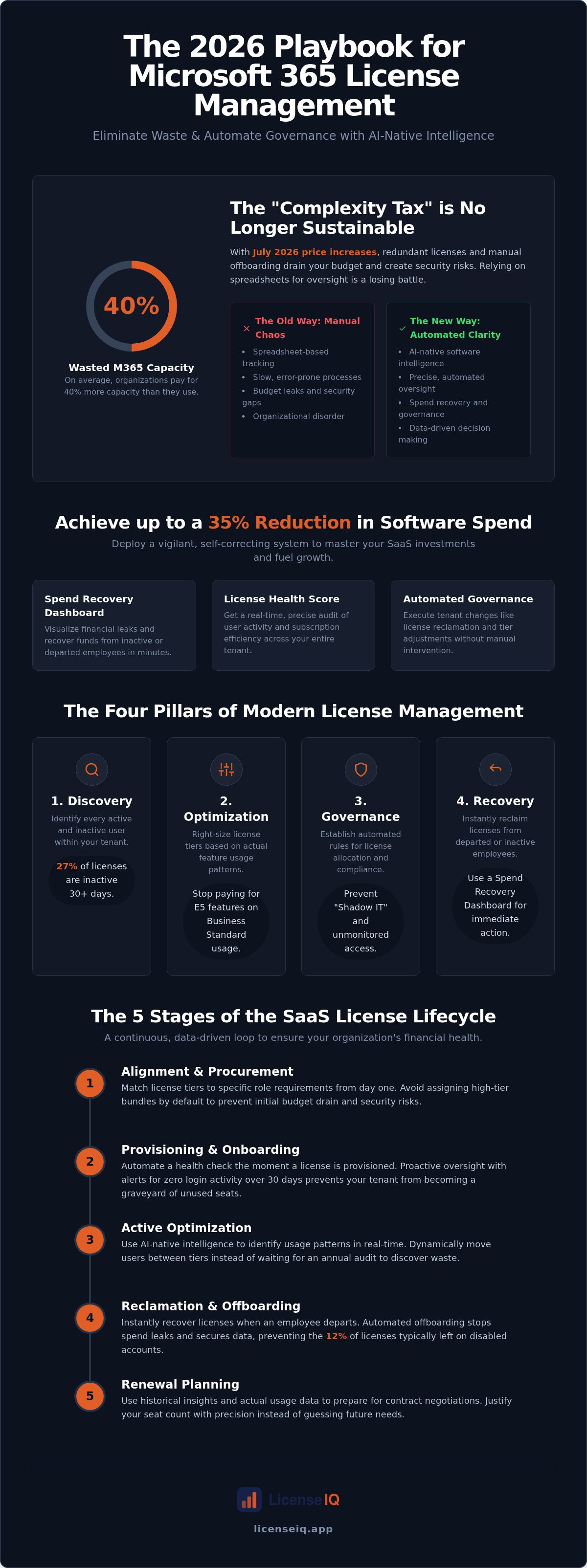
On average, organizations pay for 40% more Microsoft 365 capacity than they actually use. With the July 2026 price increases adding significant overhead to your bottom line, this "complexity tax" is no longer sustainable. You know the frustration of redundant licenses draining your budget while manual offboarding leaves your environment vulnerable. Maintaining oversight through spreadsheets is a losing battle that creates organizational disorder. It's time to replace manual effort with precise, automated oversight.
This guide delivers the 2026 automated playbook for microsoft 365 license lifecycle management. You'll learn how to master your SaaS investments to eliminate waste and automate governance using AI-native software intelligence. We'll show you how to achieve a 35% reduction in software spend by deploying a Spend Recovery Dashboard and a clear Health Score for every license. This isn't just about cutting costs; it's about building a vigilant, self-correcting system that secures your resources and fuels growth through data-driven clarity.
Key Takeaways
- Modern microsoft 365 license lifecycle management replaces manual tracking with AI-native intelligence to oversee the full procurement and reclamation process.
- Identify and eliminate the "complexity tax" to recover up to 35% of your annual software spend by automatically flagging inactive users.
- Implement Automated Governance Workflows that use the Model Context Protocol to execute tenant changes without manual intervention.
- Monitor your License Health Score for a real-time, precise audit of user activity and subscription efficiency.
- Align every license with actual role requirements from day one to prevent budget drain and security risks during the onboarding phase.
What is Microsoft 365 License Lifecycle Management?
Microsoft 365 license lifecycle management is the end-to-end process of procuring, deploying, optimizing, and reclaiming software seats. In 2026, this discipline has transitioned from manual spreadsheet tracking into a system driven by AI-native software intelligence. It's no longer sufficient to simply assign a license; you must monitor its entire journey from the moment of purchase to the final recovery of funds. Unmanaged lifecycles lead to "SaaS sprawl," where redundant subscriptions drain SMB budgets and create massive security gaps through unmonitored access.
Effective management acts as a vigilant guardian of your corporate resources. Without a structured lifecycle, your organization pays a "complexity tax" that grows with every new hire and department expansion. SMBs frequently lose thousands of dollars annually because they lack the oversight to visualize these financial leaks. By treating licenses as dynamic assets rather than static costs, you transform your IT operations into a proactive participant in company growth. This approach ensures that every dollar spent on your Microsoft tenant delivers measurable value. To scale these efficiencies beyond licensing, you can explore Cloud-based IT process automation and application management subscriptions that simplify software packaging and deployment across your entire estate.
The Four Pillars of Modern License Management
To master your environment, you must focus on four distinct operational stages. These pillars ensure that your software investments remain lean and secure:
- Discovery: You must identify every active and inactive user within your tenant. Obscured details often hide the fact that 27% of licenses are assigned to users who haven't logged in for over 30 days.
- Optimization: This involves right-sizing tiers based on actual feature usage patterns. You shouldn't pay for E5 security features if your staff only utilizes Business Standard tools.
- Governance: Establish automated rules for license allocation. This ensures compliance and prevents "shadow IT" where departments purchase licenses outside centralized procurement.
- Recovery: The final stage is reclaiming spend from departed or inactive employees instantly. Using a Spend Recovery Dashboard allows you to execute these changes in minutes.
Why Traditional ITAM Fails in 2026
Legacy Asset Management (ITAM) tools weren't built for the velocity of modern SaaS. Manual spreadsheets are too slow to keep up with the rapid adoption of new AI add-ons like Copilot. Organizations estimated to be overspending by 20-30% often rely on these outdated methods. Traditional tools lack real-time usage data, leaving you blind to actual user activity. This lack of transparency is the primary driver of organizational disorder. You need a system that connects to your tenant in minutes to provide immediate clarity and a definitive License Health Score.
The 5 Stages of the SaaS License Lifecycle
Effective microsoft 365 license lifecycle management isn't a linear path. It's a continuous, data-driven loop that ensures your organization's financial health. By segmenting the lifecycle into five distinct stages, you eliminate the guesswork that leads to overspending. This structured approach allows you to maintain total clarity over your resources from the moment of purchase to the final reclamation.
Stage 1 & 2: Beyond Simple Provisioning
Alignment starts on day one. You must match license tiers to specific role requirements rather than assigning high-tier bundles by default. Modern systems automate a health check the moment a license is provisioned. This proactive oversight sets the tone for the entire cycle. You need to establish firm benchmarks immediately; for instance, zero login activity over 30 days should trigger an automatic alert. Integrating automated license governance early in the cycle prevents your tenant from becoming a graveyard of unused seats.
Stage 3 & 4: The Active Recovery Phase
This phase focuses on optimization and right-sizing. You shouldn't wait for an annual audit to discover that users on E5 plans only utilize basic email features. AI-native intelligence identifies these patterns in real-time, allowing you to move users between tiers dynamically. Reclamation is equally vital. When an employee departs, the recovery of their license must be instantaneous. Manual offboarding is slow and often leaves 12% of licenses assigned to disabled accounts. Following a structured Office 365 Offboarding Checklist 2026 ensures you secure your data while stopping spend leaks immediately.
Stage 5: Renewal Planning
The final stage uses historical insights to prepare for contract negotiations. Instead of guessing your future needs, you use actual usage data to justify your seat counts. This transparency gives you the upper hand during renewals, especially as Microsoft prices continue to rise. By mastering the microsoft 365 license lifecycle management stages, you transition from reactive IT support to proactive resource guarding. You can see your entire subscription status at a glance with a License Health Score, providing the clarity needed to make informed financial decisions.
Financial Hygiene: Eliminating Wasted M365 Spend
Financial hygiene in your SaaS environment requires a relentless focus on data-driven transparency. Most organizations are significantly overpaying for their subscriptions, with the "Hidden 35%" representing budget lost to underutilization. Effective microsoft 365 license lifecycle management uncovers these obscured details, transforming wasted capital into recoverable savings. Identifying inactive users is the fastest way to stabilize your budget in any fiscal quarter. When a user hasn't accessed their apps for over 30 days, their license becomes a drain on your resources.
Beyond inactive users, you must confront the danger of "Zombie Licenses." These are paid seats that sit unassigned in your tenant, often forgotten after a bulk purchase or a shift in staffing. They provide zero value while incurring full monthly costs. Using a License Health Score allows you to prioritize your optimization efforts based on actual dollar value. This metric serves as a real-time audit, distinguishing between essential operational costs and pure financial waste.
M365 Spend Recovery Strategies
Strategic recovery involves more than just deleting accounts. You must scrutinize usage patterns to downgrade unutilized E5 features to E3 or Business Premium. If a user only needs basic security and office apps, paying for advanced compliance tools is an unnecessary expense. You should also eliminate duplicate licenses assigned to the same user across different departments, a common byproduct of organizational disorder. Learn how to reduce M365 subscription costs by applying these targeted recovery tactics to your tenant today.
The ROI of Automated Governance
Manual license management is a reactive, high-cost process that relies on flawed human oversight. AI-native automation, however, operates as a proactive digital auditor that never sleeps. While manual audits capture a single point in time, continuous monitoring prevents spend from creeping back up after the initial cleanup. This shift from manual spreadsheets to automated workflows reduces administrative overhead while ensuring your License Health Score remains optimal. In 2026, M365 optimization delivers a direct, bottom-line impact by converting obscured technical debt into immediate liquidity for your organization. This approach to data-driven clarity is a hallmark of modern management, often facilitated by a comprehensive AI business and life infrastructure like LifeOS™ by Venturis 13.
Automating Governance Workflows in the Lifecycle
Automated Governance Workflows represent the final stage of a mature microsoft 365 license lifecycle management strategy. In 2026, these workflows operate as background intelligence that executes policy-driven actions without the need for manual IT tickets. They transform your static License Health Score into a dynamic engine for spend recovery. By connecting directly to your tenant via the Model Context Protocol (MCP), these systems move beyond simple reporting to actual execution. They can reassign, downgrade, or reclaim licenses in real-time based on the specific rules you define.
Safety is paramount in lifecycle automation. Precise Guardrails prevent the system from accidentally deleting accounts or interrupting critical services during a reclamation sweep. You maintain total administrative control through a Human-in-the-Loop model. This setup allows you to approve AI-generated recommendations before any changes go live in your environment. You gain the speed of AI-native software intelligence with the security of human oversight, ensuring your resources are always protected.
Best Practices for Lifecycle Automation
Efficiency improves when you link your license management to external triggers. Trigger-based reclamation occurs the moment your HR system updates an employee's status. This ensures that departures don't result in months of wasted spend. Usage-based right-sizing is equally critical. If the system detects a user only utilizes basic productivity apps, it can automatically suggest a downgrade from E5 to Business Premium. Review your Microsoft 365 Cost Optimization Strategy to ensure your automation rules align with long-term financial goals.
Solving the Offboarding Challenge
Orphaned licenses are more than a budget drain; they're a massive security risk. Active accounts for departed employees provide an unmonitored entry point for potential data breaches. Automated workflows solve this by ensuring 100% license reclamation within 24 hours of an employee leaving the company. Every action is logged in an automated audit trail, providing the governance logs needed for financial accuracy and compliance. This level of meticulous oversight eliminates the organizational disorder common in manual environments. Automate your governance workflows with the LicenseIQ platform to secure your tenant and stop budget leaks instantly.
Optimizing the Lifecycle with LicenseIQ
Microsoft 365 license lifecycle management reaches its peak efficiency when you move from theoretical planning to platform execution. LicenseIQ facilitates this transition by connecting to your tenant in minutes. You don't need weeks of manual data gathering or complex configurations. The system performs an immediate scan to uncover every obscured detail of your subscription, identifying where your resources are being underutilized or wasted.
Your License Health Score acts as the central pulse of your environment. It provides a real-time audit that traditional asset management tools simply cannot match. This score quantifies your operational efficiency, showing you exactly how much of your investment drives productivity versus sitting idle. By providing a single, definitive metric for lifecycle success, the platform removes the ambiguity that leads to organizational disorder and budget drain.
The Spend Recovery Dashboard translates technical data into financial clarity. It visualizes exactly where you can reclaim budget, from inactive users to redundant licenses. You move from automated insight to action with a single click. This allows you to execute the governance workflows discussed in previous sections without leaving the interface. It's the difference between seeing a problem and solving it instantly.
The AI-Native Advantage
Traditional discovery methods are too slow for the 2026 SaaS environment. Periodic manual audits are obsolete the moment they're completed. AI-native intelligence provides continuous monitoring, acting as a meticulous digital auditor that is always one step ahead. It identifies waste with a level of precision that manual oversight cannot replicate. This proactive approach ensures that your 35% savings aren't just a one-time event but a permanent state of financial health. Visit LicenseIQ to start your 5-minute license audit today and secure your resources against unnecessary spend.
Getting Started: Your 2026 Roadmap
Establishing total clarity over your tenant requires a structured approach. Follow these three steps to secure your environment and recover your budget:
- Connect your tenant: Establish an immediate baseline Health Score to visualize your current standing.
- Review recommendations: Analyze the top three spend recovery suggestions provided by the AI, focusing on the highest dollar-value impact first.
- Deploy workflows: Activate your first automated governance workflow to stop budget leaks and ensure long-term compliance.
By following this roadmap, you transform your IT operations into a vigilant system of resource protection. You gain the confidence that every license is accounted for, every user is right-sized, and every dollar is working toward your company's growth.
Securing Your Resources with Precise Digital Oversight
Manual license tracking is a liability that your budget can no longer afford. By adopting a structured approach to microsoft 365 license lifecycle management, you transform technical debt into operational liquidity. You've seen how identifying inactive users and zombie seats stops immediate leaks. Now, you must maintain that efficiency through AI-native automation that secures your environment and monitors every dollar spent.
Total transparency starts with a definitive audit of your tenant. You can identify waste and deploy automated governance workflows that run in the background, ensuring your organization remains lean and compliant. It's time to replace organizational disorder with a vigilant system of resource protection. This proactive stance ensures your software investments always align with actual user activity.
Recover your wasted M365 spend with LicenseIQ today. You'll receive a comprehensive License Health Score generated in minutes and join organizations achieving up to 35% spend recovery. Take control of your SaaS investments and build a more secure, data-driven future for your business.
Frequently Asked Questions
What is the most common stage where SaaS license waste occurs?
License waste most frequently occurs during the reclamation and offboarding stages. Organizations often fail to revoke access when employees depart; this leaves approximately 12% of licenses assigned to disabled accounts. This oversight creates a "zombie license" problem that drains budgets silently. Effective microsoft 365 license lifecycle management ensures these seats are recovered within 24 hours of a status change. This proactive approach prevents technical debt from accumulating over time.
Can I automate M365 license reclamation without losing user data?
You can absolutely automate reclamation while maintaining data integrity by setting specific guardrails. AI-native platforms use "Human-in-the-Loop" models to ensure no account is deleted without administrative approval. These workflows can include steps to convert mailboxes to shared status or back up OneDrive files before a license is reclaimed. This balance of speed and security protects your corporate resources while eliminating the cost of unused subscriptions. It's a precise way to manage assets.
How often should I audit my SaaS license lifecycle?
You should move away from periodic audits in favor of continuous, real-time monitoring. Manual audits are often obsolete by the time they're finished because user activity changes daily. A persistent digital auditor identifies waste as it happens rather than months later. At a minimum, your organization should review its Spend Recovery Dashboard monthly. This ensures that license allocations still align with actual department usage patterns. Don't let your oversight become a reactive process.
What is a good SaaS License Health Score for an SMB?
A high-performing SMB should aim for a License Health Score of 90% or above. This indicates that your license assignments closely mirror actual usage and that you've got minimal inactive seats. If your score falls below 70%, it's a clear signal of organizational disorder and financial waste. Monitoring this metric provides immediate clarity. It allows you to prioritize optimization efforts where they'll have the greatest dollar-value impact on your bottom line.
Does SaaS lifecycle management work for small teams under 100 people?
Teams under 100 people often see the fastest ROI from microsoft 365 license lifecycle management because their budgets are less elastic. Even a few unused Business Premium or E5 seats represent a significant percentage of an SMB's IT spend. Automated tools like LicenseIQ connect in minutes. This makes it feasible for small teams to maintain enterprise-level oversight without a dedicated IT asset manager. Efficiency is a vital competitive advantage regardless of your company's size.
What is the difference between ITAM and SaaS license lifecycle management?
IT Asset Management (ITAM) is a broad discipline that often focuses on hardware and static software inventory. SaaS license lifecycle management is a specialized, high-velocity process focused on real-time usage and subscription health. While ITAM might tell you how many licenses you own, lifecycle management tells you who's actually using them. It's a more surgical approach to financial hygiene. This distinction is critical for organizations looking to recover wasted spend in cloud-first environments.
How does the Model Context Protocol help with license governance?
The Model Context Protocol (MCP) serves as the secure bridge between AI-native intelligence and your Microsoft tenant. It allows the platform to move beyond simple reporting and actually execute governance commands directly. By using MCP, your system can automate complex tasks like downgrading tiers or reassigning licenses based on real-time data. This protocol ensures that your automated governance workflows are both precise and secure. It maintains total administrative control throughout the entire optimization process.


