

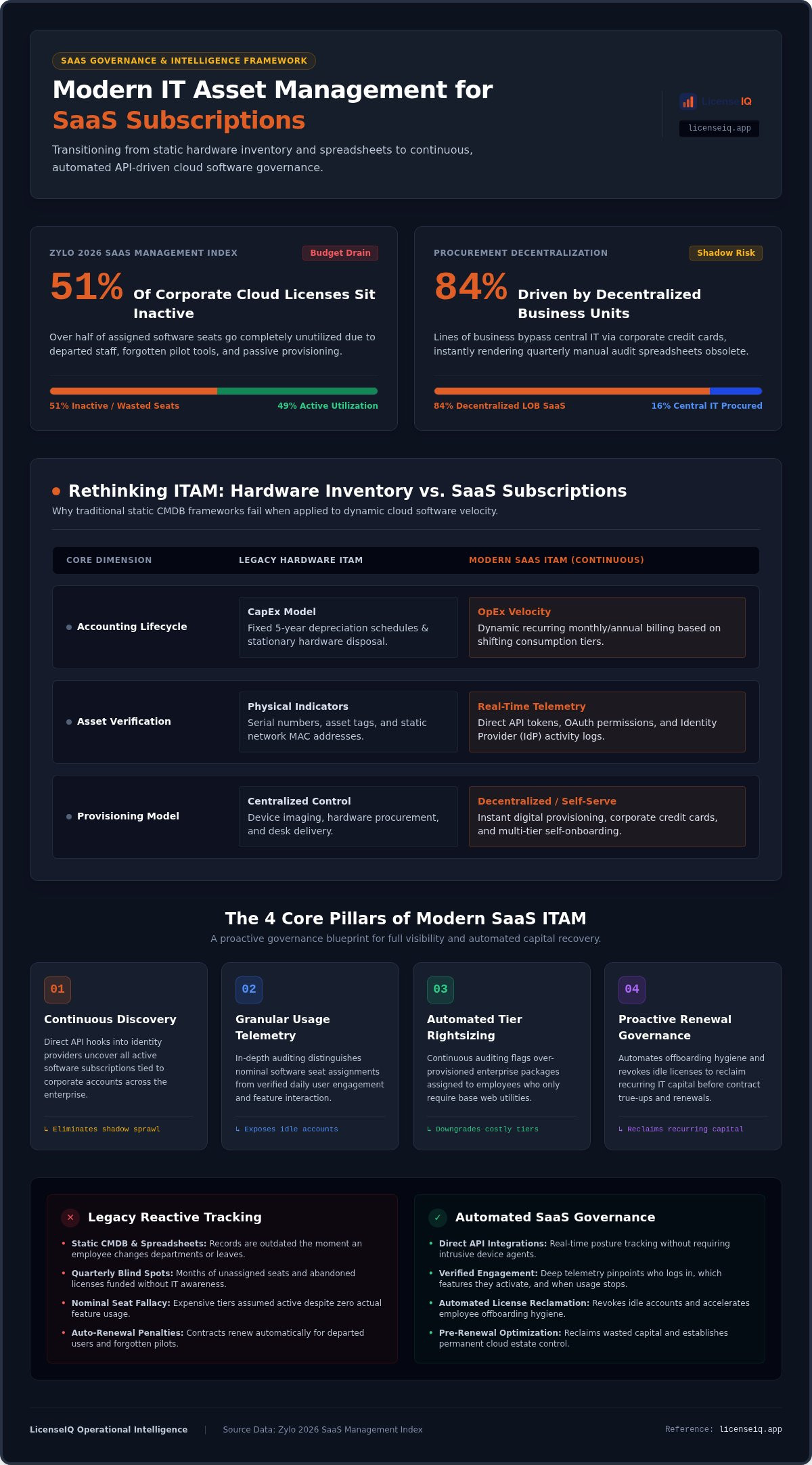
Up to 51% of corporate cloud licenses sit completely inactive, according to Zylo's 2026 SaaS Management Index. If your team still tracks software across static CMDB records and disconnected spreadsheets, you know the frustration firsthand. You watch monthly and annual renewals process automatically for departed employees, forgotten pilot tools, and underutilized premium tiers. Traditional inventory tactics weren't built for modern cloud velocity. Today, executing effective it asset management for saas subscriptions demands continuous, automated governance rather than periodic manual guesswork.
Controlling software costs shouldn't require endless spreadsheet reconciliation or security blind spots from unmonitored accounts. You can easily turn software chaos into predictable operational discipline. In this guide, you'll discover how modern ITAM frameworks eliminate SaaS sprawl, automate license reclamation, and slash subscription waste across your organization. We examine the operational plays, automated workflows, and visibility benchmarks you need to reclaim your budget and establish permanent control over your cloud estate.
Key Takeaways
- Understand why modern IT asset management for SaaS subscriptions requires real-time API telemetry instead of static CMDB records and manual spreadsheets.
- Uncover hidden budget waste by distinguishing nominal software seat assignment from verified daily user engagement.
- Pinpoint the direct financial drain of zombie licenses and over-provisioned enterprise tiers across your primary productivity environments.
- Deploy automated governance rules to revoke idle accounts, accelerate offboarding hygiene, and reclaim recurring IT capital before contract renewals.
- Evaluate purpose-built software intelligence platforms against legacy asset trackers to establish executive-level oversight and operational agility.
Rethinking IT Asset Management: Hardware Inventory vs. SaaS Subscriptions
Traditional IT asset management relies on physical physics. You purchase a server, assign a static asset tag, calculate linear depreciation over five years, and eventually dispose of the metal. Cloud software operates under entirely opposite economics. SaaS subscriptions represent recurring operational expenditures where value shifts dynamically based on user activity, license tiers, and consumption cycles. Treating continuous software access like stationary hardware leaves organizations blind to mounting overhead.
Static Configuration Management Databases (CMDBs) simply cannot track this fluidity. A legacy CMDB registers a configuration item once and expects it to stay put. Cloud services change daily. Team members switch roles, projects end, and vendors adjust multi-tiered plans. Relying on fixed asset registries to manage volatile cloud seats creates compounding waste. Modern it asset management for saas subscriptions requires real-time posture tracking rather than passive ledger recording.
| Dimension | Hardware ITAM | SaaS ITAM |
|---|---|---|
| Accounting Lifecycle | Capital expenditure (CapEx) with fixed depreciation schedules. | Operational expenditure (OpEx) with recurring monthly or annual billing. |
| Asset Verification | Physical serial numbers and network MAC addresses. | API tokens, OAuth permissions, and identity provider (IdP) activity logs. |
| Provisioning Model | Centralized procurement, device imaging, and desk delivery. | Self-serve onboarding, corporate credit cards, and instant digital provisioning. |
The Limitations of Legacy ITAM Frameworks in Cloud-First Environments
Quarterly audit cycles create massive financial blind spots. According to Zylo's 2026 data, decentralized lines of business drive 84% of corporate SaaS tools. When business units bypass central IT using corporate credit cards, manual tracking fails immediately. Spreadsheets become outdated the moment an employee switches departments or departs the company. By the time an annual true-up arrives, organizations have funded months of unassigned seats and abandoned licenses without knowing it.
The Shift to Proactive Software Asset Management (SAM)
Modern operational discipline requires continuous data ingestion rather than intrusive device agents. By leveraging the foundational principles of the Software Asset Management (SAM) framework, IT leaders can transition from reactive tracking to proactive governance. Direct API integration delivers deep telemetry into core productivity suites, pinpointing who logs in, which features they activate, and when their engagement stops.
Nominal license assignment does not equal active utilization. A user might hold an expensive enterprise tier but only interact with basic web utilities. Leaders adopt proactive strategies like mastering the Microsoft 365 license management lifecycle in 2026 to resolve this gap. Establishing continuous API visibility ensures it asset management for saas subscriptions actively reclaims wasted capital instead of recording historical losses.
Core Pillars of an Effective SaaS IT Asset Management Strategy
Controlling cloud expenditure requires tactical visibility across your entire operational surface. Because cloud software bypasses physical infrastructure, governance must anchor to identity, actual usage metrics, and automated contract workflows. Treating subscriptions as dynamic operating tools rather than static purchases lets IT teams expose real usage patterns. Modern it asset management for saas subscriptions rests on four practical pillars:
- Continuous Subscription Discovery: Direct API hooks into identity providers reveal every cloud tool tied to corporate credentials.
- Granular Usage Telemetry: In-depth auditing separates actual feature interaction from passive account provisioning.
- Automated Tier Rightsizing: Continuous monitoring flags premium enterprise packages assigned to workers who only need base utility access.
- Proactive Renewal Governance: Centralized timelines track contractual terms well before automatic renewal windows lock in unwanted spend.
Implementing these operational checks aligns with the security posture guidelines established in the CISA Cloud Security Technical Reference Architecture, ensuring software tracking protects data boundaries alongside budgets.
Automated Discovery and Identity Provider Integration
Effective governance starts at the identity layer. Integrating directly with identity platforms maps user directories against provisioned software tiers instantly. When employees authenticate using single sign-on (SSO), their digital footprints log vendor relationships that procurement records often miss. These access logs unmask redundant tools across teams, spotlighting unvetted shadow tools and eliminating duplicate accounts before they generate multiple annual invoices.
Feature-Level Utilization Tracking vs. Login Verification
Authentication logs alone can mislead IT leaders. A single sign-on timestamp merely proves an employee signed in to an enterprise portal. It doesn't prove they engaged with high-cost capabilities. Enterprise tiers bundle complex analytical suites, advanced security controls, and storage allocations that standard users rarely touch.
Consulting the Microsoft 365 license types reference guide reveals stark price and feature differentials across business tiers. If a user only sends emails and drafts light documents, paying for advanced compliance eDiscovery or premium analytical modules burns company budget. Direct telemetry exposes this misalignment so you can downgrade accounts to appropriate tiers.
Establishing continuous oversight gives leadership immediate visibility into cloud efficiency. If your team needs to eliminate guesswork and reclaim misallocated software budgets, testing your tenant with the LicenseIQ Platform provides instant clarity across your entire active subscription footprint.
The Hidden Costs of Unmanaged SaaS: Sprawl, Zombie Seats, and Security Risks
Unchecked software estates bleed financial resources while quietly expanding your organizational attack surface. Flexera's 2025/2026 State of ITAM Report reveals that 35% of IT asset managers watched SaaS waste accelerate over the past year. When IT teams lack dynamic operational oversight, small inefficiencies multiply across departments. Effective it asset management for saas subscriptions stops this silent budget erosion by confronting three distinct exposure areas:
- Zombie Licenses: Provisioned accounts tied to inactive or departed personnel that silently renew.
- License Tier Inflation: Premium tiers assigned to utility workers who require only foundational capabilities.
- Orphaned Credential Risks: Abandoned cloud access points that leave sensitive systems open to exfiltration.
These liabilities compound quickly. Left unaddressed, organizations leak recurring capital every single billing cycle while violating core NIST IT Asset Management guidelines on operational visibility.
Zombie Licenses and Inactive Account Accumulation
Offboarding procedures break down constantly. When HR removes an employee from active payroll, helpdesk staff often disable primary mailbox access but forget underlying subscription allocations. These unassigned or idle seats become zombie licenses. They sit silently inside your cloud tenant, consuming monthly and annual fees without generating a shred of business value. Establishing a structured office 365 offboarding checklist ensures your administrators strip software assignments immediately when personnel depart.
License Tier Inflation: The E5 vs. E3 Dilemma
Enterprise plans bundle extensive security tools, compliance features, and voice services into high-cost SKUs like Microsoft 365 E5. Many teams default to provisioning these top-tier bundles across their entire staff. In practice, typical operational employees rarely engage with sophisticated threat protection or advanced data governance capabilities. Downgrading basic users to an E3 or Business Premium profile preserves required productivity tools while instantly reducing overhead. Reviewing strategic methods on how to reduce M365 subscription costs helps leadership systematically realign license tiers with proven role requirements.
Compliance Vulnerabilities and Identity Blind Spots
Financial waste represents only half the problem. Stale accounts retain access to cloud repositories, confidential customer records, and internal file shares long after employees move on. Unmonitored OAuth permissions granted to third-party web apps widen this attack surface further. Modern regulatory mandates like DORA and NIS2 enforce strict penalties for ungoverned software access. Rigorous it asset management for saas subscriptions turns chaotic user estates into strictly governed, auditable operational environments.
How to Implement an Automated SaaS Governance Framework
Traditional ITAM implementation projects often collapse under administrative weight. You don't need multi-quarter consulting engagements to secure basic oversight. Modern it asset management for saas subscriptions thrives on rapid API deployment, objective usage baselines, and programmatic enforcement. A streamlined governance cycle executes across four operational steps:
- Establish Direct API Telemetry: Connect directly to identity platforms and productivity tenants using read-only API permissions.
- Define Objective Activity Thresholds: Set clear activity benchmarks across specific timeframes to separate active contributors from dormant seats.
- Execute Automated Reclamation: Harvest abandoned licenses into a shared pool for immediate reassignment rather than buying net-new subscriptions.
- Lock Down Renewal Cadences: Map real consumption figures against contract schedules 60 to 90 days before renegotiation windows close.
This closed-loop system replaces manual spreadsheet audits with consistent digital oversight, ensuring every active line item delivers demonstrable utility.
Establishing API-Driven Tenant Visibility in Minutes
Legacy asset tracking relied on device agents that took months to deploy and maintain across remote fleets. Cloud-native software management circumvents this friction entirely through native tenant APIs. Connecting via secure, read-only graph endpoints takes minutes. This direct pipeline reads user telemetry, authentication timestamps, and specific SKU assignments without touching endpoint hardware or exposing sensitive employee communications. You achieve instant tenant transparency without operational disruption.
Configuring Automated Reclamation and Deprovisioning Rules
Manual license harvesting is too slow to stop subscription waste. By the time an IT admin manually verifies an unused seat, several billing cycles have already passed. Automated Governance Workflows solve this latency by applying clear, objective reclamation policies.
| Inactivity Threshold | System Action | Operational Outcome |
|---|---|---|
| 30 Days | Send automated alert to user and direct manager. | Prompts confirmation of whether the software seat is still required. |
| 60 Days | Downgrade high-tier license to base web utility. | Eliminates premium tier over-allocation while preserving core email access. |
| 90 Days | Revoke license entirely and return seat to tenant pool. | Stops recurring billing charges and satisfies deprovisioning compliance. |
Implementing targeted rules around Microsoft 365 license optimization ensures unutilized seats are reassigned immediately to incoming staff. To capture immediate dollar savings across your cloud estate, connect your tenant to LicenseIQ and trigger automated reclamation rules today.
Evaluating SaaS ITAM Solutions: Choosing Between CMDBs and Dedicated Governance
Legacy IT service management suites claim a general-purpose CMDB can handle your cloud subscriptions. In practice, forcing cloud operational data into static asset tables fails. Monolithic CMDBs excel at logging fixed infrastructure, network hardware, and endpoint serials. They break down when tracking dynamic OAuth tokens, real-time feature telemetry, or fluctuating user seat pools. Dedicated software governance platforms bypass these architectural limitations by focusing exclusively on continuous discovery and automated rightsizing.
Choosing the right architecture directly impacts how fast your organization captures financial savings. When evaluating modern tooling for it asset management for saas subscriptions, specialized leadership needs solutions that act on data rather than just cataloging it.
Feature Checklist for Modern SaaS Asset Management
Separating basic inventory tracking from true SaaS intelligence requires clear operational criteria. Ensure any prospective platform delivers the following capabilities:
- Instant Native API Integration: Eliminates heavyweight agent installations by integrating directly into core cloud tenants within minutes.
- Granular Telemetry Analytics: Measures actual user interaction across specific functional capabilities, rather than relying solely on superficial SSO authentication stamps.
- Executive Spend Dashboards: Translates complex technical usage metrics directly into realized dollar-value savings and recoverable spend opportunities.
- Autonomous Governance Rules: Executes deprovisioning and tier adjustments automatically without requiring manual administrator intervention for routine tasks.
Transforming SaaS Management with LicenseIQ
For organizations prioritizing agility, the LicenseIQ Platform replaces multi-month enterprise software rollouts with an AI-native engine built for rapid execution. Focusing squarely on core Microsoft 365 environments, it connects via native APIs in minutes to provide instant visibility across your entire tenant.
Instead of wrestling with disconnected spreadsheets, IT leaders receive an objective License Health Score. This single executive metric benchmarks overall operational hygiene, instantly revealing unassigned seats, over-licensed accounts, and zombie accounts. Backed by a dedicated Spend Recovery Dashboard, leadership sees the exact dollar value available for reclamation.
LicenseIQ moves beyond passive diagnostics by executing Automated Governance Workflows. These automated sequences routinely reclaim underutilized and inactive seats, helping organizations recover up to 35% in wasted subscription spend. Ready to eliminate spreadsheet overhead and protect your operating budget? It is time to take control of SaaS subscriptions with LicenseIQ.
Take Control of Your Cloud Estate and Reclaim Wasted Budget
Managing recurring software seats requires continuous, programmatic oversight. Outdated spreadsheets and legacy CMDB registries can't keep pace with the velocity of modern cloud licensing. By adopting automated discovery, establishing rigorous activity baselines, and executing timely reclamation workflows, specialized IT leaders eliminate zombie seats and prevent license tier inflation. Mastering modern it asset management for saas subscriptions converts hidden operational waste into predictable capital efficiency.
You don't need multi-month deployment cycles to secure this level of visibility. Connecting to corporate tenants via secure APIs in minutes reveals immediate operational clarity. Modern intelligence tools generate an instant, objective License Health Score with concrete dollar-value recovery insights, identifying up to 35% in wasted subscription spend across Microsoft 365 environments. Take the decisive step toward continuous software transparency. Audit your cloud subscriptions and eliminate wasted spend with LicenseIQ today.
Frequently Asked Questions
How does SaaS IT asset management differ from traditional ITAM?
SaaS IT asset management governs operational recurring software subscriptions rather than depreciating physical hardware. Traditional ITAM tracks fixed network endpoints, serial tags, and linear amortization schedules. In contrast, modern it asset management for saas subscriptions monitors real-time user seat allocations, API-driven consumption, and shifting tier requirements. This shifts IT governance from static asset ledgers to continuous cloud operational oversight.
Why do single sign-on (SSO) login logs provide incomplete SaaS usage data?
SSO login logs only verify identity authentication; they cannot track functional feature engagement. An employee might authenticate into an enterprise portal once a month to read an announcement without ever using the high-tier analytical or compliance tools bundled in their package. Granular API telemetry inspects direct application events, exposing whether that user genuinely needs an expensive enterprise seat or can safely drop down to a base utility tier.
How much can an organization realistically save by implementing SaaS license governance?
Organizations routinely recover up to 35% of their recurring software expenditure by executing active license governance. Most corporate environments harbor significant waste through idle accounts, unassigned pooled licenses, and over-provisioned enterprise tiers. Specialized tools track these misallocations directly on a Spend Recovery Dashboard, converting raw tenant telemetry into concrete dollar-value savings that leadership can immediately reclaim before contract renewals lock in unwanted costs.
What are zombie licenses and how do they impact IT operational budgets?
Zombie licenses are paid cloud subscriptions that remain provisioned for inactive users, contractors, or departed staff. Because cloud agreements renew automatically on monthly or annual cadences, these orphaned seats continuously siphon capital from IT operational budgets. Left unmonitored, zombie seats accumulate across multiple departments, creating recurring financial waste while simultaneously exposing the organization to security risks by leaving dormant tenant access paths unmanaged.
How long does it take to implement dedicated SaaS asset management software?
Modern cloud governance platforms deploy in minutes rather than requiring multi-month consulting projects. Unlike legacy IT service management suites that demand custom endpoint agents, agile tools connect directly to your cloud tenant via native, read-only APIs. Once linked, the platform immediately benchmarks your operational hygiene, generates a License Health Score, and identifies reclamation opportunities without interrupting your daily operations or IT staff.
Can automated SaaS asset management help with cybersecurity compliance?
Yes, executing it asset management for saas subscriptions plays a pivotal role in zero-trust cybersecurity and regulatory audits. Abandoned accounts and excessive OAuth scopes leave sensitive corporate file repositories vulnerable to breach. Automated governance continuously audits user directories, identifying stale credentials and stripping orphaned access rights. This provides clear compliance records required by frameworks such as NIS2 and DORA while shrinking your threat surface.
How do Automated Governance Workflows handle employee offboarding?
Automated Governance Workflows standardize offboarding by systematically identifying and reclaiming software allocations when HR records signal an employee departure. Instead of relying on manual checklists where mailbox access is closed but licenses linger, automated workflows revoke active seats, archive necessary data, and return unassigned licenses to the shared tenant pool. This prevents accidental subscription purchases and stops recurring billing immediately without creating helpdesk friction.


