

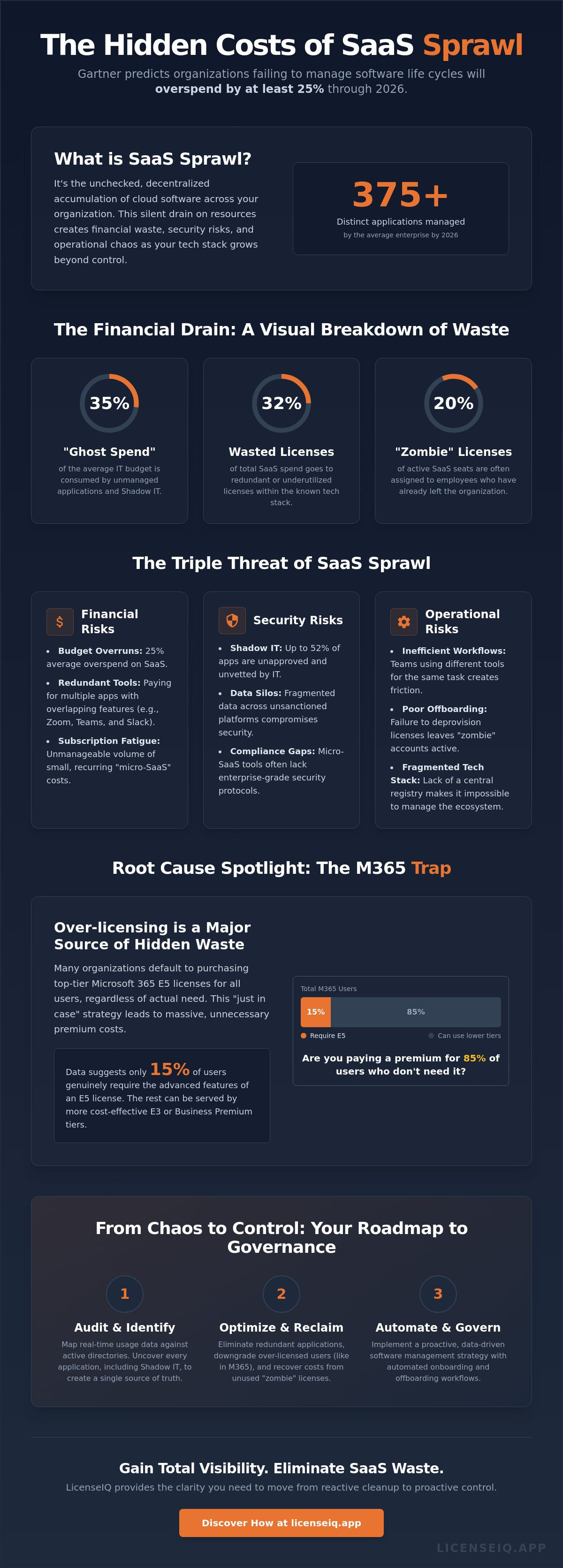
Gartner predicts that organizations failing to centrally manage software life cycles will overspend on SaaS by 25% through 2026. This financial drain is the direct consequence of unmanaged growth. Understanding what is saas sprawl is the first step toward reclaiming your bottom line. As your team scales, your ecosystem becomes a fragmented web of redundant licenses and invisible Shadow IT subscriptions that compromise your security and your margins.
You likely suspect that your software budget is leaking. It's difficult to justify costs when multiple departments use overlapping tools for the same tasks. This guide provides the clarity you need to present a business case for automated governance to leadership. You'll learn how to identify waste, mitigate offboarding risks, and implement a roadmap for license recovery. We're moving from the chaos of unknown spend to the precision of total visibility.
Key Takeaways
- Define what is saas sprawl in the 2026 workplace and recognize how decentralized procurement creates a hidden drain on corporate resources.
- Quantify the "Ghost Spend" that consumes up to 35% of IT budgets while addressing the security gaps left by unmanaged applications.
- Avoid the common "M365 Trap" by aligning license tiers with actual user needs to eliminate unnecessary premium costs.
- Master a streamlined audit framework to map real-time usage data against active directories for total ecosystem visibility.
- Implement automated governance to move beyond reactive cleanup and establish a proactive, data-driven software management strategy.
Defining SaaS Sprawl in the 2026 Digital Workplace
SaaS sprawl is the silent drain on your corporate bottom line. By 2026, the average enterprise manages over 375 distinct applications. When executives ask what is saas sprawl, they are looking at the unchecked, decentralized accumulation of cloud software across their entire organization. This isn't a minor administrative hurdle. It represents a systemic failure to track license utilization and financial waste.
We've reached a tipping point in 2026. The explosion of AI-integrated applications has accelerated this proliferation beyond traditional management capabilities. Departments now bypass central procurement to solve immediate, niche problems with specialized tools. This results in a fragmented tech stack where data silos thrive and budgets leak. You must distinguish between strategic growth and toxic sprawl. Strategic growth adds measurable value; toxic sprawl adds unnecessary redundancy and security vulnerabilities.
The Difference Between SaaS Sprawl and Shadow IT
Many leaders confuse sprawl with Shadow IT. These concepts are related but distinct. Shadow IT refers specifically to unapproved software that employees use without the knowledge or consent of the IT department. It is a primary source of security risk. SaaS sprawl is a broader challenge. It encompasses both these hidden tools and your officially sanctioned stack that has grown too large to manage.
Sprawl often emerges from agile procurement policies. You might have four different project management tools all approved for different teams. While each purchase seemed logical in isolation, the aggregate effect is financial chaos. Data from early 2026 indicates that 32% of SaaS spend is wasted on redundant or underutilized licenses. Understanding what is saas sprawl allows you to identify these overlaps before they impact your fiscal year. LicenseIQ provides the visibility needed to eliminate this waste.
The Proliferation of the "Micro-SaaS" Ecosystem
The 2026 market is saturated with micro-SaaS solutions. These are specialized, single-feature apps designed to plug small gaps in larger platforms. They enter your ecosystem through freemium models or low-cost entry points. A $12 monthly seat seems harmless at first glance. However, when 100 employees subscribe to different micro-tools, your finance department faces massive subscription fatigue.
These small apps often lack enterprise-grade compliance and security. They clutter the digital workplace and complicate employee offboarding. When you lack a clear view of your entire stack, you pay for "ghost" seats long after projects end. Managing this complexity requires a proactive approach that prioritizes transparency over mere convenience. You need to uncover hidden costs to remain a vigilant guardian of your corporate resources.
The Root Causes: Why Software Proliferation Happens Unchecked
SaaS sprawl isn't a random accident. It's the logical result of prioritizing departmental speed over central oversight. When executives ask what is saas sprawl, they're usually looking at the financial fallout of a "buy first, ask later" culture. The 'sprawl' term is used by technology advocates to describe the fragmented environment where software grows faster than the systems designed to track it.
Decentralized procurement is the primary engine of this growth. Every department head now carries a corporate credit card. They solve immediate bottlenecks by subscribing to niche tools without consulting IT. This creates a visibility gap. Industry data shows that up to 52% of SaaS applications in a typical mid-market company are "shadow IT," meaning they don't appear in the official tech stack registry.
Redundancy adds another layer of waste. It's common to find teams using Zoom, Microsoft Teams, and Slack simultaneously for the exact same communication tasks. This feature overlap drains budgets and complicates workflows. Additionally, inadequate offboarding remains a persistent drain. Roughly 20% of active SaaS seats are often "zombie licenses" assigned to employees who left the organization months ago. To fix this, you must understand your SaaS license footprint through a lens of total transparency.
The Hidden Sprawl Within Microsoft 365
Microsoft 365 is often the largest source of hidden waste. Many organizations fall into the "E5 Trap," purchasing top-tier licenses for every user regardless of their actual needs. Data suggests only 15% of users typically require the advanced analytics or security features found in E5. The rest can function perfectly on E3 or Business Premium tiers. This "just in case" upgrading leads to massive overspending. Unassigned and inactive licenses often sit dormant in the tenant for billing cycles. For a structured recovery plan, see this guide on Microsoft 365 License Optimization.
Decentralized Buying and the Death of Centralized IT
Product-Led Growth (PLG) has fundamentally changed how software enters the building. Tools like Notion, Canva, and Airtable target individual contributors directly. This bypasses traditional IT gatekeepers. In modern SMBs, the culture of "permissionless" adoption means software is often deployed before IT even knows it exists. This lack of a unified SaaS license management lifecycle turns IT departments into reactive accountants rather than strategic partners. Without a central point of truth, the organization loses all leverage during contract renewals and vendor negotiations.
The Triple Threat: Financial, Security, and Operational Risks
Understanding what is saas sprawl requires looking beyond the sheer number of icons on an employee's dashboard. By 2026, the average enterprise manages over 350 distinct applications, creating a Triple Threat that erodes profit margins and compromises data integrity. Relying on manual spreadsheets to track this complexity isn't just inefficient; it's a liability. Static tracking methods fail because they can't keep pace with the real-time nature of modern software sprawl, leaving gaps that lead to significant organizational waste.
The Financial Impact: Wasted Spend and License Bloat
Financial waste is the most visible symptom of an unmanaged stack. Industry data indicates that Ghost Spend, or software expenditure that provides zero return, now accounts for up to 35% of total IT budgets. This waste manifests as shelfware, which are licenses purchased but never assigned or used. The problem compounds through annual auto-renewals. Without a centralized system, these contracts renew silently, locking companies into another 12 months of unnecessary costs. Comparing LicenseIQ vs. Manual Tracking reveals that automated visibility can reclaim thousands in monthly spend by identifying these dormant accounts before the renewal window closes.
Security and Compliance: The Danger of the Unknown
Shadow IT creates massive security blind spots. When employees sign up for unvetted apps using corporate credentials, they create Zombie Accounts. These accounts often remain active long after an employee leaves the company, providing a permanent entry point for data breaches. This lack of oversight makes achieving GDPR or SOC2 compliance nearly impossible. If you don't know where your data lives, you can't protect it. Organizations must implement a rigorous Office 365 Offboarding Checklist to ensure that departing staff lose access to every single integrated tool, not just the core suite.
The operational tax is equally heavy. Data silos emerge when different departments use conflicting tools to perform similar tasks. This forces employees into a cycle of context switching, which can reduce individual productivity by 40% according to workflow studies. The mental energy spent jumping between disconnected platforms is a hidden cost that slows down every project. In a 2026 market, speed is a competitive advantage. You can't move fast when your team is buried under a fragmented tech stack, which is why identifying what is saas sprawl within your own infrastructure is the first step toward total optimization.
How to Identify and Measure Sprawl in Your Organization
Identifying what is saas sprawl within your specific environment requires a shift from passive observation to active interrogation of your digital environment. You cannot manage what you cannot see. Visibility is the first step toward recovery. Follow this five-step framework to regain control over your software ecosystem.
- Step 1: Conduct a comprehensive audit. Document every M365 seat and third-party SaaS subscription. Research shows that 40% of SaaS spend occurs outside the view of IT departments. You must account for every license to stop the leak.
- Step 2: Map application usage data. Connect your SaaS applications to active user directories like Okta or Azure AD. This reveals which employees actually log into the tools the company pays for.
- Step 3: Identify functional overlaps. Scrutinize your stack for redundancy. Organizations often find they pay for three different CRM tools or four separate project management platforms across different departments.
- Step 4: Calculate your License Health Score. Create a metric based on utilization rates versus seat costs. This score allows you to prioritize recovery efforts on the most expensive, underutilized contracts first.
- Step 5: Establish a continuous monitoring cadence. SaaS environments change daily. A quarterly review is no longer enough to prevent re-sprawl in a fast-moving organization.
Manual Auditing: The Traditional (and Slow) Way
Manual audits rely on credit card statements and expense reports. IT managers often spend 25 or more hours per month chasing department heads for lists of "must-have" tools. This method is inherently reactive. Spreadsheets are static and become obsolete the moment they are saved. Industry data suggests that organizations using manual methods for SaaS tracking overspend by 30% on average due to hidden shadow IT and forgotten subscriptions. It is a labor-intensive process that yields low-accuracy results.
Automated Discovery: The Modern Standard
Modern organizations use AI-native tools to scan tenants in minutes. Real-time utilization tracking provides a live pulse of your software health, while point-in-time snapshots only capture a fleeting moment. Understanding the distinction between cloud cost optimization vs management is critical for your 2026 strategy. Management keeps the lights on; optimization aggressively cuts waste by identifying what is saas sprawl and eliminating it at the source.
Automated discovery uncovers abandoned accounts and redundant subscriptions instantly. It eliminates the dark spend that plagues finance departments. By integrating directly with your tech stack, these tools provide the transparency needed to make data-driven procurement decisions. This proactive approach ensures that your software spend remains lean and purposeful.
Stop guessing and start optimizing your software stack with precision data.
Get full visibility into your SaaS spend with LicenseIQ.From Chaos to Control: Implementing Automated Governance
Reactive cleanup is a trap. Most organizations wait until a budget crisis or a renewal deadline to address what is saas sprawl. By then, the waste is already baked into the fiscal year. True control requires a shift to proactive governance. This means moving away from manual spreadsheets and adopting systems that monitor usage in real-time. LicenseIQ eliminates the guesswork by providing a clear lens into your software environment, specifically targeting high-cost areas like Microsoft 365.
M365 spend often hides significant waste. LicenseIQ automates the discovery of unassigned licenses and over-provisioned users who don't utilize the full suite of premium features. Instead of IT managers chasing down departments, the system sets up automated workflows for license reclamation. If an account remains inactive for 30 days, the software triggers a reclamation protocol. This precision can reclaim up to 35% of a typical software budget, turning wasted capital into accessible liquidity for 2026 initiatives.
- Identify dormant accounts across the entire M365 tenant in seconds.
- Downgrade underutilized E5 licenses to more cost-effective tiers.
- Automate offboarding to ensure licenses are returned to the pool immediately.
Leveraging AI-Native Software Intelligence
The Model Context Protocol (MCP) represents a leap forward in how we manage digital assets. It enables LicenseIQ to bridge the gap between disparate data sources, providing deeper insights into license compliance and vendor terms. We are entering the era of self-healing IT stacks. These systems don't just report problems; they optimize themselves by reallocating resources based on actual demand. Automated Governance is the final evolution of ITAM, where policy-driven software autonomously enforces fiscal and operational compliance.
Next Steps: Securing Your 2026 Budget
Financial hygiene starts with visibility. You cannot manage what you cannot see. Establishing a culture of software transparency ensures that every department is accountable for their digital footprint. This prevents the silent accumulation of shadow IT that drives what is saas sprawl across the enterprise. It transforms IT from a cost center into a strategic partner that maximizes every dollar spent.
Efficiency doesn't require months of planning. You can start a 5-minute audit today to uncover immediate savings. Take the first step toward a leaner, more secure software stack. Start your free License Health Check at LicenseIQ and regain control of your digital environment before the next renewal cycle.
Turn SaaS Chaos Into Financial Clarity
Managing a modern software stack requires more than manual spreadsheets or periodic audits. Understanding what is saas sprawl is the first step toward securing your digital perimeter and protecting your bottom line. Research indicates that unmanaged software leads to a 30% increase in security vulnerabilities across the enterprise. Without automated governance, your organization remains exposed to redundant costs and compliance risks that scale alongside your headcount. You need total visibility to transform your software ecosystem from a financial liability into a strategic asset.
Stop letting invisible licenses drain your IT budget. Recover up to 35% of your M365 spend; get your License Health Score in minutes. Our AI-native scan takes less than 5 minutes to complete. It automatically identifies redundant M365 E3 and E5 licenses and provides immediate, actionable dollar-value recommendations for your team. You'll gain the precision needed to eliminate waste without impacting employee productivity. Take control of your infrastructure and build a leaner, more secure digital workplace today.
Frequently Asked Questions
Is SaaS sprawl the same as Shadow IT?
No, SaaS sprawl isn't identical to shadow IT, though they're closely linked. While shadow IT refers specifically to software used without IT's knowledge, understanding what is saas sprawl requires looking at the total volume of apps, including those that are officially sanctioned but redundant. Gartner estimates that shadow IT accounts for 30% to 40% of IT spending, contributing heavily to the overall sprawl.
How much money does the average company waste on SaaS sprawl?
The average organization wastes approximately 29% of its total software budget on unused or underutilized licenses. This figure comes from the Flexera 2023 State of ITAM report. For a company spending $1 million annually on software, this equates to $290,000 in preventable losses. Eliminating these redundancies directly improves your bottom line and financial health.
What are the first signs that our organization has a SaaS sprawl problem?
The primary indicators include a surge in "miscellaneous" software expenses on corporate credit cards and redundant app functionality across different departments. Research indicates that mid-sized companies now average 371 SaaS applications. If your IT team can't produce a real-time list of every active subscription, you've already lost visibility and control over your stack.
Can SaaS sprawl be managed with a simple spreadsheet?
You can't manage modern software proliferation with a static spreadsheet. Manual tracking is reactive and prone to human error, often missing up to 50% of an organization's actual SaaS footprint. Real-time discovery tools are necessary to identify hidden costs and security gaps that a manual document simply won't catch. Efficiency requires automated data feeds.
How does Microsoft 365 contribute to SaaS sprawl?
Microsoft 365 contributes to sprawl when teams adopt third-party tools that duplicate existing M365 features. BetterCloud research shows that 65% of organizations pay for at least two apps that perform the same function, such as using Slack or Zoom while already paying for Microsoft Teams. This overlap inflates costs without adding any unique operational value.
What is the best way to prevent SaaS sprawl during employee offboarding?
Automation is the only reliable way to handle offboarding. Relying on manual checklists leads to "zombie accounts" where former employees retain access to sensitive company data. A 2023 study found that 25% of ex-employees still have active credentials. Integrating your SaaS management platform with your HR system ensures immediate license reclamation and data security.
Does SaaS sprawl affect company security or just the budget?
Security is at greater risk than your budget. Unmanaged apps create "dark data" silos and unmonitored entry points for attackers. When you ask what is saas sprawl, you must consider the 2023 IBM report showing the average data breach cost reached $4.45 million. Each unvetted app increases your organization's attack surface and compliance risk.
How often should a company conduct a SaaS license audit?
Conduct a comprehensive SaaS license audit every 90 days. Waiting for an annual review allows 12 months of wasted spend to accumulate and security risks to go unnoticed. Organizations that move to a quarterly cadence achieve a 20% higher rate of cost optimization compared to those using annual cycles. Regular audits ensure your software stack remains lean and efficient.


