

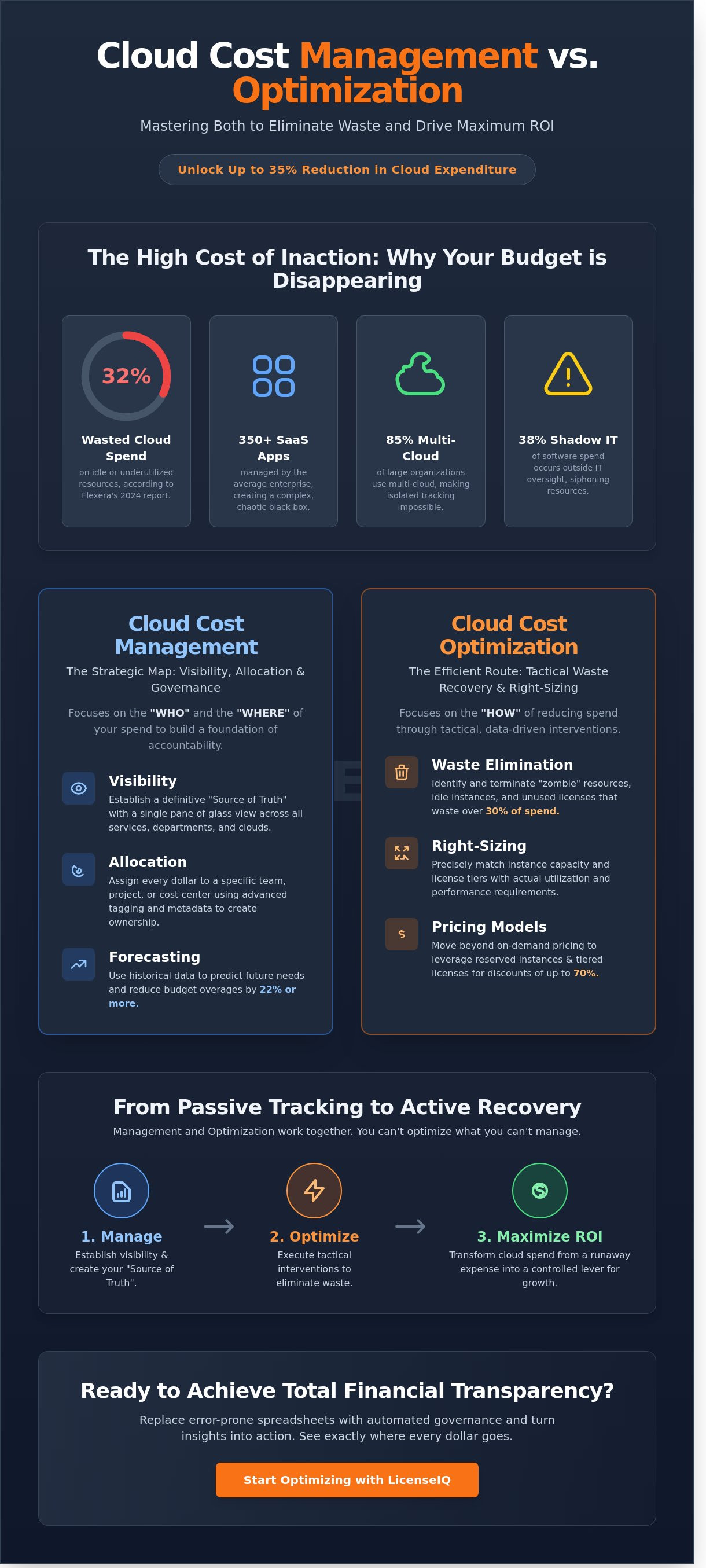
Flexera's 2024 State of the Cloud Report reveals that 32% of cloud spend is wasted on idle or underutilized resources. This waste isn't just a tracking error; it's a strategic gap. Understanding the specific nuances of cloud cost optimization vs management is the difference between watching your budget disappear and actively reclaiming it.
You've likely felt the frustration of M365 and SaaS sprawl as manual spreadsheets fail to provide the visibility you need. It's difficult to justify costs to stakeholders when you're stuck in a reactive cycle of chasing invoices and overages. You need a way to turn the lights on across your entire digital estate to see exactly where every dollar goes.
This guide delivers a precise framework to master both disciplines, helping you eliminate waste and drive maximum ROI. You'll discover actionable steps to reduce your cloud expenditure by up to 35% using data-driven decision-making. We're moving beyond simple tracking to a future of proactive recovery and total financial transparency.
Key Takeaways
- Establish a definitive "Source of Truth" by using advanced tagging and metadata to gain total visibility into complex cloud environments.
- Master the critical distinctions of cloud cost optimization vs management to transition from passive budget tracking to active waste recovery.
- Implement precise right-sizing methodologies to identify over-provisioned licenses and align your software spend with actual utilization.
- Replace manual, error-prone spreadsheets with automated governance workflows to maintain real-time accuracy in high-velocity SaaS ecosystems.
- Shift your financial strategy from simply identifying who spent the budget to executing tactical interventions that drive maximum ROI.
Defining Cloud Cost Management and Optimization in 2026
By 2026, the average enterprise manages over 350 distinct SaaS applications. This complexity turns cloud spend into a chaotic black box where money disappears into unused licenses and idle instances. You can't fix what you can't see. Effective Cloud management provides the necessary visibility to stop the financial bleed. Understanding cloud cost optimization vs management starts with recognizing their distinct roles. Management is your strategic map; it defines the boundaries and tracks the movement. Optimization is the shorter route. It finds the most efficient, cost-effective path to your business goals without sacrificing performance.
The 2026 landscape demands a unified approach. Multi-cloud environments are now the standard for 85% of large organizations, making isolated tracking impossible. Without a centralized system like LicenseIQ, your data remains siloed. Management ensures you're on the right road, while optimization ensures you're driving the most efficient vehicle. Together, they transform cloud spend from a runaway expense into a controlled lever for growth.
The Core Pillars of Cloud Cost Management
Management focuses on governance and accountability. It's the "who" and the "where" of your spend. It creates the framework for fiscal responsibility across the entire organization.
- Visibility: You need a single pane of glass. This means knowing exactly which services are active across every department in real time.
- Allocation: Stop guessing. Assign every dollar to a specific team, project, or cost center. This creates a culture of accountability where teams own their consumption.
- Forecasting: Use historical data to predict future needs. Organizations that master forecasting can reduce surprise budget overages by 22% or more.
The Core Pillars of Cloud Cost Optimization
Optimization is tactical and results-driven. It's the "how" of reducing spend. It requires constant adjustment to ensure you aren't paying for resources you don't need. This is where cloud cost optimization vs management becomes a functional reality.
- Waste Elimination: Identify and kill "zombie" resources. Industry data suggests that 30% of cloud spend is wasted on resources that are never used.
- Right-Sizing: Match your capacity to your actual performance requirements. Don't pay for a high-performance tier when a standard instance handles the load.
- Pricing Models: Move beyond on-demand pricing. Leverage reserved instances, spot instances, or tiered license structures to secure discounts of up to 70% on predictable workloads.
The Pillar of Management: Visibility, Allocation, and Governance
Cloud cost management serves as the foundation for every successful digital infrastructure. It creates a definitive Source of Truth that aligns financial teams with IT leaders. Without this baseline, any attempt to evaluate cloud cost optimization vs management becomes a guessing game. You must know exactly what you own before you can determine what it should cost. Effective management transforms a chaotic cloud environment into a structured financial asset through rigorous metadata application.
Tagging is the primary tool for this transformation. Every resource requires a specific owner, a department code, and a clear business purpose. This level of organization allows companies to set realistic budgets that align with growth objectives rather than reacting to surprise invoices. It establishes the guardrails necessary to prevent Shadow IT from siphoning resources. When 38% of software spend occurs outside the IT department's oversight, these management protocols become a financial necessity.
The Visibility Gap: Why You Can’t Manage What You Can’t See
The danger of unassigned licenses and "zombie" resources is a constant threat to the bottom line. Idle instances and abandoned storage volumes drain capital every hour they remain active. Relying on monthly manual audits is a failing strategy. By the time a discrepancy appears on a monthly statement, the capital is already lost. Real-time monitoring provides the only viable solution for modern enterprises. SaaS Sprawl is the silent killer of modern IT budgets.
Eliminating this gap requires a proactive approach to license utilization. Many organizations pay for premium features that remain untouched by 70% of their user base. Management identifies these discrepancies immediately. Identifying these hidden costs is the first step toward a leaner infrastructure. You can start by auditing your current stack with LicenseIQ to find immediate savings and reclaim wasted spend.
Strategic Governance Frameworks
Governance defines who has the authority to provision new cloud resources and under what conditions. It moves the organization away from a "wild west" deployment style toward a disciplined operational model. This structure separates basic cloud cost management and FinOps practices from reactive firefighting. A mature framework includes automated alerts that trigger the moment spending exceeds 10% of the allocated budget. This ensures that minor configuration errors don't escalate into five-figure financial disasters.
Integration is the final piece of the governance puzzle. Cost management shouldn't exist in a silo. It must be woven into standard operating procedures, such as integrating governance steps into your Office 365 offboarding checklist. This ensures that when an employee leaves, their associated licenses are reclaimed and reallocated instantly. This meticulous attention to detail protects corporate resources and maintains a relentless focus on operational transparency.
The Pillar of Optimization: Tactical Waste Recovery and Right-Sizing
Cloud cost management identifies the leak; cloud cost optimization plugs it. This distinction is the core of the cloud cost optimization vs management debate. Management provides the necessary visibility, but optimization executes the recovery. You move from spending awareness to spending efficiency through decisive action. It's the difference between seeing a $10,000 overage and reclaiming it through technical adjustments.
The methodology of right-sizing is your most potent tool. Many organizations default to high-tier licenses, such as Microsoft 365 E5, for their entire workforce. However, data analysis often reveals that 40% of those employees only utilize features found in the E3 tier. This mismatch creates silent financial hemorrhaging. By aligning license tiers with actual user requirements, you eliminate waste without degrading performance. This technical alignment is a central theme in any comprehensive review of cloud cost optimization strategies, which highlights how resource allocation directly dictates fiscal health.
Financial impact also extends to commitment coverage. Utilizing Reserved Instances (RIs) and Savings Plans can stabilize your budget, but they require precise forecasting. Optimization ensures you aren't just buying commitments for the sake of it, but rather covering the steady-state workloads that management has already identified as essential.
Identifying and Reclaiming Wasted SaaS Spend
Waste often hides in plain sight within your Microsoft 365 tenant. Inactive users alone can account for up to 35% of total SaaS spend. These are orphaned accounts from former employees or service accounts that no longer serve a purpose. A 5-minute audit can reveal immediate dollar-value recommendations by scanning for these redundant licenses. To automate this discovery and maintain total visibility, tools like LicenseIQ provide a direct path to recovery. Stop guessing where the money goes. Use automated scanning to find every unassigned or underutilized seat in your stack.
The Right-Sizing Workflow
Optimization isn't a one-time event; it's a continuous cycle. A static audit fails because cloud environments are dynamic. Your workflow must analyze user behavior to determine if high-tier licenses are actually utilized. If an employee hasn't opened Power BI or used advanced security features in 90 days, they don't need an E5 license. Downsizing these accounts is a surgical process. It reduces costs while ensuring productivity remains untouched. Successful cloud cost optimization vs management strategies rely on this constant loop of monitoring, analyzing, and adjusting. You don't just find the waste once; you build a system that prevents it from returning.
- Analyze actual feature utilization daily.
- Automate the downgrade of underutilized accounts.
- Reclaim licenses from departed staff within 24 hours.
Cloud Cost Optimization vs Management: A Comparison Framework
Cloud cost management answers the question: "Who spent the budget?" Cloud cost optimization answers the question: "How do we spend less?" These are distinct disciplines. Management is a continuous state of visibility and accountability. It keeps the lights on and ensures departments stay within their allocated limits. Optimization, however, consists of tactical interventions. It's the active process of rightsizing resources and eliminating the 28% of cloud spend that Flexera’s 2023 State of the Cloud Report identifies as wasted.
Most SMBs stall after implementing management tools. They see the data but lack the framework to act. Management focuses on the bottom line to prevent overages. Optimization focuses on the ROI of every dollar. It isn't enough to know you spent $10,000 on SaaS licenses last month. You need to know if $3,000 of that spend supported inactive accounts. Without optimization, management is simply a documented record of inefficiency.
Key Differences at a Glance
- Scope: Management is organizational and financial. Optimization is technical and behavioral.
- Primary Goal: Management ensures compliance and budget adherence. Optimization secures profit-margin protection.
- Outcome: Management produces reports for stakeholders. Optimization produces bankable savings for the balance sheet.
The Symbiotic Relationship
Optimization is impossible without the data management provides. Think of management as the "Health Score" for your infrastructure. It highlights where the bleeding is most severe so you can prioritize your interventions. You can't rightsize a database if you don't have three months of utilization logs to prove it's over-provisioned. Data creates the roadmap; optimization is the vehicle.
Automated governance bridges this gap, especially for Microsoft 365 users. A 2023 study indicated that 56% of Microsoft 365 licenses are unassigned, inactive, or underutilized. Management flags these licenses in a monthly report. Optimization uses automated workflows to de-provision those seats the moment a user leaves the company or stops using the app. This turns a passive observation into immediate capital recovery.
Stop watching your budget disappear and start reclaiming your software spend. Book a LicenseIQ demo to turn visibility into actual savings.
Beyond Manual FinOps: Moving Toward Automated Governance
Manual FinOps teams can't keep pace with high-velocity SaaS growth. Traditional management relies on static spreadsheets that expire the moment they're saved. This creates a widening gap in your cloud cost optimization vs management strategy. Optimization requires immediate action. Management often settles for historical reporting. By 2026, Gartner predicts 60% of organizations will automate cloud governance to stop financial leakage. Automated workflows replace manual data entry with programmatic precision. They provide the visibility required to control spend before it impacts your bottom line.
- Eliminate human error inherent in manual data entry.
- Gain real-time visibility into software utilization.
- Scale governance without increasing headcount.
- Shift from reactive reporting to proactive recovery.
The Rise of AI-Native Software Intelligence
AI-native software intelligence represents the future of fiscal discipline for IT leaders. These platforms connect to your SaaS tenants in under 10 minutes to analyze usage data. They deliver an instant Health Score that identifies exactly where your organization is overspending. Using the Model Context Protocol, these tools automate license reclamation across your entire software ecosystem. AI identifies subtle patterns of waste, such as redundant feature sets and license duplication, that human auditors consistently miss. This precision is the cornerstone of microsoft 365 license optimization. It converts a grueling manual audit into a hands-free recovery process that runs in the background.
Implementing a Continuous Savings Engine
Continuous savings engines replace the outdated audit-and-forget mentality. Modern enterprises need automated workflows that trigger immediately during employee offboarding. This ensures instant license recovery and maintains 100% financial accuracy across all departments. Perpetual scanning monitors utilization 24/7, ensuring every subscription delivers measurable value to the business. This proactive stance eliminates zombie licenses where costs accumulate for months after a user has departed. It's the most effective way to maintain the balance in your cloud cost optimization vs management framework. You stop being reactive and start being strategic.
Scan your tenant for free with LicenseIQ to see your Health Score and uncover hidden savings today.
Future-Proof Your Cloud Financial Health
The boundary between cloud cost optimization vs management is the defining factor for operational efficiency in 2026. Management provides the essential visibility and governance framework to identify every asset in your stack. Optimization delivers the tactical execution needed to eliminate waste and right-size your environment. Relying on one without the other creates blind spots that lead to unchecked spend and operational friction.
Success in this landscape requires moving beyond manual FinOps toward AI-native automation. IT and finance leaders must prioritize systems that offer immediate clarity rather than buried data. By implementing automated governance workflows, you eliminate the risk of shadow IT and ensure your software utilization remains at peak levels. It's time to replace the chaos of unmanaged subscriptions with a vigilant, data-driven approach to resource allocation.
Discover your M365 Health Score in minutes with LicenseIQ and secure your organization’s financial future. Our platform allows you to save up to 35% on software subscriptions using AI-native automated governance workflows. You'll receive your Health Score recommendations in under 5 minutes. Turn your software spend into a competitive advantage today.
Frequently Asked Questions
What is the main difference between cloud cost optimization and management?
Cloud cost management provides the visibility and reporting necessary to track spending, while cloud cost optimization focuses on the active reduction of waste and the improvement of resource efficiency. Management identifies where your budget goes across various departments. Optimization uses that data to downsize underutilized instances or terminate idle resources. Understanding the nuances of cloud cost optimization vs management is the first step to reclaiming your IT budget.
Can I do cloud cost optimization without management tools?
You can perform manual optimization using native cloud portals and spreadsheets, but this method often misses 30% of hidden savings opportunities. Manual tracking lacks the real-time visibility required to catch sudden price spikes or instances of shadow IT. Automated tools eliminate human error and provide the precision needed to manage complex SaaS stacks effectively and profitably.
How much can a company typically save through cloud cost optimization?
Organizations typically reduce their cloud spend by 20% to 30% within the first six months of implementing a dedicated strategy. According to the 2023 State of the Cloud Report, average waste accounts for 28% of total cloud budgets. Proactive optimization identifies these specific inefficiencies, turning wasted capital into reinvestment opportunities for your core business operations.
Is cloud cost optimization a one-time project or a continuous process?
Cloud cost optimization is a continuous lifecycle that must occur daily to match the dynamic nature of modern cloud environments. SaaS usage fluctuates constantly, meaning a configuration that's efficient today might be wasteful by next Friday. Continuous monitoring ensures your infrastructure scales down during low-traffic periods, preventing unnecessary charges from accumulating on your monthly invoice.
What are the biggest challenges in cloud cost management for SMBs?
The primary challenges for SMBs are shadow IT and a lack of granular visibility into department-level spending. Small businesses often see 32% of their software budget wasted on unused licenses because they lack a centralized management system. Without clear data, these organizations struggle to negotiate renewals or identify redundant applications that drain their financial resources.
How does FinOps relate to cloud cost optimization and management?
FinOps is the cultural framework that integrates cloud cost optimization vs management into a single collaborative practice. It brings finance, engineering, and business teams together to take ownership of their cloud usage and spending. This alignment ensures that every technical decision is backed by financial data, driving maximum business value from every dollar spent on infrastructure.
What is a License Health Score and why does it matter?
A License Health Score is a metric from 0 to 100 that quantifies the efficiency and compliance of your software assets. A score below 70 indicates high waste or significant legal risk from over-provisioning or under-utilization. Monitoring this score gives you immediate clarity on which vendors require urgent attention during your next renewal cycle to avoid financial penalties.
Does cloud cost optimization affect the performance of my applications?
Proper optimization improves application performance by aligning resource allocation with actual demand patterns. Right-sizing ensures your workloads have exactly what they need, which often eliminates the latency caused by misconfigured or bloated instances. It's about precision rather than just cutting costs, ensuring your infrastructure remains robust while staying lean and cost-effective.


