

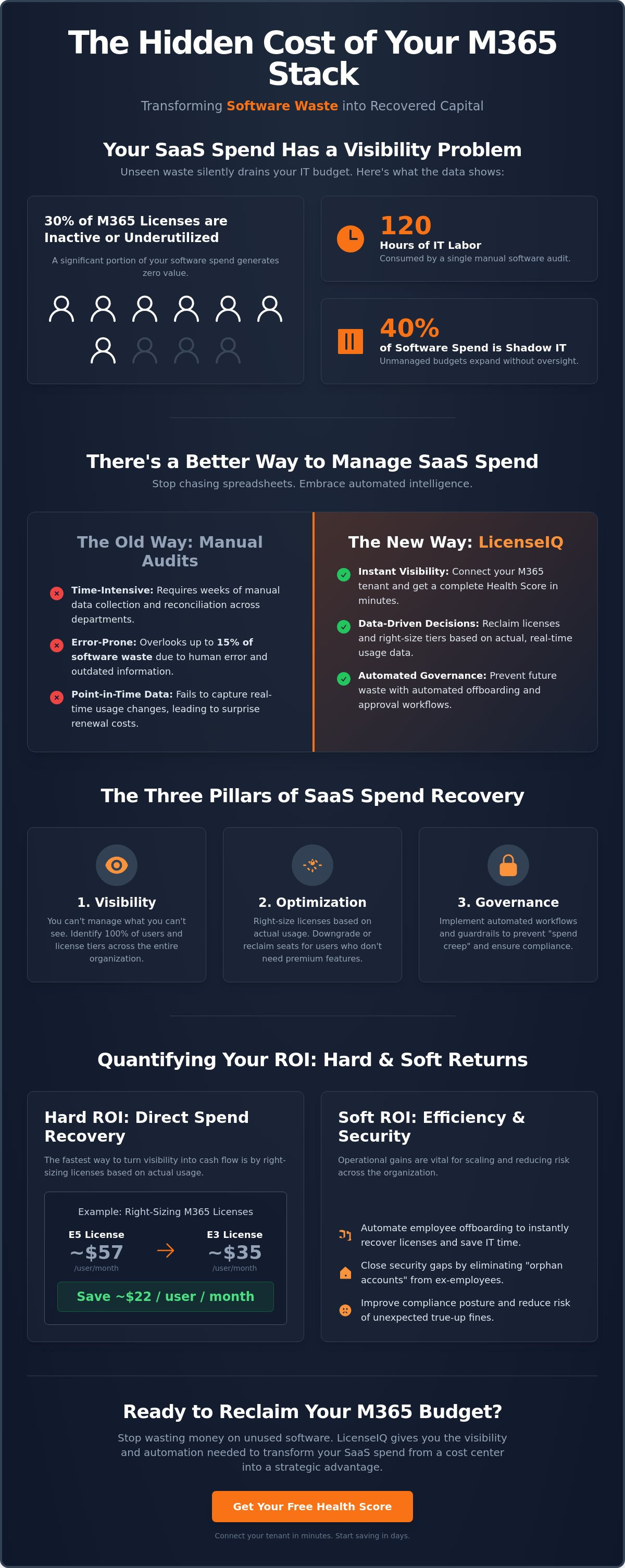
Research indicates that 30% of Microsoft 365 licenses in the average organization are currently inactive or underutilized. This hidden waste creates a silent drain on your IT budget that manual audits, which often consume 120 hours of IT labor, fail to capture in real time. Proving a high saas spend management roi is difficult when you're blinded by shadow IT and surprise renewal costs. It's a common challenge for finance leaders who need to justify every dollar spent on the software stack while maintaining operational agility.
This article delivers a precise framework to quantify the financial impact of your software intelligence by identifying exactly where optimization converts into recovered capital. We'll show you how to move beyond manual spreadsheets and implement automated governance that prevents future sprawl. You'll learn how to transform M365 from a black hole of expense into a lean, optimized engine of productivity through data-driven decision-making and total visibility.
Key Takeaways
- Define the precise metrics required to quantify saas spend management roi and demonstrate tangible financial impact to executive leadership.
- Identify hidden waste by distinguishing between direct subscription savings and the operational gains recovered through automated license reclamation.
- Learn why manual audits often overlook 15% of software waste and how to eliminate human error with specialized software intelligence.
- Implement a structured 30-day roadmap to transform unmanaged software stacks into fully optimized, high-visibility environments.
- Leverage an automated Health Score to pinpoint your most significant cost-recovery opportunities within minutes of connecting your M365 tenant.
What is SaaS Spend Management ROI?
SaaS spend management ROI is the measurable financial gain and operational efficiency recovered through specialized oversight of software subscriptions. It quantifies how much capital a company reclaims by eliminating waste and streamlining internal workflows. This practice aligns with the broader framework of Software Asset Management, ensuring every digital resource serves a strategic purpose. For CFOs heading into 2026, this metric is the primary indicator of fiscal health. Software costs now represent the fastest-growing expense category, often trailing only payroll in total volume.
Calculating saas spend management roi requires looking at two distinct categories: hard and soft returns. Hard ROI delivers direct cash savings. It involves terminating 50 unused seats or downgrading 100 users from premium to basic tiers based on actual usage. Soft ROI focuses on risk mitigation and time recovery. When a platform like LicenseIQ automates a task that previously required an IT manager to spend 15 hours a month on manual spreadsheets, that is soft ROI. We measure this success through the License Health Score. This KPI tracks the ratio of active utilization against total spend, providing a single data point for executive review.
The Three Pillars of SaaS Spend Recovery
Visibility is the first requirement. You cannot manage what you cannot see. This involves identifying 100% of users and license tiers across the entire organization. Optimization follows by right-sizing licenses. If a user only opens an app once a month, they do not need an enterprise-grade seat. Finally, governance implements automated workflows. These guardrails prevent "spend creep" by ensuring new subscriptions follow a standardized approval process.
The Cost of Inaction (COI)
Ignoring software waste is an expensive choice. Unassigned or inactive Microsoft 365 licenses can waste $30 per user every month. For a company with 500 employees, even a 10% waste rate results in $18,000 lost annually. Manual auditing adds to this burden. IT staff often spend 40 hours per quarter verifying logins, costing thousands in redirected labor. Shadow IT accounts for 40% of software spend in the average enterprise. Without a strategy for saas spend management roi, these unmanaged budgets continue to expand without oversight or security compliance.
The Components of SaaS ROI: Beyond the Subscription Price
Calculating saas spend management roi involves more than tallying vendor discounts. True value emerges when you align software costs with actual business utility. Most organizations overspend because they lack visibility into their stack; they pay for what they think they need rather than what they use. High-performing teams treat software intelligence as a continuous audit process rather than a once-a-year renewal event.
Hard ROI: Direct Spend Recovery
Direct savings provide the most immediate impact on the bottom line. Spend recovery is the immediate reclamation of unused capital. This process starts by identifying inactive users who haven't logged into a platform for 30 days or more. Removing these dormant seats yields instant monthly subscription reductions. It's the fastest way to turn visibility into cash flow.
Financial leaders find significant gains by right-sizing license tiers. Shifting a user from a Microsoft 365 E5 to an E3 license can save approximately $22 per user every month. When applied across a 500-person department where premium features aren't required, this single adjustment recovers $132,000 annually. Industry data from 2024 shows that 38% of SaaS licenses remain completely unused, representing a massive pool of trapped capital waiting for reclamation.
Soft ROI: Efficiency and Security
Operational gains are harder to track on a balance sheet but remain vital for scaling. Manual offboarding is a drain on IT resources. Automating this process ensures licenses are recovered instantly when an employee leaves. This eliminates the "orphan account" problem where companies pay for ex-employees for months. It also closes security gaps that hackers exploit through unmonitored entry points.
Shadow IT remains a persistent threat to both budget and security. Continuous AI-native monitoring reveals applications purchased on corporate credit cards outside of official channels. Current SaaS Investment Trends indicate that decentralized purchasing is increasing app sprawl, making central visibility a requirement for survival. By consolidating these rogue applications, you improve your compliance posture for external software audits and reduce the risk of unexpected true-up fines.
Recovered funds shouldn't just sit in the bank. Strategic value comes from using those saved dollars to fund high-impact digital transformation projects. When you eliminate waste, you create a self-funding mechanism for innovation. You can audit your current stack to find these hidden opportunities and optimize your total saas spend management roi today.
Calculating the ROI: Management Platforms vs. Manual Audits
Quantifying your saas spend management roi starts with a cold look at labor costs. Manual audits aren't just tedious; they're expensive. When a Senior IT Admin earning $65 per hour spends 20 hours cross-referencing CSV exports, the company loses $1,300 in productivity alone. This figure doesn't include the opportunity cost of stalled strategic projects. Manual processes turn high-value engineers into data entry clerks.
The Manual Audit Trap
Spreadsheets are the graveyard of software budgets. Human auditors often miss up to 15% of waste because they can't track granular usage data across complex M365 tiers. Distinguishing between a user who needs E5 security features and one who only uses E3 core apps is nearly impossible via manual inspection. This gap leads to over-provisioning that stays hidden for months or years.
The biggest flaw is the "Point-in-Time" problem. A manual audit is obsolete 24 hours after completion. New hires join. Employees depart. License assignments shift. Without continuous monitoring, your data is a historical artifact, not a management tool. To see how much you're leaving on the table, conduct a SaaS License Health Check to stop the bleed immediately.
The Automation Advantage
LicenseIQ replaces weeks of manual labor with a 5-minute scan. It delivers total visibility in the time it takes to brew a cup of coffee. Instead of static monthly reports, you get a real-time dashboard that reflects your current environment. This speed is critical for maintaining a high saas spend management roi as your organization scales.
- AI-Driven Recommendations: Software intelligence identifies underutilized accounts that human eyes overlook; it suggests downgrades based on actual feature usage.
- Instant Scalability: The platform manages 5,000 licenses as easily as 50. ROI actually improves as complexity increases because the manual alternative becomes physically impossible.
- Proactive Alerts: Stop reacting to invoices. Start preventing overspend before the billing cycle closes.
Automation eliminates the 15% error margin inherent in manual tracking. It shifts your IT team from data entry to data-driven decision-making. You gain a vigilant digital auditor that never sleeps. This ensures every dollar spent on M365 or other SaaS tools contributes directly to your bottom line without the risk of human oversight.
Implementation Strategy: How to Maximize ROI in 30 Days
Achieving a high saas spend management roi doesn't require months of manual auditing. You can realize significant savings within a single billing cycle by following a structured, data-driven deployment. Speed is your greatest asset in eliminating waste. The following five steps transform your software stack from a black hole of expenses into a lean, optimized engine.
- Step 1: Connect your M365 tenant. This provides an instant baseline scan, pulling metadata directly from the source to reveal every active and inactive license.
- Step 2: Analyze the Health Score. Use this metric to prioritize high-value recovery opportunities. It highlights where your financial leaks are largest.
- Step 3: Execute "Right-Sizing." Act immediately to downgrade users to appropriate tiers or reclaim licenses that show zero activity.
- Step 4: Establish automated governance. Build workflows for new user provisioning to ensure you don't over-provision licenses the moment a new hire joins.
- Step 5: Review the Spend Recovery Dashboard. Quantify your monthly savings in real-time to demonstrate immediate value to stakeholders.
Quick Wins: The Low-Hanging Fruit
Identify "Zombies" first. These are users who haven't logged in for 90+ days but still hold premium licenses. These accounts often represent 15% to 20% of wasted spend in enterprise environments. Another immediate win involves reclaiming licenses from former employees. If your offboarding process is manual, you're likely paying for seats that should have been closed months ago. Follow this Office 365 Offboarding Checklist to secure your data and stop the financial bleed instantly.
Long-Term Optimization: Right-Sizing
True saas spend management roi comes from aligning license tiers with actual feature adoption. Many organizations pay for E5 licenses when the user only requires E3 capabilities. For example, if an employee doesn't use Power BI Pro or advanced security features, the upgrade cost is pure waste. Evaluate the M365 E3 vs. E5 breakdown to see if your 2026 upgrade plans actually deliver value. Continuous monitoring prevents waste from recurring. Set up alerts that trigger when a user's activity drops below a specific threshold, allowing you to reallocate resources before the next billing cycle begins.
Ready to uncover hidden savings in your software stack? Start your 30-day recovery plan with LicenseIQ and gain total visibility into your SaaS spend.
LicenseIQ: Automating M365 Spend Recovery
Visibility is the only cure for software waste. LicenseIQ provides that clarity instantly. By connecting directly to your Microsoft 365 environment in minutes, the platform eliminates the guesswork that plagues IT departments. The system immediately generates a comprehensive Health Score. This score provides a clear baseline for your current license efficiency. Most SMBs discover they're overspending by up to 35% on underutilized or redundant licenses. This is the fastest way to realize a high saas spend management roi without the burden of manual spreadsheets or month-long audits.
The platform doesn't just show you data; it provides a roadmap for recovery. It identifies inactive users, detects license overlaps, and flags accounts that haven't been accessed in over 90 days. You get a list of exactly which licenses to downgrade or reassign. This precision ensures that your software stack remains lean and aligned with your actual headcount.
AI-Driven Governance for Modern SMBs
LicenseIQ leverages the Model Context Protocol (MCP) to automate license management at scale. This isn't a passive dashboard. It's a proactive digital auditor. The platform provides real-time dollar-value insights that make ROI reporting effortless for IT leaders. You can present hard numbers to finance, showing exactly how much capital was reclaimed from the M365 budget.
LicenseIQ is the specialist alternative to bloated, generic SaaS management tools. While generalist platforms provide surface-level data across hundreds of apps, LicenseIQ dives deep into the Microsoft ecosystem. It uncovers hidden costs that generic tools often miss, such as mismatched feature sets or forgotten premium add-ons. It turns raw utilization data into actionable intelligence, allowing you to govern your environment with absolute precision. This focused approach ensures that your saas spend management roi is maximized where you spend the most.
Start Your 5-Minute Audit
The journey to total visibility begins with a simple connection process. You don't need a complex implementation plan or external consultants. You need five minutes. Once you authorize the connection to your M365 tenant, the engine begins its analysis. Your first Spend Recovery report will highlight immediate savings opportunities, often totaling thousands of dollars in annual spend.
- Instant Visibility: Identify every active and inactive license across your organization.
- Dollar-Value Reporting: See the exact cost of waste in your preferred currency.
- Automated Recommendations: Receive step-by-step instructions on how to reclaim your budget.
- Continuous Monitoring: Stop sprawl before it starts with ongoing utilization tracking.
Stop overpaying for seats your team doesn't use. Take control of your software budget and prove the value of your IT operations. Optimize your M365 licenses with LicenseIQ today and secure your 5-minute audit report.
Turn Software Insights Into Immediate Financial Recovery
Maximize your saas spend management roi by shifting from reactive auditing to proactive software intelligence. Manual spreadsheets can't keep pace with the complex sprawl of modern license ecosystems. You need total visibility to eliminate shadow IT and reclaim wasted resources within your first 30 days of implementation. LicenseIQ provides the antidote to unmanaged software stacks by replacing manual guesswork with AI-native precision designed specifically for SMBs. Our platform automates governance so you can focus on strategic growth rather than tedious license reconciliation.
Don't let budget leaks compromise your bottom line. You can recover up to 35% of wasted M365 spend by identifying underutilized seats and redundant subscription tiers. This isn't just a simple cost-cutting exercise; it's a calculated move to secure your organization's financial health. Efficiency isn't a luxury; it's a requirement for modern IT and finance leaders who demand transparency. Get the clarity your organization deserves and stop paying for what you don't use. It's time to bring your software spend into the light.
Get Your Free M365 Health Score in 5 Minutes
Frequently Asked Questions
How do you calculate the ROI of a SaaS management tool?
You calculate the return by subtracting the tool's annual cost from the total savings achieved through license reclamation and contract negotiations, then dividing by the tool's cost. Gartner reports that organizations using SaaS management platforms typically reduce spending by 30 percent within the first year. This calculation provides a clear metric for saas spend management roi by focusing on hard cost avoidance. It transforms abstract software costs into measurable financial gains.
What is a typical ROI for SaaS spend management in an SMB?
SMBs typically see a return of 3x to 5x their initial investment within 12 months. According to 2023 industry benchmarks, small businesses often waste 38 percent of their SaaS budget on unused or underutilized seats. By eliminating this waste, a company spending $200,000 annually on software can recover $76,000. This immediate capital injection proves the value of proactive spend oversight and eliminates the financial drag of software sprawl.
Can I manage M365 licenses effectively using just the Microsoft Admin Center?
No, the Microsoft Admin Center provides raw data but lacks the granular utilization insights needed for true optimization. It shows who has a license, but it doesn't automatically flag users who haven't opened Excel or Teams in 90 days. Manual tracking in the portal often leads to 20 percent license over-provisioning. LicenseIQ bridges this gap by providing actionable intelligence that the native portal ignores, ensuring you don't pay for idle seats.
How much time can automation save my IT team on license management?
Automation reduces the time spent on manual license audits by 80 percent. Instead of spending 15 hours a month cross-referencing spreadsheets with login logs, IT managers can review automated reclamation workflows in under 30 minutes. This efficiency allows your team to focus on high-value security projects rather than administrative tasks. It eliminates the manual burden that leads to human error and data silos across your organization.
What are the hidden costs of unmanaged SaaS spend?
Hidden costs include redundant application subscriptions, automatic renewals for canceled projects, and security risks from shadow IT. Research indicates that 40 percent of SaaS spend happens outside of IT's visibility. These "ghost" subscriptions create a financial leak that drains 15 to 20 percent of total software budgets annually. Without a centralized view, you're paying for tools your employees have already abandoned or replaced with unauthorized alternatives.
Is SaaS spend management worth it for companies with fewer than 500 employees?
Yes, because companies with 100 to 500 employees often experience the fastest growth in software sprawl. A typical 200-person firm uses 130 different apps, many of which overlap in functionality. Implementing a strategy for saas spend management roi early prevents the accumulation of technical debt. It ensures that every dollar spent on software scales directly with your headcount, keeping your financial operations lean and efficient during growth phases.
How does LicenseIQ identify inactive users differently than manual reports?
LicenseIQ uses real-time API integrations to track deep activity metrics rather than just the last login date. Manual reports often miss users who log in but don't actually use the software's core features. Our system identifies "zombie" accounts that have been idle for 60 days or more across your entire stack. This precision ensures you only pay for active engagement, providing a level of visibility that manual spreadsheets simply can't match.
What is a "License Health Score" and why does it matter for ROI?
A License Health Score is a numerical rating from 0 to 100 that measures how efficiently your organization uses its software licenses. A score of 60 indicates that 40 percent of your spend is currently wasted on underutilized assets. Improving this score directly correlates with increased ROI and reduced waste. It provides a single, clear metric for leadership to track the success of their cost-saving initiatives and overall digital health.


