

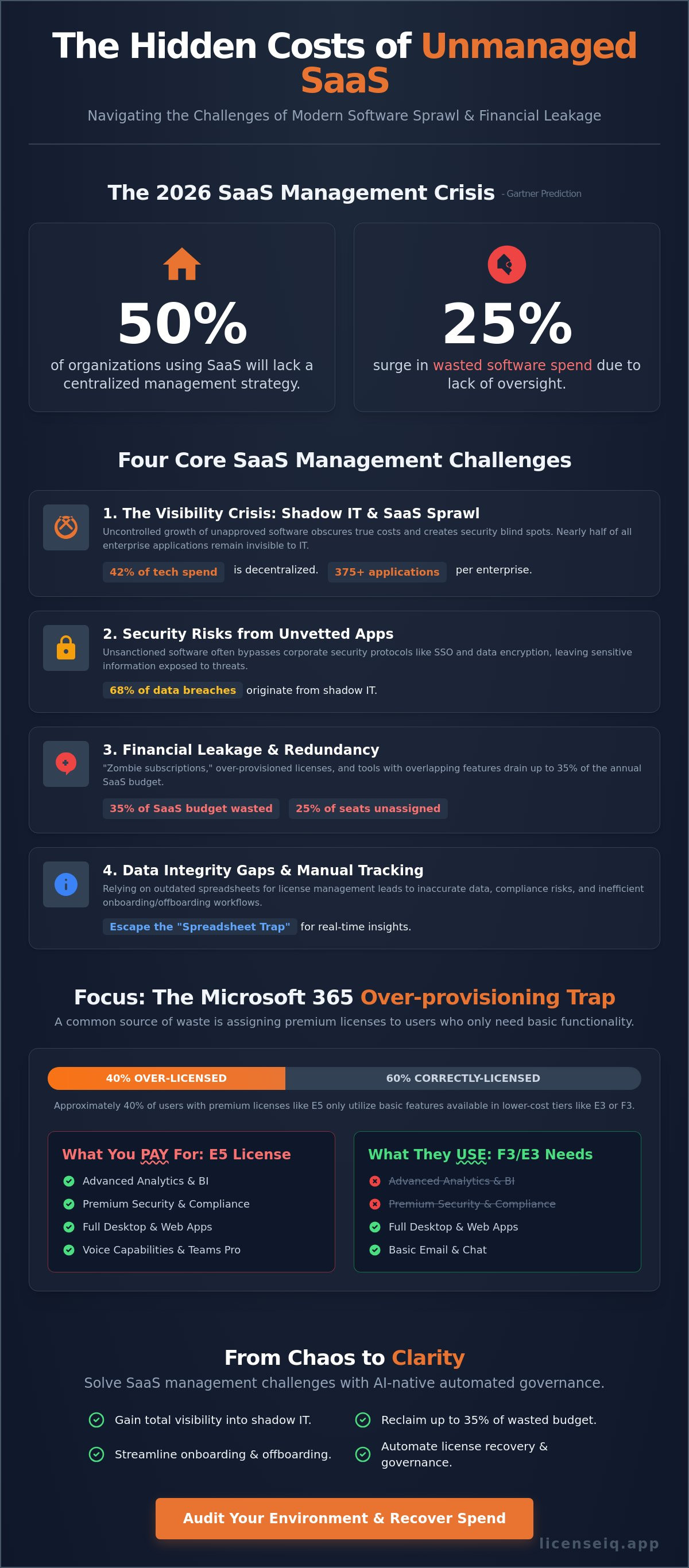
Gartner predicts that by 2026, 50% of organizations using SaaS will lack a centralized management strategy, resulting in a 25% surge in wasted software spend. You've likely felt the frustration of paying for premium Microsoft 365 licensing tiers when users only need basic features, or the anxiety of a former employee retaining access to sensitive data via unmanaged shadow IT. These saas management challenges aren't just IT headaches; they're financial leaks that drain your corporate resources. You know that total visibility is the only way to stop the bleed and restore operational order.
We promise to help you move from the chaos of unmanaged sprawl to the clarity of a precise, automated system. You'll learn how to identify underutilized licenses and implement secure, efficient offboarding workflows that protect your data. This guide breaks down the specific steps to recover your budget and transform your software stack into a lean, high-performance engine for growth.
Key Takeaways
- Eliminate security blind spots and financial leakage by gaining total visibility into shadow IT and uncontrolled software sprawl.
- Reclaim up to 35% of your wasted software budget by identifying redundant subscriptions and inactive users within your ecosystem.
- Boost employee productivity and operational efficiency by streamlining friction-heavy onboarding and offboarding processes.
- Escape the "spreadsheet trap" and ensure data integrity with real-time insights that replace outdated manual tracking.
- Solve modern saas management challenges by deploying AI-native workflows that automate license recovery and governance.
The Visibility Crisis: Shadow IT and SaaS Sprawl in 2026
SaaS sprawl is the uncontrolled growth of software subscriptions across an organization. By 2026, the average enterprise manages more than 375 distinct applications, yet nearly half of these remain invisible to IT departments. This fragmentation obscures the true cost of digital operations and creates a persistent visibility crisis. Shadow IT is the use of IT systems, devices, or software without explicit organizational approval. When individual teams bypass procurement, they trigger financial leakage that erodes profit margins. Recent data indicates that decentralized purchasing now accounts for 42% of total technology spend. This lack of oversight is among the primary saas management challenges that prevent finance leaders from achieving budget predictability.
The Hidden Cost of Shadow IT
Unvetted applications are more than just a budget nuisance; they are a critical security liability. Statistics show that 68% of data breaches in 2025 originated from unsanctioned software. These tools often bypass corporate single sign-on (SSO) and data encryption protocols, leaving sensitive information exposed. Shadow IT also leads to massive resource waste through duplicate functionality. It's common for marketing and sales teams to use different, incompatible CRM add-ons that perform identical tasks. Tracking these decentralized renewals is a manual nightmare. Without a central dashboard, 32% of SaaS contracts renew automatically without a usage review, locking the company into another year of unnecessary expense.
Portfolio Bloat and Redundant Tools
Portfolio bloat occurs when organizations accumulate a surplus of tools with overlapping features. Project management and collaboration suites are the most frequent offenders. Many organizations pay for premium Slack tiers while also maintaining full Microsoft Teams deployments. This feature overlap means you're paying for the same service twice. You can find specific examples and recovery tactics in our Microsoft 365 license optimization guide. Solving these saas management challenges requires absolute transparency. You can't manage what you can't see. Converting unknown spend into visible, optimized assets is the first step toward financial health. LicenseIQ provides the clarity needed to eliminate this digital noise and reclaim your budget.
Financial Leakage: Identifying Wasted Spend and Redundancy
Organizations typically waste 35% of their SaaS budget every year. This financial leakage isn't a result of one single error. It's the cumulative effect of hundreds of small, unmonitored inefficiencies. One of the most persistent saas management challenges is the "zombie subscription." These are licenses tied to specific projects or former employees that continue to bill the company long after the need has vanished. Without a centralized system to track lifecycle changes, these charges persist indefinitely on the balance sheet.
Over-provisioning also drains corporate resources. Finance leaders often approve bulk license purchases to secure volume discounts, but these savings are illusory if seats remain vacant. Data from 2024 shows that roughly 25% of provisioned SaaS seats are never even assigned to a user. This lack of visibility creates a cycle of unnecessary spending that compounds as the software stack grows.
Redundant Licenses and Feature Overlap
License tiers are complex by design. IT leaders often default to top-tier licenses like Microsoft 365 E5 to ensure compliance and security. This leads to massive waste. Approximately 40% of your workforce likely only needs basic email and chat functionality. Paying for an E5 license when an F3 or E3 version suffices is an avoidable drain on capital. To stop the leak, use this checklist to identify overlap:
- Feature Audit: Identify premium features like advanced analytics that are paid for but never enabled in the admin console.
- Tool Redundancy: Scan for multiple tools that serve the same purpose, such as paying for Zoom and Slack Pro while having full access to Microsoft Teams.
- Headcount Alignment: Perform monthly audits to ensure license counts match the actual headcount provided by HR.
To regain total control of your software stack, you can audit your environment with LicenseIQ to eliminate these redundancies immediately.
The Inactive User Problem in Microsoft 365
Inactive users are the primary source of waste in the Microsoft ecosystem. Large organizations often pay for thousands of licenses that haven't seen a login in over 30 days. This issue is amplified for remote teams where tracking Windows 365 spending becomes a logistical hurdle. Virtual desktops are frequently provisioned for contractors or temporary projects and then forgotten.
Manual tracking can't keep up with the pace of modern hiring and offboarding. Automated scanning is the only way to solve this specific saas management challenges. By identifying users who haven't accessed the suite in 30 days, IT can reclaim and reassign licenses. This proactive reclamation turns hidden costs into immediate savings. It moves the organization from a reactive stance to a position of data-driven financial health.
Operational Friction: The Hurdles of Lifecycle Management
Inefficient lifecycle management creates a persistent bottleneck that stalls organizational growth. When onboarding takes days, new hires can't contribute. This delay directly impacts employee productivity and erodes the ROI of your software investments. A 2024 report by Gartner found that employees lose up to 20% of their productive time waiting for tool access. These delays are symptoms of broader saas management challenges that stem from fragmented, manual processes.
Manual workflows are the primary culprit. IT teams often manage permissions through static spreadsheets or email chains. This approach invites human error. One missed step in a manual checklist leaves a door open for unauthorized access. By 2026, firms that rely on manual provisioning will face 3x more compliance failures than those using automated systems. Visibility is the only cure for this operational friction. You can't manage what you can't see.
Inefficient Employee Offboarding
Ghost accounts represent a massive, silent drain on corporate budgets. Industry data from 2025 indicates that mid-sized enterprises waste an average of $135,000 annually on licenses assigned to inactive users. These seats remain active because IT lacks a real-time link between HR systems and SaaS rosters. To stop this financial bleed, leaders must implement a structured approach. Using an Office 365 offboarding checklist ensures that every license is reclaimed and every data point is secured. Automation allows IT teams to reclaim seats instantly, turning a three-hour manual task into a three-second background process. This optimization ensures your utilization rates remain high and your waste remains zero.
Security Risks of Improper De-provisioning
Leaving a digital door unlocked is a liability your firm can't afford. The 2024 Cost of a Data Breach Report highlighted that 15% of breaches stem from credentials belonging to former employees. These zombie accounts are prime targets for attackers. Centralized identity management solves this by creating a single kill-switch for all applications. Automated governance ensures 100% compliance with security policies by revoking access the moment a contract ends. This proactive stance mitigates saas management challenges before they become legal nightmares. Precise de-provisioning protects your data and your reputation simultaneously. It replaces the chaos of manual tracking with the certainty of a digital auditor.
The Data Integrity Gap: Why Manual Tracking Fails
Static spreadsheets are the primary enemy of efficient software governance. Most organizations still rely on manual logs that become obsolete the moment the "Save" button is clicked. This creates a dangerous data integrity gap. In a 2026 business environment, SaaS stacks evolve daily. Manual tracking simply cannot keep pace with the velocity of modern seat provisioning and deprovisioning.
Traditional IT asset management lacks the real-time API connectivity required to see what's actually happening inside an application. Without live data, you're making decisions based on history rather than reality. This is particularly evident when IT teams attempt a manual Microsoft 365 license types comparison. Trying to map specific feature usage against E3 versus E5 tiers for hundreds of employees results in massive overspending. These visibility gaps represent one of the most expensive saas management challenges facing leadership today.
The Failure of Manual Spreadsheet Audits
Manual audits are a drain on high-value resources. Research indicates that IT staff in mid-sized firms lose over 120 hours annually performing manual license counts. These audits only capture "last login" dates, which is a vanity metric. They miss granular activity, such as whether a user is actually utilizing the premium plugins that justify a high-tier subscription. Furthermore, self-reported usage surveys are frequently inaccurate. Internal data shows a 38% error rate in employee-reported software needs, leading to bloated budgets and wasted seats.
Lack of Cross-Departmental Buy-in
Effective management dies in departmental silos. IT focuses on operational uptime, while Finance prioritizes cost containment. This disconnect prevents a unified strategy. To bridge this gap, leaders must adopt a "Health Score" for their SaaS stack. This single metric translates technical utilization into financial risk, making it easy for executives to grasp the status of their software investments. Presenting clear spend recovery data, such as identifying a 22% waste margin in redundant project management tools, provides the necessary evidence to secure budget for automated management solutions.
Eliminate the guesswork and gain total visibility into your software spend. Optimize your SaaS stack with LicenseIQ today.
Overcoming Challenges with Automated Governance Workflows
Manual tracking is a liability in 2026. It leads to overspending and significant security gaps. Automated governance workflows solve modern saas management challenges by removing the human element from repetitive, error-prone tasks. AI-native intelligence identifies underutilized accounts instantly. It initiates recovery protocols without waiting for a monthly review. This proactive stance is a core pillar of modern FinOps. It transforms IT from a cost center into a lean, data-driven department. Efficiency replaces guesswork.
Automated workflows bridge the gap between discovery and action. Instead of spending weeks on manual license recovery, these systems execute changes in seconds. This shift ensures that your software stack remains optimized regardless of headcount changes or shifting project needs. Continuous monitoring replaces the outdated annual audit, providing a constant shield against waste.
Leveraging AI for Spend Recovery
Speed is a competitive advantage for finance leaders. LicenseIQ integrates with your SaaS tenants in under five minutes, providing total visibility into your software ecosystem. The system generates a "Health Score" to quantify your financial hygiene. This isn't a static report. It's a living metric that fluctuates based on real-time usage patterns. You receive actionable recommendations with specific dollar values attached. For example, the system might identify $4,200 in monthly savings by downgrading underused licenses. You stop guessing and start optimizing based on hard data.
- Immediate Visibility: Connect to your environment in minutes, not days.
- Financial Hygiene: Track your Health Score to maintain peak efficiency.
- Waste Elimination: Receive precise, dollar-value recommendations for every tenant.
Implementing Continuous Governance
Traditional audits are reactive. They identify waste that has already occurred. Continuous governance prevents waste before it settles into your budget. Automated workflows ensure licenses are reclaimed the moment a user hits an inactivity threshold, such as 30 days of zero logins. This real-time reclamation ensures you never pay for "ghost" users or abandoned seats. It addresses the most persistent saas management challenges by creating a self-healing software stack.
The ROI of this shift is measurable and immediate. Organizations moving from annual reviews to real-time management typically reduce their SaaS spend by 22% within the first 90 days. You gain the confidence that every dollar spent is tied to an active, productive user. Ready to recover your wasted spend? Scan your M365 tenant with LicenseIQ today.
Master Your Software Ecosystem Today
The landscape of 2026 demands a departure from manual oversight. Relying on static spreadsheets leads to a 25% increase in shadow IT costs according to recent industry benchmarks. You've seen how financial leakage and operational friction erode your bottom line. Solving these saas management challenges requires a proactive approach centered on total visibility and automated governance workflows. Organizations that prioritize data integrity now will outperform competitors by reclaiming wasted spend and streamlining lifecycle management.
LicenseIQ acts as your vigilant digital auditor. Our platform identifies redundancies that others miss. You can connect to your tenant in minutes to gain immediate clarity on your utilization. Save up to 35% on Microsoft 365 subscriptions by deploying our AI-native automated governance workflows to eliminate waste. It's time to stop guessing and start optimizing with precision. Our system ensures your software spend is monitored with absolute accuracy.
Discover your M365 Health Score in minutes with LicenseIQ and secure your organization's financial health. You're ready to transform your software stack into a lean, high-performance engine.
Frequently Asked Questions
What are the most common SaaS management challenges for SMBs?
SMBs face three primary saas management challenges: shadow IT, redundant applications, and underutilized licenses. Gartner reports that organizations without centralized management overspend on SaaS by 30% on average. Small teams often lack the visibility to track individual subscriptions across departments. This leads to duplicate tools like having both Zoom and Microsoft Teams seats for the same user.
How does shadow IT impact SaaS management?
Shadow IT creates security vulnerabilities and financial waste by bypassing official procurement channels. A 2023 study by Everest Group found that shadow IT accounts for 50% or more of an organization's total cloud spend. These hidden applications introduce compliance risks because they haven't undergone security vetting. You can't manage what you can't see, and unmonitored apps often lead to data silos.
Why is Microsoft 365 license management so difficult to do manually?
Manual Microsoft 365 management is difficult because the platform offers over 20 different license types with overlapping features. IT admins must track usage across Exchange, SharePoint, and Teams to determine if a user needs an E5 or a cheaper E3 license. Research from CoreView shows that 56% of M365 licenses are inactive or underutilized. Tracking these metrics in spreadsheets is prone to error.
Can SaaS management tools help with employee offboarding?
SaaS management tools automate the deprovisioning process to ensure former employees lose access to company data immediately. Statistics show that 20% of organizations have experienced data breaches caused by former employees who still had active credentials. A centralized platform identifies every app assigned to a user, including those outside the SSO. This eliminates manual checklists and prevents zombie accounts from draining your budget.
What is the difference between SaaS management and IT asset management?
SaaS management focuses on the lifecycle of cloud-based software subscriptions, while IT asset management (ITAM) handles physical hardware and on-premise software. Traditional ITAM doesn't account for the decentralized nature of SaaS, creating new saas management challenges for modern enterprises. It shifts the focus from what you own to what you use. This approach prioritizes continuous utilization monitoring over static inventory tracking.
How much can a company save by optimizing its SaaS licenses?
Companies typically save between 20% and 30% of their annual software spend through aggressive license optimization. Flexera’s 2024 State of the Cloud Report found that respondents waste 29% of their SaaS spend on average. By identifying inactive accounts and downgrading users to lower-tier plans that match their actual needs, finance leaders recover thousands in capital. These savings provide immediate ROI.
What is a SaaS Health Score and why does it matter?
A SaaS Health Score is a single metric that measures the efficiency, security, and compliance of your entire software stack. It aggregates data points like login frequency, license cost, and security certifications to rank every application. A low score signals that you're paying for shelfware or exposing the company to risk. This metric provides a clear benchmark for IT leaders to justify renewals.
How do I get executive buy-in for a SaaS management platform?
Secure executive buy-in by presenting a data-driven business case focused on cost recovery and risk mitigation. Use a discovery tool to show the CFO exactly how much the company loses each month to redundant licenses and shadow IT. Proving that 30% of the software budget is wasted makes the investment in a management platform a logical financial decision. Frame the solution as total visibility.


