

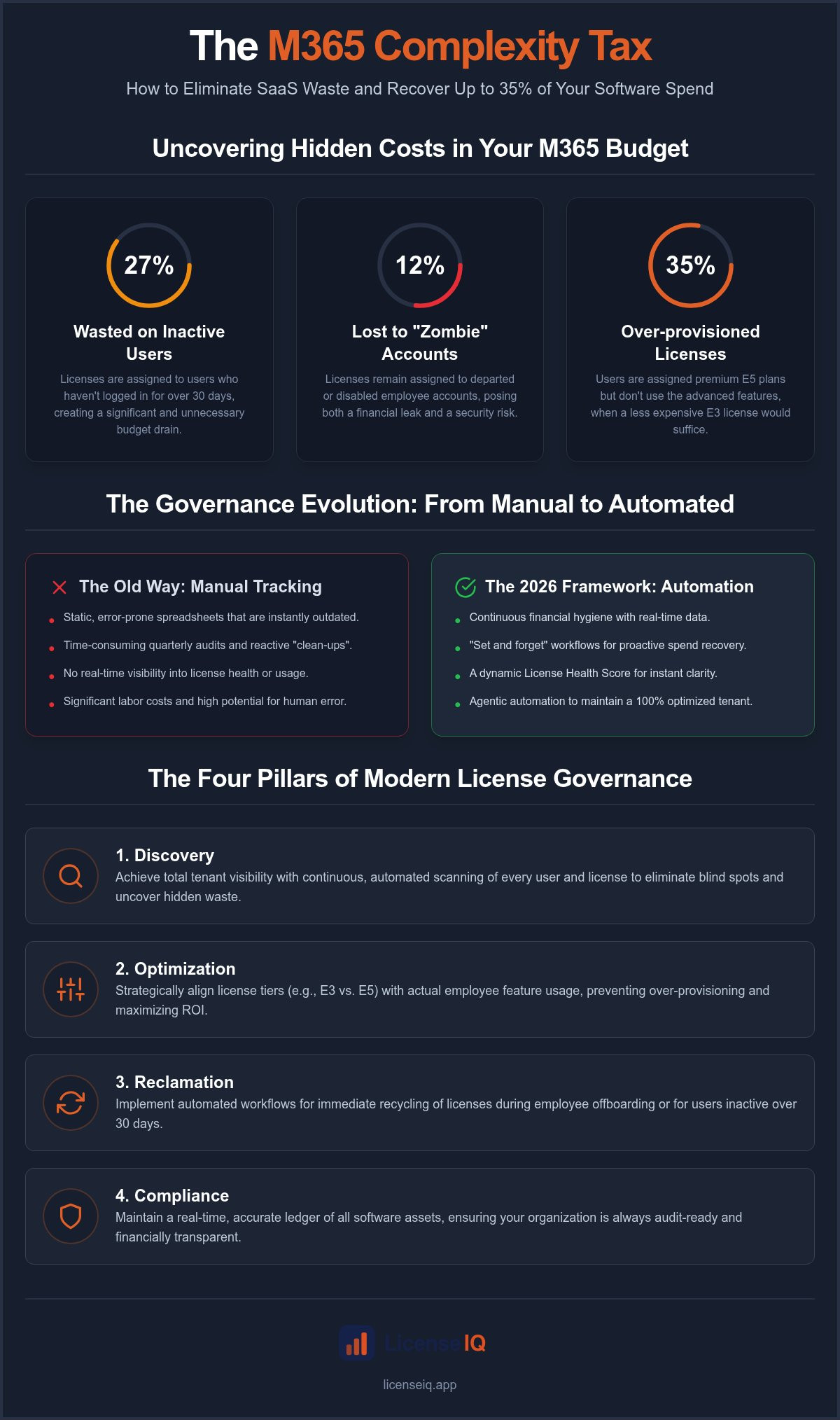
Your organization is likely losing 27% of its Microsoft 365 budget to users who haven't logged in for thirty days. Even worse, 12% of your licenses are probably still assigned to employees who left the company months ago. These aren't just administrative oversights. They're direct hits to your bottom line that prove why modern license governance best practices are no longer optional.
Managing these assets through manual spreadsheets is a liability that invites human error and over-provisioning. You know that paying for an E5 license when an E3 suffices is an unnecessary drain on resources. This guide delivers the 2026 framework designed to eliminate the M365 Complexity Tax and replace organizational disorder with digital precision.
You'll master the automated workflows required to eliminate SaaS waste and maintain a 100% optimized tenant. We'll show you how to transition to a set and forget governance model that provides immediate visibility into your license health. This article explores how to recover up to 35% of your software spend through proactive digital oversight and agentic automation.
Key Takeaways
- Transition from static, periodic audits to a continuous financial hygiene model to keep pace with rapid Microsoft 365 environment changes.
- Eliminate the labor-cost fallacy of manual tracking by utilizing automated discovery and precise license tier optimization.
- Execute license governance best practices by establishing a baseline License Health Score and automating the reclamation of licenses for inactive users.
- Bridge the visibility gap between IT operations and finance with a Spend Recovery Dashboard that provides clear, dollar-value ROI data.
- Maintain a 100% optimized tenant by matching license tiers to actual feature usage, preventing unnecessary over-provisioning of premium SKUs.
The Evolution of License Governance in 2026
In 2026, license governance is no longer a quarterly box-ticking exercise. It's a continuous financial hygiene process that demands the same vigilance as your cybersecurity perimeter. Traditional IT departments often treat licenses as static assets, but in a cloud-first environment, they're dynamic operational costs. License governance is the strategic intersection of IT Asset Management (ITAM) and Financial Operations (FinOps).
Manual audits fail because they're outdated the moment they're finished. High-growth SMBs struggle with the sheer velocity of user lifecycle changes. When you rely on spreadsheets, you aren't managing assets; you're documenting history. Transitioning to license governance best practices means moving from reactive "clean-ups" to proactive "automated recovery." This shift ensures your financial resources aren't leaked through administrative cracks.
The Real Cost of Governance Gaps
Ignoring the "Zombie User" problem is expensive. Research shows that 27% of M365 licenses are assigned to users who haven't logged in for over 30 days. These inactive accounts represent pure capital drain. Additionally, approximately 12% of licenses remain assigned to disabled or departed employee accounts. This isn't just a financial leak. It's a security vulnerability. Unmanaged active licenses on dormant accounts provide a silent entry point for unauthorized access.
Over-provisioning is the second silent killer. Up to 35% of users on Microsoft 365 E5 plans don't utilize the premium security or analytics features they pay for. Applying Software Asset Management principles helps identify these discrepancies. Downgrading an underutilized E5 seat to an E3 plan provides immediate, recurring savings without impacting productivity. Without constant oversight, these small inefficiencies compound into a significant "complexity tax."
Why 2026 Demands AI-Native Oversight
Static reporting can't keep up with 2026's licensing complexity. Modern governance requires AI-native tools that leverage the Model Context Protocol to understand user behavior in real time. This technology allows platforms like LicenseIQ to move beyond simple dashboards into active spend recovery. Instead of a 40-page PDF, you get a dynamic License Health Score that quantifies your tenant's efficiency.
This score provides instant clarity. It transforms complex technical data into a single, actionable metric for leadership. By using a Spend Recovery Dashboard, you can see specific dollar-value recommendations and execute automated workflows to reclaim waste in minutes. Proactive oversight ensures your M365 environment remains lean, secure, and financially optimized 24/7. This level of transparency is the cornerstone of modern license governance best practices.
The Four Pillars of Modern License Governance
Effective license governance best practices rely on four structural pillars. These pillars transform your M365 tenant from a black box of expenses into a transparent, high-performance asset. Without these foundations, your organization remains vulnerable to the complexity tax and financial leakage. Mastering these areas ensures that every dollar spent on licensing generates measurable value.
- Discovery: Continuous, automated scanning of every user and license to eliminate blind spots.
- Optimization: The strategic alignment of license tiers with actual employee feature requirements.
- Reclamation: Immediate, automated recycling of licenses during employee offboarding or periods of inactivity.
- Compliance: Maintaining a real-time, accurate ledger to ensure audit readiness and financial integrity.
Discovery and Total Tenant Visibility
Visibility is the first step toward control. You can't optimize what you can't see. Modern governance begins by connecting to your tenant in minutes to establish a definitive baseline audit. This process uncovers hidden waste, such as redundant subscriptions and accounts that have remained dormant for months. Leveraging Microsoft 365 license optimization techniques allows you to visualize every seat across your global footprint. You'll quickly identify the 12% of licenses typically assigned to departed employees, allowing for immediate action.
Optimization and Right-Sizing Strategies
Right-sizing is where the most significant financial recovery happens. Many organizations default to E5 licenses for all employees, yet research indicates that up to 35% of those users don't engage with the premium security or analytics features they pay for. A core tenet of enterprise software governance is matching the tool to the task. By analyzing actual feature usage data, you can safely downgrade light users to F-series or E3 plans without impacting their productivity. Right-sizing your environment through these methods can reduce annual subscription fees by up to 35%.
Reclamation and compliance round out the framework by addressing the user lifecycle. Manual offboarding is slow and prone to error, often leaving licenses active long after an employee departs. Automating this recycling process ensures that licenses return to the pool for reuse instantly. Finally, maintaining a precise, real-time ledger eliminates the stress of vendor audits. You can evaluate your License Health Score to see how these pillars currently function within your own environment. This proactive approach replaces organizational disorder with digital precision, ensuring your resources are always monitored by a vigilant system.
Manual vs. Automated Governance Workflows
Relying on manual spreadsheets for M365 management is a high-stakes gamble. While some teams believe manual tracking is a cost-saving measure, the reality is a labor-cost fallacy. Every hour your IT staff spends cross-referencing CSV files is an hour stolen from high-value projects. Manual processes are inherently reactive. They cannot keep pace with the 2026 licensing environment, where pricing updates and feature bundles change frequently. Implementing automated license governance best practices eliminates this administrative burden and replaces it with real-time accuracy.
The Hidden Costs of Manual Audits
Manual audits suffer from the "Cost of Delay." If your team identifies a redundant seat thirty days after an employee departs, you've already lost that capital. For a mid-sized organization, these delays across dozens of users result in significant unrecoverable spend. Spreadsheets also suffer from the "Stale Data" problem. A manual report is accurate only at the moment of export. By the end of the week, new hires and role changes have already rendered your data obsolete. Mastering the Microsoft 365 license management lifecycle requires a shift toward live, API-driven oversight.
The AI-Native Advantage
AI-native systems discover patterns that human eyes miss. While an administrator might see an active user, an AI-driven auditor sees a user who hasn't touched a premium security feature in months. This level of granular insight allows for a true "Health Check" that runs 24/7. Automated Governance Workflows execute your policies the moment a trigger occurs. If a user is deactivated in your HR system, the license is reclaimed instantly. This scalability is essential for SMB growth. You don't need to hire more administrators as you scale; you simply need a more vigilant system.
Real-time Spend Recovery Dashboards provide immediate clarity, replacing the guesswork of monthly reports with hard data. Adopting these license governance best practices through automation ensures that your financial health is never at the mercy of human error. Platforms like LicenseIQ connect to your tenant in minutes, transforming license management from a manual chore into a precise, automated recovery engine.
7 Best Practices for M365 License Governance
Achieving a 100% optimized tenant requires a repeatable set of protocols rather than periodic clean-up projects. Implementing license governance best practices transforms your M365 environment from an opaque cost center into a lean operational asset. These seven standards ensure your financial resources are always directed toward active productivity. Following these steps provides the digital precision needed to navigate the 2026 licensing landscape.
- Establish a License Health Score: Quantify your tenant's efficiency immediately to create a baseline for improvement.
- Automate 30-Day Reclamation: Set workflows to harvest licenses from users who haven't logged in for a month. This targets the 27% of spend typically wasted on dormant accounts.
- Implement a "Default to E3" Policy: Stop over-provisioning E5 seats for new hires. Since M365 E5 costs $60 per user while E3 is $39, defaulting to E3 saves $21 per month for every standard user.
- Quarterly Tier-Usage Reviews: Audit E5 seats every 90 days to verify that users are actually engaging with premium security and analytics features.
- Link HR to License Recycling: Ensure your identity provider triggers an immediate license return when an employee status changes.
- Set Financial Alert Thresholds: Configure notifications for unassigned license spikes to prevent surplus inventory.
- Report Monthly Spend Recovery: Deliver dollar-value ROI reports to leadership to justify governance efforts.
Integrating Governance into Offboarding
Offboarding is the primary source of financial leakage in most organizations. A departed employee who retains an active license represents a total loss on that seat every month. You must create a zero-leak offboarding workflow that automates the recycling of these assets. This ensures that licenses return to the available pool the moment an account is disabled. Use this Office 365 offboarding checklist 2026 to audit your current process and eliminate administrative gaps.
Setting Financial Thresholds for Alerts
Visibility is only useful if it leads to action. Configure your system to alert you when unassigned license counts exceed a specific dollar value. Tracking these recommendations weekly allows you to maintain a lean inventory without impacting onboarding speed. Defining "Wasted Spend" as a core KPI for leadership reporting builds trust with finance teams. This transparency demonstrates that your license governance best practices are actively protecting corporate capital. You can generate your License Health Score in minutes to identify exactly where your recovery opportunities exist today.
Implementing Automated Governance with LicenseIQ
Deploying license governance best practices shouldn't be a multi-month implementation project. Traditional governance tools often fail SMBs by demanding excessive configuration and specialized training. LicenseIQ reverses this dynamic by providing a digital auditor that integrates with your M365 tenant in minutes. This platform transforms the theoretical frameworks discussed earlier into a precise, automated recovery engine that works 24/7 to protect your capital.
Transitioning from manual tracking to Automated Governance Workflows solves the scalability problem. As your organization grows, the complexity of your Microsoft 365 environment increases exponentially. Without automation, you're forced to choose between hiring more administrators or accepting a 20-30% complexity tax in wasted spend. LicenseIQ allows you to scale your user base without scaling your administrative overhead, maintaining total transparency through every growth phase.
Your First 5 Minutes with LicenseIQ
The setup process is engineered for immediate clarity. Once connected, the platform uses the Model Context Protocol to scan your environment and generate an initial License Health Score. You don't have to hunt for waste; the Spend Recovery Dashboard identifies specific dollar-value recommendations instantly. This initial scan uncovers the obscured details of your tenant, from dormant E5 accounts to unassigned licenses that are still drawing monthly fees. You can review these findings and set up automated alerts to ensure continuous oversight moving forward.
Achieving 35% Savings through Automation
Case studies of SMBs using AI-native governance consistently show a recovery of up to 35% on software subscriptions. These savings aren't achieved through radical cuts but through the relentless elimination of administrative waste. By automating the reclamation of licenses for inactive users and right-sizing underutilized tiers, the platform ensures your budget matches your actual needs. This level of precision provides a sense of security, knowing that your resources are being monitored by a vigilant system.
The long-term value of annual subscription optimization can't be overstated. Every dollar recovered from a "Zombie User" is a dollar that can be reinvested into strategic growth or AI initiatives like Copilot. By moving beyond monthly reports to real-time spend recovery, you establish a model of financial hygiene that becomes a permanent part of your operational DNA. Start your automated audit today to gain total visibility and master your M365 environment.
Secure Your Financial Efficiency in 2026
Manual license management is a liability that drains corporate capital through administrative oversight. By implementing modern license governance best practices, you replace organizational disorder with a vigilant, automated system. You now have the framework to right-size E5 seats and automate reclamation workflows, allowing you to recover up to 35% of your annual SaaS budget. These reclaimed resources represent a significant opportunity to reinvest in strategic initiatives rather than administrative waste.
It's time to eliminate the M365 complexity tax and secure your tenant. The LicenseIQ platform connects to your environment in minutes to identify every inactive user and redundant license. It provides a real-time License Health Score that ensures your resources are always monitored by a precise digital auditor. Recover up to 35% of your M365 spend with LicenseIQ and gain the total visibility your leadership demands. Your path to a 100% optimized environment is now clear and actionable.
Frequently Asked Questions
What is the difference between license management and license governance?
License management is the tactical process of assigning and tracking seats. License governance is the overarching strategic framework that ensures financial hygiene and policy enforcement. While management handles the "who," governance addresses the "why" and "how much." Implementing license governance best practices ensures that your environment remains lean and compliant through automated oversight rather than manual, error-prone administration. It transforms IT assets into high-performance financial resources.
How often should we conduct a Microsoft 365 license audit?
Modern standards demand continuous, real-time monitoring rather than periodic checks. Manual audits are historically outdated by the time they're completed, especially in high-growth environments. By using automated discovery, you move away from quarterly clean-ups to a model of perpetual optimization. This proactive approach ensures you never pay for a "Zombie User" or an unassigned license for more than a few minutes, maintaining 100% tenant health 24/7.
Can license governance be fully automated for SMBs?
Yes, full automation is now accessible for SMBs through platforms like LicenseIQ. These systems use Automated Governance Workflows to execute policies without human intervention. When a user meets specific criteria, such as thirty days of inactivity or a change in HR status, the system reclaims the license instantly. This allows smaller teams to maintain enterprise-level financial precision without scaling their administrative headcount or technical overhead.
What are the most common signs of wasted Microsoft 365 spend?
The most frequent indicators include paying for licenses of offboarded employees and maintaining premium E5 seats for users who only require E3 features. Research shows that 27% of licenses are often assigned to users inactive for over thirty days. Redundant subscriptions and unassigned license spikes are also clear signals of waste. Identifying these obscured details through a Spend Recovery Dashboard is the first step toward significant capital recovery.
How does a License Health Score help with governance?
A License Health Score provides an immediate, quantifiable metric of your tenant's efficiency. It replaces complex usage logs with a single, actionable value that leadership can understand. This score allows you to benchmark your current state against license governance best practices and track your optimization progress over time. It serves as a continuous digital audit, highlighting exactly where your recovery opportunities exist and ensuring your resources remain secure.
What happens to user data when a license is reclaimed through governance?
Reclaiming a license doesn't immediately delete user data, as Microsoft 365 typically retains mailbox and OneDrive files for thirty days. However, your governance framework should include an automated archival step before reclamation to ensure compliance with data retention policies. Linking your offboarding workflows to secure storage ensures that you stop the financial leak of an active license while preserving vital corporate information for future retrieval.
Is AI-native license governance secure for highly regulated industries?
AI-native platforms are designed with security as a primary pillar, utilizing read-only API connections and the Model Context Protocol. These systems don't require global admin credentials for routine monitoring, which reduces the attack surface. For regulated industries, this provides a more secure environment than manual spreadsheets, which are often stored insecurely and prone to unauthorized access. Automation ensures that security policies are enforced consistently across the entire tenant.
How much can a company typically save by implementing these best practices?
Organizations typically recover up to 35% of their software subscription spend by implementing these best practices. This figure comes from identifying underutilized premium features, reclaiming dormant accounts, and right-sizing user tiers. For a mid-sized company, this recovery represents thousands of dollars in monthly savings. These reclaimed funds can then be redirected toward high-impact projects, such as deploying Microsoft 365 Copilot, without increasing the overall IT budget.


