

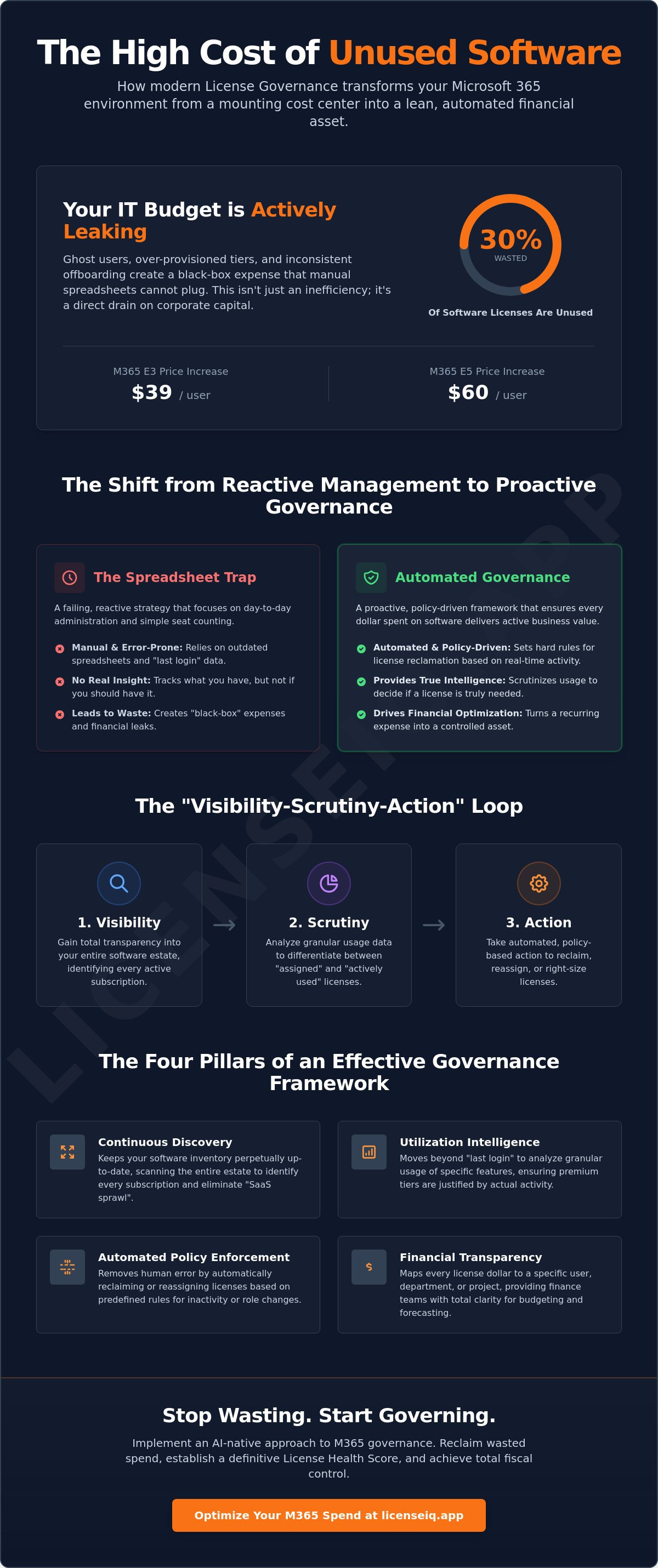
Up to 30% of your software licenses are currently sitting unused, silently draining your IT budget. As Microsoft 365 E3 prices climb to $39 and E5 hits $60 per user this July, you're likely asking: what is license governance and how can it stop the bleed? In the current 2026 landscape, ghost users and over-provisioned tiers are no longer just minor inefficiencies; they are active financial leaks that manual spreadsheets cannot plug.
Managing a complex tenant through manual tracking is a failing strategy. The visibility gap between E3 and E5 tiers, coupled with inconsistent offboarding, creates a black-box expense that obscures your true operational costs. It is time to move beyond reactive auditing and embrace a proactive stance on your digital resources. You need a system that acts as a vigilant guardian of your corporate capital.
This guide reveals how to transform your M365 environment from a mounting cost center into a lean, automated financial asset. You will discover how to implement automated governance workflows to reclaim wasted spend and establish a definitive License Health Score. We will show you the path to total transparency and precise fiscal control over your entire Microsoft ecosystem.
Key Takeaways
- Understand what is license governance and why this strategic framework is essential for securing long-term financial health in the Microsoft 365 ecosystem.
- Move beyond the "spreadsheet trap" by transitioning from manual administration to real-time utilization intelligence.
- Implement automated governance workflows to identify and reclaim budget from inactive users and redundant license tiers.
- Utilize the LicenseIQ Health Score to benchmark your tenant's efficiency and prioritize spend recovery opportunities.
- Transition from reactive management to a proactive digital audit system that monitors your software estate for hidden waste.
Defining License Governance in the Modern SaaS Ecosystem
The transition from perpetual software ownership to the "per-user-per-month" SaaS model has fundamentally altered corporate financial structures. In this environment, what is license governance? It is the strategic framework used to oversee the entire software subscription lifecycle. Unlike traditional tracking, governance ensures that every dollar spent on a subscription directly correlates to active business value. It transforms a recurring expense into a controlled financial asset.
Modern governance operates within a "Visibility-Scrutiny-Action" loop. First, you gain total visibility into the software estate. Second, you scrutinize usage data to identify inefficiencies. Finally, you take automated action to reclaim or reassign resources. This cycle eliminates the ambiguity that often plagues Microsoft 365 environments. Without this oversight, organizations face "SaaS sprawl," where the average company now manages over 100 applications, many of which overlap in functionality.
Governance vs. Management: Why the Distinction Matters
License management is a reactive process. It focuses on the day-to-day administration of assigning seats and ensuring compliance. In contrast, governance is proactive and policy-driven. Management tracks what you have; governance decides if you should have it in the first place. This distinction is critical because management alone often leads to significant budget waste. While a manager might assign an E5 license because it was requested, a governance framework checks if the user actually utilizes the premium security features included in that tier.
This approach is a specialized evolution of Software Asset Management (SAM). While SAM provides the foundation, modern governance adds a layer of automated intelligence. Organizations relying solely on manual management frequently see up to 30% of their licenses go unused. Understanding what is license governance allows IT leaders to move beyond simple seat counting and toward true financial optimization. Governance prevents waste by setting hard rules for license reclamation based on inactivity, ensuring your LicenseIQ profile remains optimized.
The Financial Pillar of License Governance
Software Hygiene is now a core metric for business health. Effective governance acts as a digital auditor, uncovering "ghost licenses" left behind by departed employees or forgotten project teams. These obscured details represent a direct drain on annual revenue. By maintaining high hygiene standards, you simplify budget forecasting and enter annual renewal negotiations with precise data rather than estimates.
With Microsoft 365 E3 and E5 prices increasing by up to 8% in 2026, the financial stakes are higher than ever. Governance provides the clarity needed to navigate these hikes. It allows leadership to justify costs through documented utilization, turning a "black-box" expense into a transparent, lean operation. This level of oversight ensures that your resources are monitored by a vigilant system, providing both security and fiscal confidence.
The Core Pillars of an Effective Governance Framework
An effective framework rests on four operational pillars that move your organization from a state of disorder to total clarity. Recent Gartner research highlighted the massive scale of SaaS spending, which reached $1 trillion in 2024. Without a structured approach, your M365 tenant becomes a primary source of financial leakage. Modern governance replaces guesswork with precise, real-time data.
Continuous discovery ensures your inventory is never out of date. It scans your entire software estate to identify every active subscription. Utilization intelligence then analyzes this data to differentiate between a license that is merely "assigned" and one that is "actively used." This distinction is the foundation of what is license governance in a high-growth enterprise. Automated policy enforcement removes the risk of human error by reclaiming seats based on predefined rules. Finally, financial transparency maps every license dollar to a specific user or department, making IT spend visible to finance teams.
Visibility and Usage Tracking
Relying on "Last Login" dates is a common pitfall in M365 oversight. A user might log in to check email but never touch the advanced analytics or security tools that justify a premium tier. Granular tracking identifies these discrepancies. For example, it highlights users who hold E5 licenses but only utilize E3 features. You can review these differences in our Microsoft 365 License Types reference guide. This level of detail allows you to downgrade users to appropriate tiers without impacting their productivity. It ensures your resources are monitored by a vigilant system that prioritizes efficiency over bulk licensing.
Policy Enforcement and Compliance
Manual reclamation processes are slow and prone to oversight. Effective governance implements automated rules. If a license remains inactive for 30 days, the system should flag or remove it automatically. This ensures your tenant stays lean without requiring constant manual intervention. It also standardizes the offboarding process. Removing access for departed employees immediately closes security gaps and stops financial leaks. By using automated governance workflows, you ensure that your compliance status is always audit-ready. This proactive stance eliminates the "audit panic" typically associated with software renewals. You gain confidence knowing that your digital resources are being optimized through a precise, automated system.
Why Static License Management Fails SMBs in 2026
Static management is a liability. Many SMBs still rely on the "Spreadsheet Trap," where manual tracking becomes obsolete the moment the file is saved. In a fluid M365 environment, users join, leave, and change roles daily. A spreadsheet provides a frozen snapshot of a moving target. This lack of real-time insight leads to cumulative financial waste that compounds every month. Understanding what is license governance helps SMBs replace these fragile manual processes with resilient, automated oversight.
The complexity of the Microsoft 365 ecosystem has outpaced human administration. Managing a mix of E3, E5, F3, and Business Premium licenses simultaneously requires constant vigilance. Without a dedicated system, it's nearly impossible to track which users actually utilize the premium features they're assigned. This complexity often results in expensive "true-up" surprises during annual audits. Poor governance leaves you vulnerable to vendor-driven corrections that can disrupt your entire IT budget for the fiscal year.
Inactive users represent a hidden cost that drains resources silently. When an employee departs or a project ends, licenses often remain active due to poor offboarding workflows. Over 12 months, the cost of a single forgotten E5 seat exceeds $700. In a growing organization, these "ghost users" create a significant deficit. A vigilant governance framework identifies these obscured details immediately, ensuring your capital is always working for you, not sitting idle in a vendor's account.
The Cost of "Just in Case" Licensing
It's a common objection: "It's easier to just keep the license active than to risk a support ticket." This mindset is the primary driver of the 35% average waste found in unmanaged M365 tenants. Security and convenience don't have to be at odds. Automated systems can reclaim licenses instantly while maintaining data integrity. In growing teams, every unmanaged seat acts as a license waste multiplier that scales your expenses faster than your productivity.
Redundant Tiers and the E3 vs. E5 Gap
Governance identifies "over-licensed" users who hold E5 credentials but never touch the advanced security or analytics tools. Right-sizing your tenant based on actual behavior data is the most effective way to recover spend. You can learn more about these strategies in our guide on Microsoft 365 License Optimization. By moving users to the appropriate tier, you eliminate redundant costs without sacrificing operational capacity. This proactive approach ensures your organization remains lean, agile, and financially secure in a high-cost software market.
Building a Governance Workflow: From Audit to Automation
Transitioning from manual oversight to a structured workflow is the only way to maintain financial hygiene in a complex SaaS environment. Modern governance isn't a one-time event. It's a continuous loop of connection, analysis, and automated action. Understanding what is license governance in a practical sense means moving away from reactive "cleanup" projects and toward a persistent state of optimization.
A high-performance governance workflow follows five precise stages:
- Connect: Integrate governance tools directly with your M365 tenant via API for real-time data access.
- Analyze: Scan for inactive users, redundant licenses, and unassigned seats that drain your budget.
- Score: Assign a definitive License Health Score to prioritize recovery efforts based on financial impact.
- Automate: Execute recovery workflows to reclaim spend without manual IT intervention.
- Monitor: Maintain a persistent oversight loop to prevent waste from re-accumulating.
This structured approach ensures that your resources are monitored by a vigilant system. It eliminates the friction typically associated with license management. By automating these steps, you transform IT from a bottleneck into a driver of financial efficiency.
Step 1: The 5-Minute Tenant Scan
Speed is the hallmark of effective governance. Traditional audits take weeks and are often outdated by the time they're finished. Modern systems must connect in minutes to provide immediate clarity. By integrating via API, you gain access to the granular data points required for a comprehensive health check. This includes login history, specific feature utilization, and license assignment dates. LicenseIQ sets the benchmark for rapid discovery, uncovering obscured details that manual audits miss. It provides the transparency needed to make data-driven decisions instantly.
Step 2: Identifying Actionable Waste
Not all waste is identical. You must categorize inefficiencies into three distinct groups: unassigned seats, inactive users, and over-licensed profiles. Setting specific thresholds is vital for accuracy. For instance, you might define an "inactive user" as anyone who hasn't accessed M365 services for 30 days. Standardizing this process ensures consistency across the organization. Utilizing an Office 365 Offboarding Checklist prevents financial leaks during employee transitions. This ensures that every departure triggers an immediate license reclamation, protecting your corporate capital.
Stop guessing and start recovering. You can deploy automated governance workflows today to secure your corporate resources and eliminate software waste permanently.
LicenseIQ: The AI-Native Approach to M365 Governance
LicenseIQ redefines what is license governance by integrating AI directly into the financial management of your M365 tenant. Traditional tools provide raw data, but LicenseIQ delivers automated financial hygiene. The platform serves as a vigilant digital auditor, operating one step ahead of organizational disorder. It transforms the complexity of your software estate into a transparent, manageable asset. By focusing on data-driven decision-making, it ensures your resources are monitored by a precise and tireless system.
The License Health Score is the primary KPI for this new era of oversight. It provides IT and Finance leadership with immediate clarity on the efficiency of their tenant. AI-native workflows uncover usage patterns and obscured details that manual audits inevitably miss. This persistent monitoring identifies every unassigned seat and underutilized premium feature. You no longer need a massive headcount to achieve enterprise-level governance. LicenseIQ empowers SMBs to maintain total fiscal control with minimal manual effort.
Recovering 35% of M365 Spend Automatically
Automated spend recovery is the core mechanism of the LicenseIQ platform. The system doesn't just generate reports; it provides actionable insights that lead to immediate savings. It identifies exactly which users are over-licensed and suggests the optimal tier based on real-world behavior. This process moves beyond the limitations of static tracking. Transitioning from manual spreadsheets to LicenseIQ delivers immediate fiscal clarity and eliminates the 35% waste typical of unmanaged tenants. You gain a lean, optimized environment where every dollar spent is justified by active utilization.
Continuous Accuracy via Model Context Protocol
Financial accuracy requires real-time data integration. LicenseIQ uses AI to maintain a continuous loop of oversight, ensuring your Spend Recovery Dashboard is always current. This isn't a periodic checkup; it's a proactive defense against budget creep. The system monitors for new "ghost users" and redundant licenses as they appear. It provides the peace of mind that comes from knowing your digital resources are being optimized by a vigilant and precise system. You can stop worrying about "true-up" surprises and start focusing on growth. This level of transparency is the cornerstone of modern corporate resource protection.
Secure your IT budget and eliminate software waste today. Get your free M365 Health Score in 5 minutes.
Secure Your IT Budget and Reclaim Wasted Capital
Manual spreadsheets and reactive auditing are no longer viable in the high-cost 2026 SaaS landscape. Understanding what is license governance represents the difference between a bloated IT budget and a lean, high-performance financial asset. You've seen how automated discovery and utilization intelligence transform your M365 tenant from a black-box expense into a transparent resource. By implementing these strategic pillars, you eliminate the spreadsheet trap and the risks of expensive true-up surprises.
LicenseIQ provides the visibility needed to identify up to 35% in wasted spend through AI-native automated workflows. It connects to your tenant in minutes, delivering immediate clarity without increasing your administrative headcount. This proactive stance ensures your corporate resources are monitored by a vigilant, precise system that prioritizes fiscal health. Take the first step toward total transparency today.
Start your 5-minute M365 audit with LicenseIQ and secure your organization's financial future. Your journey toward total operational clarity starts now.
Frequently Asked Questions
What is the difference between license management and license governance?
License management focuses on the tactical assignment of seats and day-to-day administration. Understanding what is license governance involves looking at the strategic framework that dictates why those seats exist in the first place. Governance is proactive and policy-driven, while management is reactive and administrative. It ensures that every dollar spent aligns with actual utilization rather than just assigned status, preventing the accumulation of redundant costs.
Why is license governance important for Microsoft 365?
Microsoft 365 is a complex, recurring expense that frequently hides invisible waste. With the July 1, 2026, price increases hitting E3 and E5 tiers, every unmanaged seat represents a growing financial deficit. Governance provides the oversight needed to navigate these rising costs by ensuring users are on the correct tier for their behavior. It transforms the tenant from a black-box expense into a lean, automated financial asset.
How much can a company save with automated license governance?
Organizations typically save between 23% and 30% on software spending by implementing structured governance strategies. The LicenseIQ platform identifies up to 35% in wasted spend by uncovering inactive users and redundant premium tiers that manual audits miss. These savings are achieved through automated governance workflows that reclaim seats as soon as they meet your organization's definition of inactivity, securing your corporate resources immediately.
What are the risks of poor license governance?
The primary risks include significant financial leakage and expensive true-up surprises during annual vendor audits. Poor governance also leaves ghost users from departed employees in the system, which creates security vulnerabilities and inflates your subscription costs. Without a vigilant system to monitor these obscured details, organizations face budget volatility and a lack of transparency that disrupts long-term financial planning and growth.
Does license governance impact user productivity?
No, effective governance does not negatively impact user productivity. It focuses on right-sizing licenses based on actual behavior data rather than removing access to essential tools. If a user holds an E5 license but only utilizes E3 features, governance moves them to the more efficient tier without disrupting their daily workflow. This ensures employees have the exact resources they need to remain productive without wasting corporate capital.
How does AI improve the license governance process?
AI-native workflows discover obscured details and usage patterns that manual spreadsheet tracking will inevitably miss. It analyzes vast amounts of data to identify precise instances of inactivity or over-licensing across the entire software estate. This allows for continuous accuracy and automated spend recovery, replacing slow, error-prone human intervention with a vigilant and precise digital auditor that stays one step ahead of organizational disorder.
Can license governance help with software audits?
Yes, it eliminates the audit panic by maintaining a persistent state of compliance through continuous monitoring. Governance provides a data-driven trail of license utilization and automated reclamation actions. This ensures your organization enters renewal negotiations with exact figures and documented evidence. You gain the confidence that comes from knowing your resources are optimized and your budget is protected from unexpected vendor-driven corrections.
What is a License Health Score?
A License Health Score is a primary KPI that measures the overall efficiency of your Microsoft 365 tenant. It's a central component of what is license governance in a modern enterprise. It calculates the ratio of active utilization against your total license spend to provide immediate clarity on your financial hygiene. This score allows leadership to benchmark their environment and prioritize recovery efforts based on documented financial impact.


