

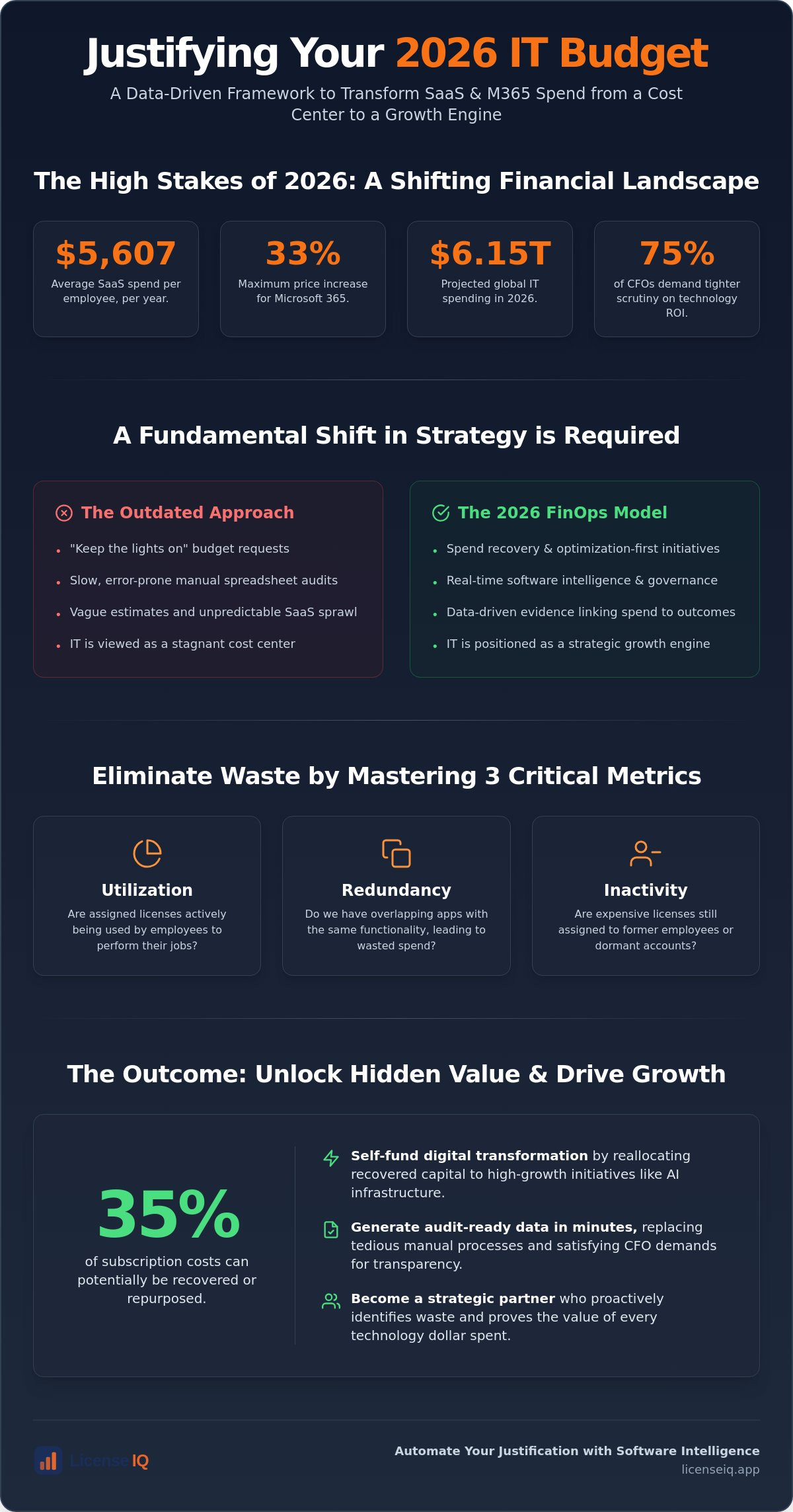
Did you know that the average organization now spends $5,607 per employee on SaaS subscriptions? With Microsoft 365 prices increasing by as much as 33% this year, your CFO is no longer accepting vague estimates or "keep the lights on" requests. You're likely feeling the pressure to justify every dollar while battling unpredictable SaaS sprawl and manual audit fatigue. It's time to stop guessing and start measuring. You need a professional it budget justification template 2026 that transforms obscured license data into a clear proposal for better resource allocation.
You already know that global IT spending is projected to hit $6.15 trillion in 2026, yet 75% of CFOs expect even tighter scrutiny on technology ROI. This guide provides the data-driven framework you need to prove software value and secure your funding. We'll show you how to leverage a License Health Score to identify redundant spend and repurpose that capital for high-growth initiatives—a strategy that aligns with the investor-ready standards promoted by Pre-IPO Hype. This article breaks down the exact steps to eliminate manual spreadsheet auditing and present a budget that your board cannot ignore.
Key Takeaways
- Shift your narrative from cost-center reporting to a FinOps-driven model that positions IT spending as a strategic growth engine.
- Utilize a data-driven it budget justification template 2026 to provide the granular evidence CFOs require for high-ticket software renewals.
- Master the three critical metrics of utilization, redundancy, and inactivity to eliminate M365 waste and optimize your license footprint.
- Address the "do we already have this?" objection by replacing manual spreadsheet audits with automated governance and proactive license optimization.
- Learn how the LicenseIQ License Health Score generates audit-ready data in minutes to help self-fund your 2026 digital transformation.
Why Your 2026 IT Budget Justification Needs a Narrative Shift
The 2026 fiscal environment has fundamentally changed. With Microsoft 365 prices increasing by up to 33% as of July 1, 2026, a "business as usual" approach guarantees a rejected budget. CFOs now view technology as a strategic investment rather than an unavoidable tax. To secure approval, your it budget justification template 2026 must pivot from simple procurement to a sophisticated FinOps model. This isn't just about spending less. It's about spending with precision and proving that every license serves a measurable purpose.
Successful leaders are adopting IT cost transparency principles to link every dollar spent to specific business outcomes. You can't rely on static spreadsheets to manage dynamic, seven-figure SaaS portfolios. Manual auditing is too slow and prone to error. Modern executive communication requires real-time software intelligence that uncovers obscured details and proves ROI before you ask for new capital. With the average IT budget now sitting at 5.7% of revenue, the stakes for financial accuracy have never been higher.
The Rise of the 'Optimization-First' IT Strategy
Governance is the new procurement. In 2026, the average organization manages over 100 SaaS applications, leading to massive sprawl and redundant functionality. CFOs prioritize efficiency over expansion. Proposing a "Spend Recovery" initiative using the LicenseIQ platform creates an immediate psychological advantage. It shows you're a vigilant guardian of company resources who optimizes existing assets before requesting new funding. This proactive stance transforms you from a cost-center manager into a strategic partner who identifies waste with surgical precision.
Key Stakeholders in the 2026 Budget Approval Process
Budget approval is a cross-functional hurdle. Finance demands predictability and hates "surprise" renewals that disrupt cash flow. Security teams require strict license hygiene to minimize the attack surface of unused accounts. Department heads need right-sized software access that matches actual usage patterns rather than theoretical needs. Your it budget justification template 2026 must address these diverse needs by providing a single, transparent source of truth. When you prove that up to 35% of current subscriptions can be recovered or repurposed, you gain the trust needed to fund your next digital transformation project.
The Essential IT Budget Justification Template Components
Generic templates designed for government agencies often fail in the fast-paced SaaS environment of 2026. Your it budget justification template 2026 must be leaner, more aggressive, and focused on software intelligence. It needs to prove that IT is a value driver rather than a stagnant cost center. A successful framework doesn't just list expenses. It tells a story of fiscal responsibility and strategic growth through meticulous resource management.
Section 1: The Executive Summary and Strategic Link
This is your elevator pitch to the CFO. Our 2026 IT strategy focuses on recovering 25% of wasted SaaS spend to fund critical AI infrastructure. By optimizing our Microsoft 365 footprint, we'll enhance security while reducing per-user costs by 15%. This alignment ensures that every dollar spent directly supports our corporate goal of 10% operational efficiency growth. Use declarative, benefit-driven language to capture attention immediately. Don't ask for permission to spend; present a plan to invest.
Rigorous justification standards aren't just for the public sector. Even the DoD Financial Management Regulation emphasizes linking IT investments to mission-critical outcomes. In a corporate setting, this means connecting Microsoft 365 costs to employee productivity and data security. If you can't prove a license is being used, you can't justify its cost. Your template should clearly map every major software line item to a specific business growth target.
Section 2: The Audit and Optimization Roadmap
You can't justify future spending without accounting for the present. Your template must include a "Current State" audit that transparently shows where resources go today. Present your M365 license utilization rates with absolute clarity. Highlight the "low-hanging fruit" such as unassigned licenses, redundant subscriptions, and accounts belonging to inactive users. These are the primary sources of budget leakage that CFOs want to see plugged before they approve new requests.
Set a concrete target for 2026, such as achieving a License Health Score of 90 or higher. This provides a measurable KPI that finance teams can track throughout the fiscal year. Moving from manual spreadsheet auditing to automated oversight is essential for maintaining this accuracy. Using the LicenseIQ platform allows you to generate these metrics in minutes, providing the hard data needed to prove your optimization roadmap is realistic and achievable.
Finally, conclude with a clear ROI projection and a risk assessment. Calculate the exact dollar value of the proposed optimizations. If you identify 15% waste on an E5 renewal, that's immediate capital recovered for the organization. Contrast this with the risk of budget rejection. Unmanaged licenses aren't just a financial drain; they're a security liability. A rejected budget means continued waste and increased vulnerability, making your proposal the only logical path forward.
Data-Driven Evidence: Justifying SaaS and M365 Spend
Microsoft 365 represents the largest software expenditure for most modern organizations. As of July 1, 2026, price increases for commercial plans have reached as high as 33%, with Microsoft 365 F1 rising to $3.00 per month and E5 climbing to $60.00. These hikes make M365 the most scrutinized line item in your 2026 budget. You can't defend these costs with vague usage claims or anecdotal evidence. Your it budget justification template 2026 requires hard data across three critical metrics: Utilization, Redundancy, and Inactivity.
Utilization measures whether employees actually use the high-tier features you're paying for. Redundancy identifies users with overlapping subscriptions that provide the same functionality. Inactivity highlights accounts that haven't been accessed in 30, 60, or 90 days. When you present these metrics, you move the conversation from "how much do we need?" to "how much can we recover?" This data-driven approach builds immediate trust with financial leadership by demonstrating a relentless focus on the organization's financial health.
M365 License Optimization: The 2026 Benchmarks
A "good" utilization rate for premium E5 licenses should exceed 85%. If your rate is lower, you're likely overpaying for advanced security or analytics tools that remain undeployed. Quantifying "License Parking"—the practice of paying for licenses assigned to departed or inactive employees—is a powerful narrative for Finance. Every parked license is a direct hit to your bottom line. Integrating a comprehensive Microsoft 365 license optimization strategy into your budget request proves you're managing resources with surgical precision. It shows you've benchmarked your spend against industry standards and are actively working to eliminate waste.
Quantifying the ROI of Automated Governance
Manual auditing is a resource drain. It takes an IT manager dozens of hours to cross-reference spreadsheets with tenant data, and these records are often outdated the moment they're saved. Automated software intelligence through the LicenseIQ Platform reduces this task to minutes. The Spend Recovery Dashboard translates technical waste into a clear dollar-value impact, often identifying up to 35% in potential savings. By reclaiming these funds, you create a self-funding mechanism for your 2026 digital transformation projects. Automated Governance Workflows prevent budget creep by ensuring license counts scale down automatically as soon as they're no longer required. This level of oversight ensures your 2026 budget remains lean, secure, and fully optimized.
Addressing the CFO's Core Objection: 'Do We Already Have This?'
When you present your it budget justification template 2026, expect one specific hurdle: the "already have it" objection. Your CFO likely believes existing IT Asset Management (ITAM) tools or manual spreadsheets provide sufficient oversight. They don't. Traditional ITAM was designed for hardware and static on-premise software. It tracks the existence of an asset, not its actual utility. In 2026, tracking is passive; optimization is active. You need a system that doesn't just list licenses but evaluates their ROI in real-time.
Spreadsheets are inherently flawed for SaaS governance. They are static snapshots of a dynamic environment. By the time you've finished auditing hundreds of M365 seats manually, the data is already outdated. This inaccuracy leads to over-provisioning during high-stakes renewals. You end up paying for the "worst-case scenario" instead of actual demand. Proving this gap to your CFO is the fastest way to secure approval for automated intelligence. It transforms the conversation from a request for more tools into a plan for total clarity.
Overcoming the 'Good Enough' Mentality
Relying on "good enough" data creates a massive financial drain through license sprawl. "Zombie" accounts, which are licenses assigned to users who no longer need them, hide in plain sight. These accounts often represent up to 35% of total software spend. Understanding how to reduce M365 subscription costs requires a shift in mindset. You must move from procurement to active governance. If you can't prove a license is delivering value, it shouldn't be in your budget.
The Security and Compliance Argument
Offboarding is a critical budget issue, not just an HR formality. Every unmonitored, inactive license is an unnecessary expense and a potential entry point for a breach. Linking license reclamation to a reduced attack surface makes your it budget justification template 2026 more persuasive. It shows that cost recovery and security are two sides of the same coin. Implementing a rigid Office 365 offboarding checklist ensures that your organization never pays for a seat that poses a security risk. This level of meticulous oversight is what modern financial leadership expects.
Stop managing your most expensive software assets with guesswork. Use the LicenseIQ Platform to gain immediate clarity and start recovering your budget today.
Automating the Justification with LicenseIQ’s Health Score
Manual data collection is the enemy of a successful 2026 budget proposal. LicenseIQ is the AI-native software intelligence platform built specifically for SMBs to bridge the gap between technical operations and financial oversight. It eliminates the guesswork that typically plagues the annual renewal process. By providing a vigilant, precise system for monitoring your Microsoft 365 environment, it ensures your it budget justification template 2026 is backed by irrefutable, real-time evidence. You no longer have to defend your spend with estimates; you defend it with a License Health Score.
The 5-Minute Audit: From Data to Justification
Traditional software audits take weeks of manual spreadsheet cross-referencing. LicenseIQ connects to your tenants in minutes, automatically identifying inactive users and redundant licenses. This rapid scan uncovers the exact dollar value of wasted spend, providing the raw data needed for your budget narrative. The Spend Recovery Dashboard generates audit-ready reports that translate technical waste into the financial language your CFO understands. It doesn't just highlight a problem; it provides the specific recommendations needed to reclaim up to 35% of your software subscriptions. This ensures your 2026 budget stays lean and fully optimized from day one.
Next Steps: Securing Your 2026 Budget Approval
To finalize your proposal, populate your it budget justification template 2026 with the metrics generated by the LicenseIQ Platform. Use the License Health Score as your lead KPI during the review with Finance. This score provides an instant, data-driven assessment of your license utilization, proving that you are an active participant in the company's financial health. When you show that your budget request is based on 100% utilization and zero waste, the path to approval becomes straightforward. Finance leaders value predictability, and the Health Score provides the transparency they require to sign off on seven-figure contracts.
Maintaining this accuracy throughout the fiscal year requires more than a one-time check. Implementing Automated Governance Workflows allows you to maintain your optimized state even as your headcount fluctuates. These workflows act as a digital auditor that is always one step ahead, preventing budget creep and license sprawl before they impact your bottom line. By combining a professional template with automated software intelligence, you transform your IT department from a cost center into a model of operational excellence. Stop relying on outdated spreadsheets and start leading with data.
Start your free M365 audit with LicenseIQ today and secure your 2026 budget with confidence.
Secure Your Strategic Funding for 2026
Don't let manual spreadsheet errors or obscured license details compromise your funding. You can identify inactive users and redundant subscriptions in minutes with AI-native automated governance. This level of precision allows you to save up to 35% on software subscriptions while maintaining total operational transparency. It's time to replace guesswork with a precise Health Score that proves your department's value. Take control of your digital environment and lead with data.
Discover your M365 Health Score and recover wasted spend with LicenseIQ
Frequently Asked Questions
What is an IT budget justification and why is it important in 2026?
An IT budget justification is a formal document that explains the business value and strategic necessity of proposed technology spending. In 2026, it's critical because Microsoft 365 costs have surged by up to 33% for certain plans. CFOs now demand granular proof of ROI before approving renewals. You must demonstrate that your department isn't just a cost center but a vigilant guardian of corporate resources.
How do I calculate the ROI of my Microsoft 365 licenses?
Calculate ROI by identifying the gap between your total license spend and actual feature utilization. Subtract the cost of inactive, redundant, or "parked" licenses from your annual contract value. This recovered capital represents the immediate financial return of your optimization efforts. Using automated tools to find this waste allows you to repurpose funds for high-growth initiatives like AI infrastructure and digital transformation.
What are the most common reasons IT budgets get rejected?
Budgets are typically rejected due to a lack of hard data or failure to address SaaS sprawl. If you can't prove that your existing licenses are fully utilized, financial leadership will view new requests as wasteful. Rejection often stems from using anecdotal evidence rather than a data-driven framework. CFOs want to see that you've eliminated "zombie" accounts before they sign off on additional capital expenditures.
Can I use a spreadsheet for my 2026 IT budget justification?
Spreadsheets are no longer sufficient for modern SaaS governance because they are static and prone to manual error. A professional it budget justification template 2026 requires real-time intelligence to be persuasive. Static data is often outdated before the budget meeting even begins. Automated platforms provide the dynamic oversight needed to justify seven-figure contracts and prove that your license counts match actual headcount and usage.
What is a License Health Score and how does it help with budgeting?
A License Health Score is a KPI from 0-100 that measures the efficiency of your software environment. It helps with budgeting by providing a single, transparent metric that represents your optimization progress. A high score proves to Finance that you've eliminated waste and maximized the value of every seat. This level of clarity builds trust and makes the approval of your 2026 budget request much more likely.
How does automated license governance reduce my annual IT spend?
Automated governance identifies waste in minutes and implements workflows to reclaim licenses from departed or inactive users. It prevents budget creep by ensuring your subscription counts scale down automatically when they're no longer needed. This proactive oversight can save your organization up to 35% on software subscriptions. By eliminating the need for manual audits, you also reduce the administrative burden on your IT team, further increasing operational efficiency.
What should be included in an IT budget executive summary?
Your executive summary must include a punchy explanation of your primary goal, strategic alignment with business targets, and a clear ROI projection. Lead with the "Why" behind your request and use benefit-driven language to capture CFO attention. Highlight the amount of capital you've recovered through optimization to show you're self-funding new projects. Keep it concise, declarative, and focused on the financial health of the organization.
How can I justify the cost of a SaaS spend management tool?
Justify the cost by comparing the tool's price to the potential 35% savings in software waste. Position it as a Spend Recovery Dashboard that pays for itself by identifying redundant licenses and eliminating manual auditing hours. Explain that the tool provides the continuous oversight necessary to prevent future budget leakage. It's an investment in transparency that ensures your 2026 IT budget remains lean, secure, and fully optimized.


