
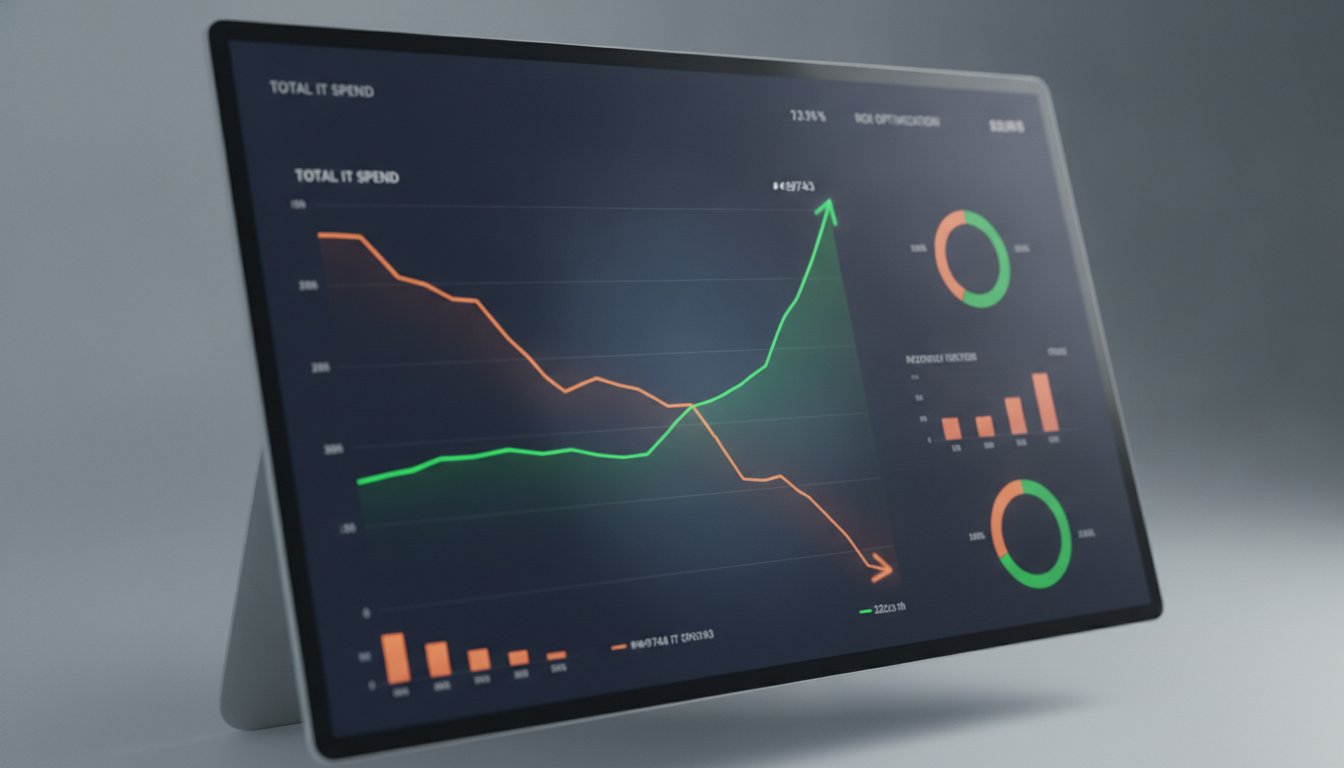
Your executive team doesn't want to hear about "savings"; they want to hear about "recovered capital" that fuels growth. Knowing how to present it cost savings to leadership is the difference between appearing like a cost center and acting as a strategic partner. It's frustrating when technical license data gets lost in translation or makes it look like you've allowed waste to accumulate. With global IT spending projected to reach $6.15 trillion in 2026, the pressure to prove every dollar's value is at an all-time high.
You shouldn't have to defend your budget management when 30-35% of cloud spend is wasted across the industry. We'll show you how to move beyond granular metrics and master the art of reframing IT expenses as strategic assets. This guide provides a clear framework for executive communication. You'll learn how to use automated governance and real-time health scores to win immediate buy-in for your optimization strategy. By the end of this playbook, you'll have the confidence to present data-backed results that secure approval for the tools needed to maintain a lean, efficient operation.
Key Takeaways
- Reframe "cost-cutting" as "spend recovery" to position IT as a strategic driver of growth rather than a drain on resources.
- Adopt the License Health Score as your primary executive KPI to provide immediate, high-level clarity on operational efficiency.
- Learn exactly how to present it cost savings to leadership by translating technical license data into monthly dollar-value waste.
- Visualize the gap between licensed and active users to build a data-backed case for automated governance and resource reallocation.
- Transition from manual, one-off audits to a "Live Spend" mindset that ensures continuous oversight and permanent waste elimination.
The Stakes of Presenting IT Cost Savings in 2026
The standard for IT financial reporting has undergone a fundamental shift. In 2026, performing an annual audit is no longer sufficient to maintain fiscal health. Modern infrastructure requires continuous hygiene. This is the era of "Spend Recovery." Unlike traditional cost-cutting, spend recovery is the systematic process of reclaiming capital from underutilized software assets and redirecting it toward high-growth initiatives. If you stay silent about SaaS waste, you risk your professional credibility with the CFO. Unaddressed waste suggests a lack of oversight, while proactive recovery demonstrates strategic leadership.
Effective communication requires understanding IT cost transparency to bridge the gap between technical operations and financial accountability. The industry is rapidly moving away from reactive IT Asset Management (ITAM) toward Automated Governance. This evolution ensures that every dollar spent on platforms like M365 is actively monitored and justified in real-time. Global IT spending is projected to reach $6.15 trillion this year, yet organizations still waste 30-35% of their cloud budgets on idle resources. Mastering how to present it cost savings to leadership allows you to turn these industry-wide losses into specific organizational wins.
Why Traditional Budget Cutting Fails
Manual spreadsheets are dead. They become outdated the moment the file is saved. Static reports fail to capture the rapid ebb and flow of modern user cycles. An SMB might add fifty users on Monday and lose thirty by Friday; if your reporting isn't live, you're presenting fiction. SaaS sprawl creates "invisible" costs that erode budgets without warning. You can't manage what you can't see, and traditional methods simply can't keep up with the volatility of 2026 software environments.
The Psychology of Executive Buy-In
CFOs don't care about technical specifications. They prioritize risk mitigation and capital efficiency. When you refine how to present it cost savings to leadership, you must avoid the "blame game." Don't frame discovered waste as a past failure. Instead, frame it as a newly uncovered recovery opportunity. Use tools like the LicenseIQ Platform to show immediate dollar-value insights. Position IT as a proactive guardian of company resources. This approach builds trust and secures the executive approval needed for future innovation and automated governance tools.
By focusing on these high-stakes outcomes, you move IT from a line-item expense to a value-generating engine. The goal isn't just to spend less. It's to spend with total clarity and precision.
Building Your Case: The Metrics Leadership Actually Cares About
Leadership teams are immune to technical jargon. They don't want to hear about seat counts or user provisioning logs. They want to see the direct impact on the profit and loss statement. When you focus on how to present it cost savings to leadership, you must shift the conversation from "number of users" to "dollar-value waste per month." This change in vocabulary transforms a technical report into a financial recovery plan. By identifying specific cost-saving approaches through engagement data, you prove that IT is a vigilant steward of corporate capital.
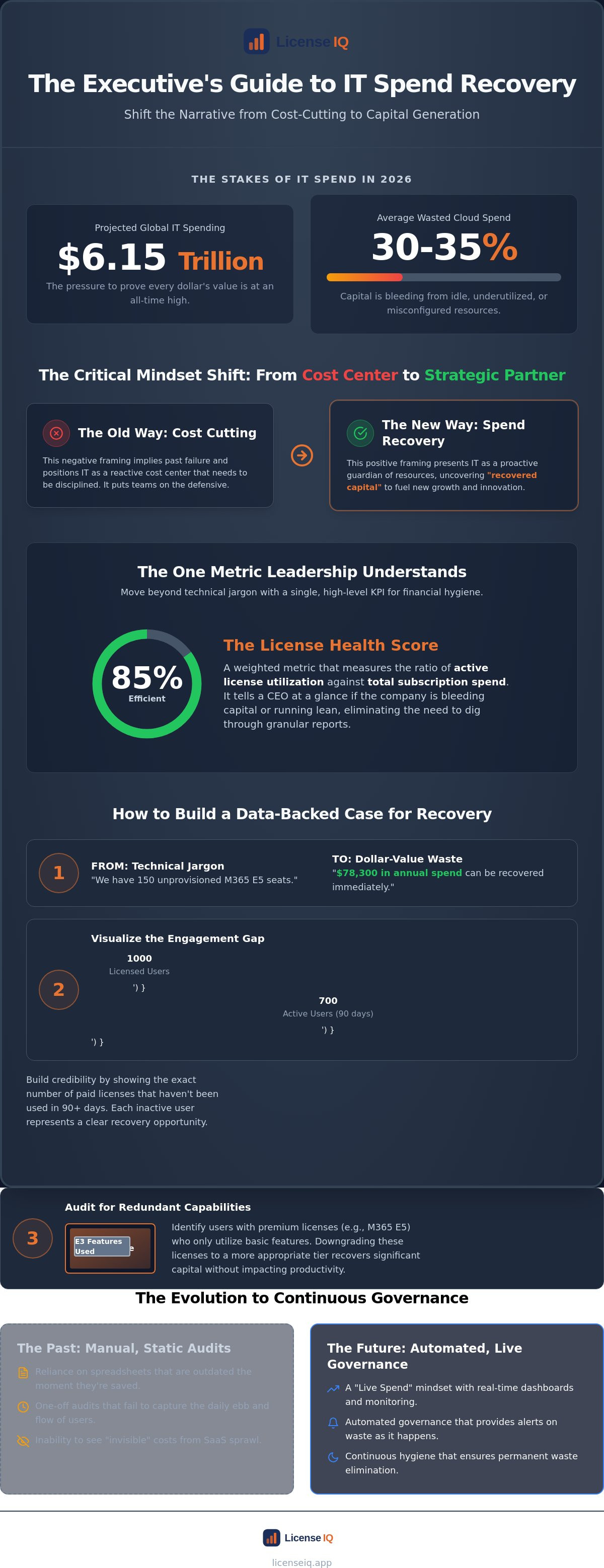
The License Health Score serves as the primary metric for this transition. It provides a high-level executive KPI that summarizes the efficiency of your entire software estate. Instead of digging through granular license types, a CEO can look at a single number to judge the organization's financial hygiene. Organizations with mature FinOps practices are currently saving 20-35% on cloud subscriptions within the first year of optimization, creating capital that eCommerce brands can reinvest into growth via eComQB. Proving waste through lack of engagement data is the fastest way to build credibility. If a user hasn't accessed a platform in 90 days, that license represents an immediate recovery opportunity. You should also audit for redundant license detection, such as identifying users with expensive E5 licenses who only utilize basic E3 capabilities.
The Power of the License Health Score
The License Health Score is a weighted metric that measures the ratio of active license utilization against total subscription spend to quantify financial hygiene. It tells a CEO at a glance if the company is bleeding capital or running lean. In 2026, the average organization wastes 30-35% of its cloud budget on idle or misconfigured resources. Comparing your score against this industry baseline creates a sense of urgency. It moves the needle from a routine IT task to a top-tier executive priority instantly.
Translating Technical Waste into Financial Opportunity
Every inactive account represents reclaimable monthly recurring revenue. Converting "inactive accounts" into "reclaimable capital" changes the psychology of the meeting. Right-sizing your environment has a compounding positive impact on the annual bottom line. When discussing how to present it cost savings to leadership, the most effective tool is the "Cost of Inaction." Failing to optimize today doesn't just keep costs flat; it compounds waste as your workforce scales. Using an Automated Spend Recovery Dashboard ensures these opportunities are captured and presented the moment they appear.
The 'Spend Recovery' Narrative: Reframing Costs as Capital
Words matter in the boardroom. If you approach an executive with a plan for "budget cuts," you're inviting resistance. Cuts imply a reduction in capability or a loss of resources. Instead, focus on "spend recovery" and "optimization." This shift in language is the cornerstone of how to present it cost savings to leadership effectively. You aren't taking anything away; you're reclaiming capital that is already being wasted on inactive licenses and redundant subscriptions. You're turning a sunk cost back into a strategic asset.
Think of this as the "Found Money" effect. When you present recovered capital, you make the CFO the hero of the story. You're giving them the financial flexibility to fund new strategic IT initiatives without requesting a budget increase. With global IT spending projected to grow by 10.8% in 2026, every recovered dollar helps offset these rising costs. Addressing the "Why now?" question is simple: the longer you wait, the more capital evaporates into the SaaS ecosystem without providing value. Data-driven urgency proves that inaction is the most expensive choice the company can make. This same logic of efficiency applies to physical asset management; for companies looking to optimize their factory relocations and machinery moves, learn more about Silver Knight Haulage & Machineries Ltd.
Reframing the Discovery of Waste
Many IT managers fear that uncovering waste will look like a management failure. This is a misconception. In high-growth environments, license sprawl is an inevitable side effect of rapid scaling. It's a systemic issue, not a human one. By using automation, you prove that manual tracking is simply impossible in a modern enterprise. Implementing Microsoft 365 cost optimization strategies allows you to position these findings as a sign of proactive oversight rather than past negligence. It demonstrates that you have the tools to see what others miss.
Connecting IT Savings to Business Goals
Financial hygiene is only one part of the story. SaaS hygiene also supports overall FinOps maturity and strengthens your security posture. For example, automated governance ensures that licenses are revoked immediately during employee exits, reducing the window of technical vulnerability. Referencing a structured Office 365 offboarding checklist 2026 shows leadership that your optimization strategy is as much about risk mitigation as it is about the bottom line. This dual-value proposition is vital when learning how to present it cost savings to leadership in a way that resonates across the entire C-suite. You aren't just saving money; you're securing the perimeter and maturing the organization's operational model.
Step-by-Step: Constructing the IT Cost Savings Pitch
Constructing a successful pitch requires precision and speed. Your opening must be direct. State the current License Health Score immediately. This single metric communicates the state of your financial hygiene without requiring a deep dive into technical logs. If the score is low, the recovery potential is high. Mastering how to present it cost savings to leadership turns a routine budget meeting into a strategic win. You aren't asking for permission to cut services; you're presenting a roadmap to reclaim capital that is already being lost.
Next, present the evidence. Contrast your total "Licensed" count against "Active" users. This gap represents pure waste. In 2026, organizations still lose an average of 30-35% of their cloud budget to idle or misconfigured resources. Propose a solution centered on automated governance workflows. Compare the minimal cost of implementation against the 35% potential savings. The ROI is immediate. By focusing on these high-level outcomes, you provide the clarity needed for a fast decision. This is the most effective way how to present it cost savings to leadership while maintaining your authority as a proactive guardian of company resources.
Visualizing the Data
Dashboards beat spreadsheets every time. Executives need actionable insights, not data dumps. Use a "Before and After" projection to illustrate how the budget shifts over the next six months once waste is eliminated. Maintain executive attention by focusing on reclaimed capital rather than technical debt. If your data isn't visual, it's invisible. A clear Spend Recovery Dashboard proves that your strategy is data-backed and ready for immediate execution.
Handling Executive Pushback
Be prepared for the manual audit objection. A CFO might ask if this work can be done manually in the M365 Admin Center. The counter is simple: the time-cost of manual auditing is prohibitive and prone to human error. The LicenseIQ Platform provides an instant scan with minutes-to-insight. Manual work is static and outdated the moment it's finished. Automated governance is live and persistent. If leadership claims the company is too small to care, remind them that mid-market companies spend 6% to 8% of revenue on IT. In smaller environments, every dollar of waste has a larger relative impact on the bottom line.
Stop guessing and start recovering. Connect your tenant for immediate dollar-value insights and see your actual recovery potential in minutes.
Scaling the Narrative: From One-Off Audits to Automated Governance
Your first successful pitch is a breakthrough, but it shouldn't be the final word. One-time audits are snapshots of the past. In the volatile SaaS environment of 2026, you must transition leadership to a "Live Spend" mindset. Financial accuracy requires a continuous reporting cycle that reflects the real-time state of your subscriptions. Mastering how to present it cost savings to leadership involves proving that IT can maintain fiscal discipline without manual intervention. AI-native platforms are now the standard for ensuring that every dollar of recovered capital stays recovered.
Savings often leak back out as new users are added or projects scale. Without automated license governance, waste is a recurring infection. Automation acts as a vigilant digital auditor that never sleeps. It removes the burden of manual tracking and replaces it with a system of total transparency. By scaling your narrative from a single event to a persistent operational model, you cement your role as a vital guardian of corporate resources.
Continuous Monitoring as a Competitive Advantage
Visibility is your strongest tool. Keeping the License Health Score visible to leadership year-round ensures that optimization remains a priority. Automated alerts notify you of new waste the moment it happens, allowing for immediate spend recovery. This proactive approach significantly reduces the "Administrative Tax" on your IT team. You stop chasing spreadsheets and start managing strategy. Continuous monitoring doesn't just save money; it provides the operational clarity needed to stay ahead of competitors who are still bogged down by manual audits.
Next Steps for the IT Leader
Execution starts with data. You don't need a weeks-long project to find your first win. Start with a 5-minute audit to gather your baseline License Health Score. Once you have the numbers, schedule a "Recovery Review" with the CFO. Present the immediate dollar-value insights and propose the transition to automated workflows. This sequence is the most effective way how to present it cost savings to leadership because it replaces theory with immediate, data-backed reality. Take the first step toward total oversight today.
Connect your tenant to LicenseIQ for a free Health Score and immediate recovery insights and turn your IT spend into a strategic advantage.
Mastering the Spend Recovery Narrative
You now have the blueprint to transform IT from a cost center into a value-generating engine. By shifting your language from "cuts" to "recovery," you align technical operations with executive financial goals. You understand that the License Health Score is your most powerful tool for maintaining transparency and securing long-term buy-in. Mastering how to present it cost savings to leadership is about more than just numbers. It's about demonstrating that you have total oversight of the company's digital resources. You're no longer just managing licenses; you're managing capital efficiency. To see how these optimizations fit into a broader strategy for growth, learn more about 41 Legacy and their work in protecting enterprise value.
Don't let manual processes obscure your actual recovery potential. Our AI-native scan identifies up to 35% waste and provides actionable dollar-value recommendations through a centralized Spend Recovery Dashboard. Transitioning to automated governance workflows ensures that your financial hygiene remains permanent and your IT team stays focused on high-impact projects. This approach turns a one-off audit into a continuous competitive advantage for your organization. Take the final step toward total operational clarity. Discover your M365 Health Score and start recovering spend in 5 minutes. You're ready to lead the conversation with confidence and precision.
Frequently Asked Questions
What are the most important IT cost savings metrics for a CFO?
CFOs prioritize the License Health Score and the specific dollar value of monthly recurring waste. They value metrics that translate technical data into capital efficiency and reclaimable revenue. Instead of reporting seat counts, focus on the total recovery potential and the cost of inaction. This approach aligns IT operations with the organization's broader financial health and bottom line goals.
How often should I present SaaS spend reports to leadership?
You should transition from quarterly snapshots to a "Live Spend" mindset with monthly high-level reviews. In the volatile software landscape of 2026, a static report is outdated the moment it is saved. Continuous oversight allows you to catch waste as it happens rather than discovering it months later. Monthly updates keep the License Health Score visible and ensure that spend recovery remains a strategic priority.
How do I explain M365 license waste without sounding like I'm not doing my job?
Frame license waste as a systemic side effect of rapid organizational growth rather than a management failure. You can master how to present it cost savings to leadership by explaining that manual tracking is physically impossible in a modern SaaS environment. Position the discovery of waste as a proactive win enabled by new automated governance tools. This demonstrates that you are evolving your oversight to match the company's scale.
What is the difference between cost cutting and spend recovery?
Cost cutting typically involves reducing service levels or eliminating necessary tools to meet a budget. Spend recovery is the process of reclaiming capital from underutilized or redundant software assets without losing capability. It focuses on optimization and financial hygiene. By recovering "lost" money, you can fund new strategic IT initiatives without requiring a budget increase from the CFO.
Is an automated license optimization tool worth the investment for an SMB?
Yes, because mid-market companies typically spend 6% to 8% of their annual revenue on IT in 2026. Since organizations waste an average of 30-35% of their cloud budget, the potential for recovery is substantial even in smaller environments. Automated tools provide an immediate ROI by identifying waste that manual audits miss. For an SMB, every recovered dollar has a significant impact on operational flexibility.
How can I prove the ROI of a SaaS management platform to my CEO?
Compare the platform's cost directly against the identified 35% waste in your environment. When you show how to present it cost savings to leadership using real-time dollar values, the ROI becomes a simple calculation. Use a "minutes-to-insight" scan to prove that the savings captured in the first month often exceed the annual cost of the tool. This turns the purchase into a self-funding project that generates immediate capital.


