

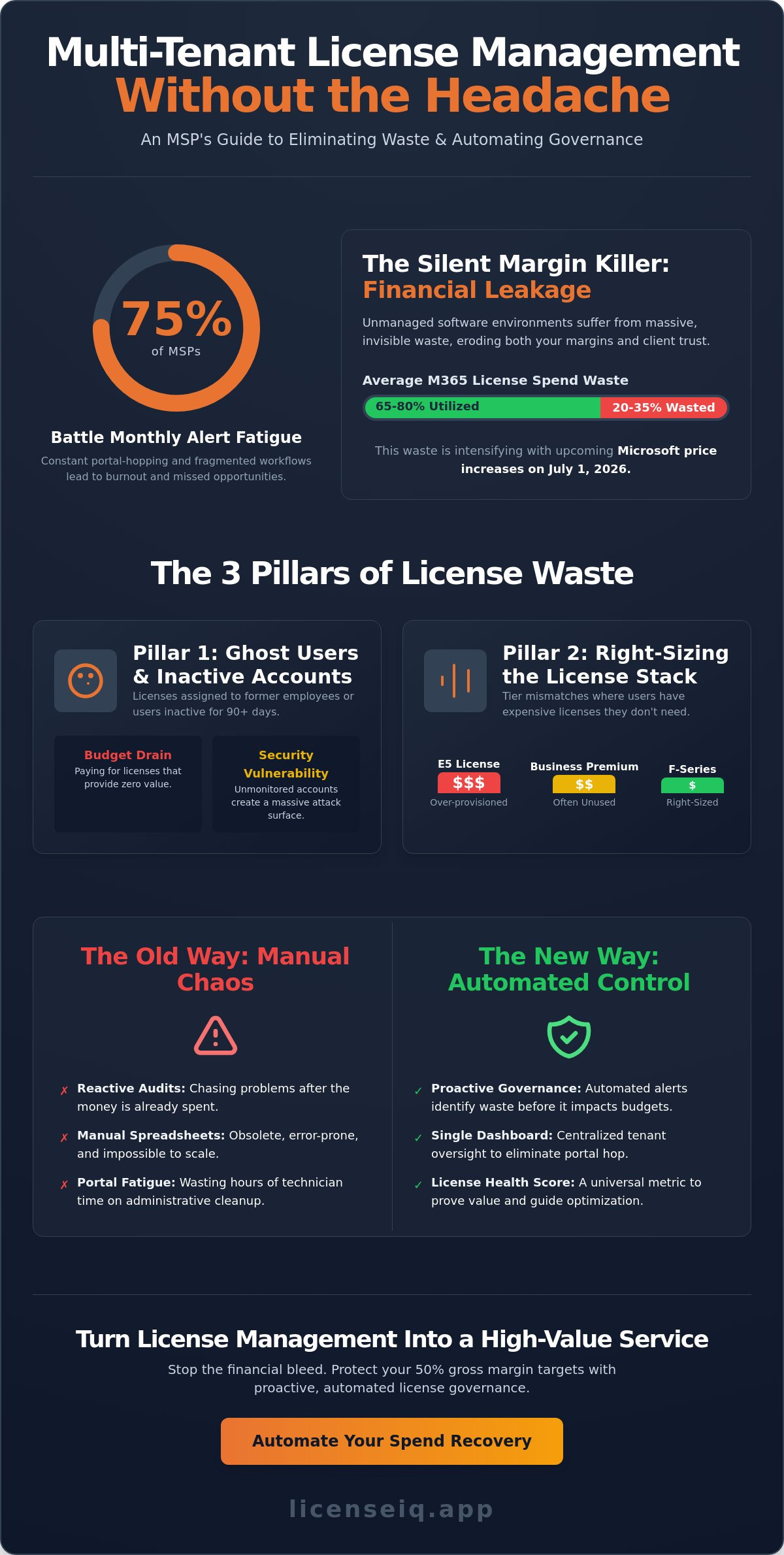
Over 75% of MSPs battle alert fatigue at least monthly, a burnout risk that's intensifying as Microsoft 365 costs climb. With Business Premium hitting $25.00 and Business Standard reaching $14.50 on July 1, 2026, manual license tracking is no longer sustainable. You're likely tired of the "portal hop" and the constant fear that invisible license waste is silently eroding your client's trust. This is your Multi-Tenant Without the Headache: A License Optimization Guide for MSPs.
We'll show you how to reclaim up to 35% of client software spend by replacing manual spreadsheets with automated governance workflows. You'll learn to consolidate license health into a single dashboard, deploy automated alerts for inactive users, and scale your operations with total financial visibility. By moving from the chaos of unmanaged stacks to a structured License Health Score, you can protect your 50% gross margin targets and turn license management from a tedious chore into a high-value, proactive service.
Key Takeaways
- Identify "Ghost Users" and resolve license tier mismatches to stop silent budget erosion across your entire client base.
- Transition from outdated manual spreadsheets to automated governance using this Multi-Tenant Without the Headache: A License Optimization Guide for MSPs.
- Scale your operations by moving from reactive billing audits to a proactive maturity model powered by automated workflows.
- Establish a standardized License Health Score for every client to provide immediate transparency and prove your managed service value.
- Centralize tenant oversight into a single Spend Recovery Dashboard to eliminate portal fatigue and reclaim wasted software spend.
The Hidden Cost of Scale: Why Multi-Tenant License Management is Broken
In the managed services sector, growth is often a double-edged sword. As you onboard more clients, your administrative burden scales vertically while your efficiency remains flat. This is the portal fatigue paradox. Managing thousands of seats across dozens of tenants requires a level of oversight that manual processes simply can't provide. Effective Software Asset Management (SAM) is the foundation of a healthy MSP, yet most firms still rely on static spreadsheets that are obsolete before the first pivot table is built. This Multi-Tenant Without the Headache: A License Optimization Guide for MSPs addresses the systemic failure of the reactive approach to licensing.
The Reality of Portal Fatigue in 2026
Portal fatigue isn't just an annoyance; it's a structural risk. Over 75% of MSPs report alert fatigue at least monthly, and those managing seven or more tools face daily burnout. Consider the "time-tax" of switching tenants. If an engineer spends 10 minutes logging into, navigating, and auditing a single Microsoft tenant, a portfolio of 50 clients consumes over eight hours of pure administrative overhead every month. Fragmented workflows lead to missed license reclamation opportunities and dangerous security gaps. Inactive accounts often remain licensed and accessible, creating an unmonitored attack surface where shadow IT thrives. You can't secure what you can't see.
Financial Leakage: The Silent Margin Killer
Unmanaged Microsoft 365 environments suffer from an average waste of 20% to 35% in license spend. This leakage occurs through "ghost users" and redundant tiering. With Microsoft’s July 1, 2026, price increases pushing Business Premium to $25.00 and Office 365 E3 to $26.00 per user, these inefficiencies are more expensive than ever. Clients don't see the complexity of tenant management; they only see a rising invoice they don't understand. When costs spike without a corresponding increase in value, client trust erodes. They often blame the MSP for the lack of financial oversight. You need a strategy to protect your margins. Discover more in our guide on how to reduce M365 subscription costs to stop the financial bleed.
Relying on manual audits is a reactive trap. True scale requires proactive governance. By centralizing visibility, you move from a technician who fixes licensing errors to a strategic advisor who optimizes financial health. This shift preserves your 50% gross margin targets and ensures your team stays focused on billable innovation rather than administrative cleanup. It's time to replace the chaos of unmanaged stacks with a vigilant, precise system of record.
The 3 Pillars of License Waste: Identifying Redundancy Across Tenants
License waste isn't a single leak; it's a series of punctures across your entire portfolio. To achieve Multi-Tenant Without the Headache: A License Optimization Guide for MSPs, you must categorize these losses into three distinct pillars. Without a structured framework, you're just guessing at utilization. Establishing a universal License Health Score for every client allows you to benchmark performance and identify the most critical areas for spend recovery. This score provides a standardized metric to prove your value, turning invisible waste into tangible savings.
Ghost Users and Inactive Accounts
The most common form of waste is the ghost user. These are licenses assigned to employees who've left the company or haven't logged in for months. In the modern hybrid workplace, we define inactivity as a 90-day window without sign-in activity. Leaving these accounts active is a dual threat. It drains the budget and creates a massive security vulnerability. Following a strict Office 365 offboarding checklist ensures you reclaim these seats immediately, preventing former employees from retaining access to corporate resources.
Right-Sizing the License Stack
Tier mismatching is the silent margin killer. Many clients default to E5 licenses because they want the highest tier, yet their staff only uses basic productivity tools. With Office 365 E3 costs rising to $26.00 and Business Premium reaching $25.00 on July 1, 2026, the price of over-provisioning is steep. You can often slash costs by moving frontline staff to F-series licenses or downgrading users who don't require advanced voice or security features. Consult our Microsoft 365 license types guide to map user needs to the correct SKU and eliminate unnecessary spend.
Unassigned Surplus and Add-on Overlap
MSP environments often carry a 5-10% "just in case" surplus of unassigned licenses. While a small buffer helps with onboarding, large pools of unassigned licenses are pure waste. These often hide in the available column of a billing portal, unnoticed until a manual audit occurs. Additionally, many clients pay for third-party security or backup tools that overlap with native M365 features they're already paying for. Identifying these redundancies requires total visibility across the stack. You can benchmark your portfolio's efficiency to see exactly where these overlaps exist and how much they're costing your clients. Setting automated thresholds ensures unassigned counts never exceed 2% of total seats, keeping the environment lean and optimized.
From Manual Audits to Automated Governance: The MSP Maturity Model
Scaling a portfolio requires more than just adding technicians. It demands a shift in operational philosophy. Most firms struggle with Multi-Tenant Without the Headache: A License Optimization Guide for MSPs because they remain stuck in reactive cycles. To move from a cost center to a value provider, you must progress through the MSP Maturity Model. This framework defines how successfully you convert raw data into spend recovery and operational efficiency.
- Level 1: Reactive. Audits only occur when a client disputes an invoice. This approach is high-friction and damages trust because the waste has already accumulated.
- Level 2: Scheduled. Quarterly checks using manual exports. While more organized, the data is often weeks old by the time it's reviewed, leading to delayed savings.
- Level 3: Proactive. Monthly reporting using basic management tools. You identify waste sooner, but the reclamation and offboarding processes remain largely manual.
- Level 4: Automated Governance. Real-time, AI-driven spend recovery. You maintain a continuous License Health Score across every tenant, ensuring maximum efficiency without human intervention.
The Pitfalls of PowerShell for Multi-Tenancy
PowerShell is a common tool for Level 2 MSPs, but it's a brittle solution for long-term scale. Microsoft API changes happen frequently, requiring constant script maintenance that drains your senior engineers' time. Scripts also create dangerous data silos. They provide a snapshot of a single tenant but fail to offer the portfolio-wide financial view necessary for strategic decision-making. Relying on custom scripts also introduces a single point of failure risk. If the technician who wrote the library leaves, your entire auditing process collapses. Efficiency shouldn't depend on one person's code; it should be baked into your platform's DNA.
Defining Automated Governance Workflows
True automated governance integrates discovery, analysis, and reclamation into a single, closed loop. This system scans for inactivity and tier mismatches continuously, rather than waiting for a scheduled audit. By operationalizing these workflows, you empower junior technicians to perform expert-level audits. They don't need to understand complex SKU hierarchies; they only need to follow the platform's data-driven recommendations. Establishing License Health Scores as a standard KPI for client QBRs changes the conversation. You're no longer just reporting on uptime. You're proving that you're a vigilant guardian of their corporate resources, maintaining a lean environment through a proactive, meticulous system that uncovers hidden costs before they impact the bottom line.
Operationalizing Spend Recovery: A 5-Step Workflow for MSPs
Implementing a systematic approach is the only way to ensure Multi-Tenant Without the Headache: A License Optimization Guide for MSPs becomes a reality. You need a repeatable, scalable workflow that turns technical data into financial results. This 5-step process moves your team from manual checks to a continuous loop of spend recovery.
- Step 1: Connect all client tenants to a central software intelligence platform to gain a unified view.
- Step 2: Run a cross-tenant scan to establish a baseline License Health Score for every client.
- Step 3: Categorize findings into "Quick Wins," such as removing inactive users, and "Strategic Shifts," such as downgrading license tiers.
- Step 4: Present these findings through a formal Spend Recovery Report to demonstrate immediate ROI.
- Step 5: Automate ongoing monitoring to ensure license sprawl doesn't return as your clients grow.
Step-by-Step Discovery and Analysis
Efficiency starts with rapid discovery. You can't spend hours manually auditing every seat. A centralized platform allows you to scan for unassigned licenses across your entire portfolio in minutes. AI-native intelligence then analyzes usage patterns to identify accounts that don't utilize high-tier features. For example, if a user with an Office 365 E3 license (costing $26.00 after July 1, 2026) hasn't opened a desktop app in 60 days, the system generates a dollar-value recommendation for a downgrade. This precision allows you to target specific savings without disrupting the client's workflow. You identify the waste; the system provides the evidence.
Reporting and Client Communication
Technical data often fails to resonate with business owners. You must translate license utilization into a Spend Recovery Dashboard that non-technical stakeholders can understand. This visibility shifts the narrative from "Why is my IT bill so high?" to "How much did my MSP save me this month?" Use these documented savings to justify fee increases or to fund critical security upgrades, helping you maintain your goal of 50% to 70% gross margins. By providing this level of financial transparency, you position your MSP as a FinOps partner rather than a simple helpdesk. You move from being a cost on their ledger to a vital guardian of their corporate resources.
Stop the manual grind and start your first cross-tenant scan today to uncover hidden savings and prove your value to every client.
Scaling Your MSP Margin with LicenseIQ AI-Native Intelligence
Scaling your portfolio shouldn't increase your administrative burden. LicenseIQ acts as the antidote to chaos for complex multi-tenant license stacks, replacing manual labor with AI-native intelligence. By leveraging the Model Context Protocol, our platform facilitates automated governance workflows that connect technical utilization data directly to financial outcomes. This is the final step in achieving Multi-Tenant Without the Headache: A License Optimization Guide for MSPs. You gain the power to manage hundreds of tenants with the same effort previously required for one.
Onboarding is designed for speed. You can connect a new client tenant in minutes, immediately gaining total visibility into their software spend. Our Spend Recovery Dashboard provides a unified view across 100+ clients, allowing your team to identify and resolve inefficiencies from a single pane of glass. This centralized approach eliminates the need for "portal hopping" and ensures that no license waste remains hidden in the shadows of unmanaged environments. You move from darkness to total visibility with a few clicks.
The LicenseIQ Advantage for Partners
We provide the tools necessary to maintain a vigilant and precise system of oversight. Proactive alerts ensure you never let an unassigned license sit for more than 24 hours, preventing unnecessary costs from accumulating. The License Health Score serves as a simple, visual metric that proves your MSP's value during every monthly review. It transforms complex SaaS utilization into a clear grade that clients can understand and appreciate. Our tiered pricing model is built to scale alongside your growth, ensuring your margins remain protected as you expand your footprint. You don't just manage licenses; you optimize corporate resources.
Next Steps: Reclaiming Your Time and Your Clients' Money
Efficiency is a choice. You can continue to struggle with fragmented spreadsheets or you can adopt a system designed for the modern IT ecosystem. Integrating the LicenseIQ Platform into your standard onboarding process ensures every new client starts with an optimized environment. This proactive stance builds immediate trust and establishes you as a financial guardian of their resources. Don't let invisible waste erode your profitability. It's time to take control of your multi-tenant environment with a tech-savvy problem-solver that's always one step ahead. Start your first 5-minute audit with LicenseIQ today and discover exactly how much spend you can recover for your largest tenant.
Turn Visibility into Your Competitive Advantage
Managing a growing MSP portfolio requires a fundamental shift from technical maintenance to financial intelligence. You've learned how manual spreadsheets and constant portal hopping drain your team's energy while eroding client trust. By identifying the three pillars of waste; ghost users, tier mismatches, and unassigned surplus; you can transform your operational model. This Multi-Tenant Without the Headache: A License Optimization Guide for MSPs provides the exact roadmap to move from reactive billing to proactive, automated governance.
Scale shouldn't be a burden on your engineers. With AI-native discovery that analyzes environments in under 5 minutes, you can identify up to 35% savings per tenant immediately. Standardizing portfolio-wide License Health Scores allows you to prove your value as a strategic FinOps partner during every QBR. Don't let invisible software costs stay in the dark. It's time to reclaim your time and your clients' budgets with a vigilant, automated system that stays one step ahead. You have the tools to protect your 50% gross margin targets and deliver total transparency.
Start recovering wasted client spend with LicenseIQ and build a more profitable, transparent managed service today.
Frequently Asked Questions
How does multi-tenant license optimization differ from standard M365 management?
Standard management focuses on technical administration like user access and password resets, while optimization targets financial health and resource utilization. Management ensures the software is accessible; optimization ensures the investment isn't wasted. It involves identifying the specific categories of waste, such as inactive users or tier mismatches, across your entire portfolio from a single pane of glass.
Is it safe to give a third-party tool access to all my client tenants?
Security is maintained through read-only API permissions and secure OAuth connections that don't require storing global admin credentials. LicenseIQ acts as a vigilant digital auditor, scanning for utilization data without accessing sensitive client files or emails. This approach provides total visibility while ensuring your clients remain compliant with enterprise-grade security standards.
Can LicenseIQ help me identify inactive users across different license tiers?
Yes, the platform identifies inactivity by analyzing sign-in logs and app utilization patterns across all license SKUs. It can pinpoint a user on a $25.00 Business Premium plan who hasn't logged in for 90 days, even if the account is still active in Entra ID. This allows for immediate spend recovery by offboarding users who no longer require a paid seat.
How much time can an MSP save by automating license governance?
MSPs typically save 15 to 20 hours of senior engineering time per month for every 50 tenants they manage. By replacing manual PowerShell scripts and CSV exports with automated workflows, you eliminate the "portal hop" entirely. This efficiency allows your team to focus on high-value security projects rather than administrative cleanup, supporting your 50% gross margin targets.
Does license optimization work for both Annual and Monthly Microsoft subscriptions?
Optimization is effective for both terms by providing the data needed to make informed decisions before renewal windows close. Under the New Commerce Experience (NCE), you have a limited time to adjust seat counts. Having a real-time Spend Recovery Dashboard ensures you don't get locked into a 12-month commitment for licenses that are currently sitting idle.
What is a 'License Health Score' and how should I explain it to my clients?
A License Health Score is a standardized KPI that measures how efficiently a client is utilizing their software investment. Explain it to your clients as a transparency report that proves you're actively monitoring their budget. It converts complex usage data into a simple percentage, showing them exactly how much of their spend is productive versus wasted.
Can I use LicenseIQ for clients with only 5-10 users?
Yes, the platform is designed to scale across your entire portfolio, regardless of individual client size. While a single small client might only have 10 users, managing a portfolio of 50 such clients without automation creates significant overhead. This Multi-Tenant Without the Headache: A License Optimization Guide for MSPs ensures every client receives professional financial oversight without increasing your headcount.
How does automated spend recovery improve MSP profit margins?
Automated spend recovery improves margins by reducing non-billable administrative labor and creating a new, high-value advisory service. This Multi-Tenant Without the Headache: A License Optimization Guide for MSPs demonstrates how identifying the average 20% to 35% waste per tenant justifies your management fees. You move from being a commodity service provider to a strategic FinOps partner who protects the client's bottom line.


