

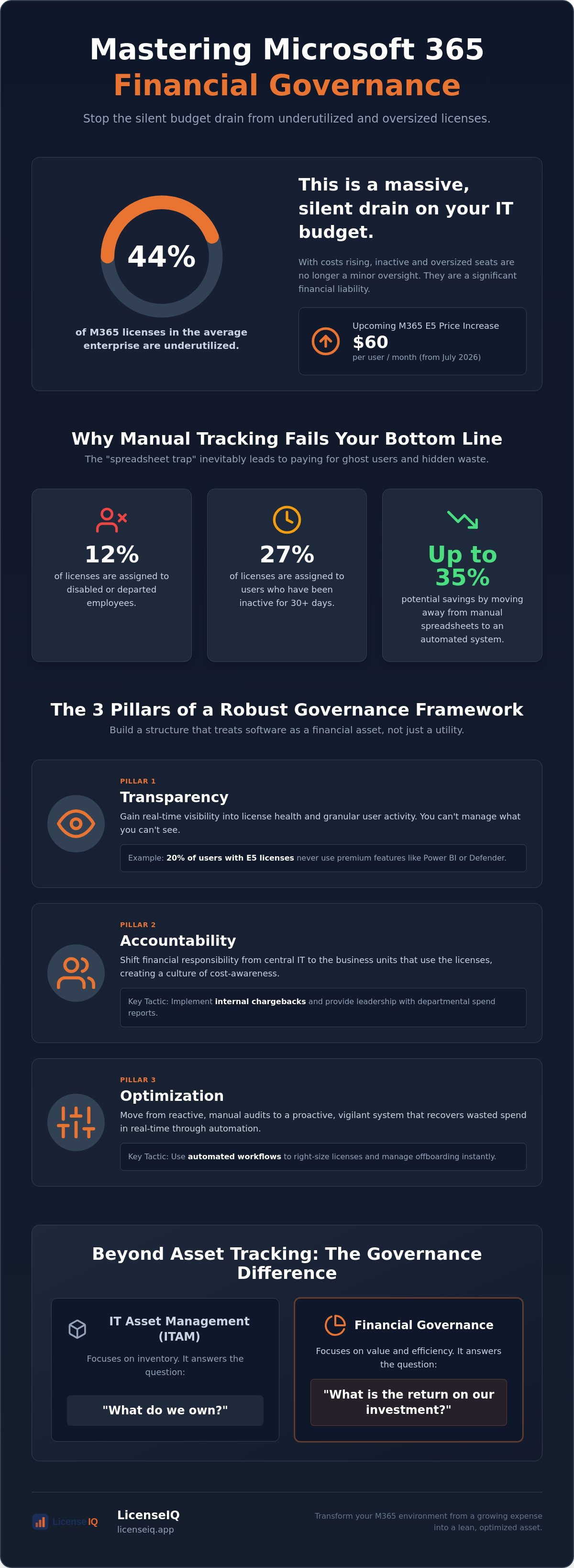
Did you know that 44% of Microsoft 365 licenses in the average enterprise are currently underutilized or oversized? With the July 2026 price increases pushing Microsoft 365 E5 costs to $60 per user, these inactive seats are no longer just a minor oversight. They represent a massive, silent drain on your IT budget. Mastering microsoft 365 financial governance is the only way to stop the bleed. You likely feel the frustration of unpredictable monthly invoices and the manual burden of auditing which employees actually use their high-tier features.
It is time to stop guessing and start governing. We understand that manual license tracking is a significant time-sink that often yields incomplete data. This article provides a comprehensive framework to give you total visibility and immediate spend recovery. You will learn how to right-size your environment through automated oversight and precise, data-driven decision-making. We aim to replace organizational disorder with total financial clarity.
We will preview the specific workflows needed to automate offboarding and explain how a License Health Score can establish a permanent financial baseline for your organization. By the end of this guide, you will have the tools to transform your Microsoft 365 environment from a growing expense into a lean, optimized asset. This strategy ensures your resources remain under the watch of a vigilant and precise system.
Key Takeaways
- Define the critical distinction between security and financial oversight to protect your bottom line with microsoft 365 financial governance.
- Identify the "spreadsheet trap" and learn why manual tracking systems inevitably lead to paying for departed or inactive employees.
- Follow a structured five-step roadmap to baseline your environment and right-size licenses based on verified user activity.
- Leverage automated workflows to replace reactive audits with a proactive, vigilant system that recovers wasted spend in real-time.
What is Microsoft 365 Financial Governance in 2026?
In 2026, a static approach to IT spending is a financial liability. Microsoft 365 financial governance is the strategic, real-time oversight of subscription costs and license utilization. It's no longer enough to simply manage access. You must manage value. While security governance focuses on who can enter your environment, financial governance focuses on what you pay for that access. This discipline ensures every dollar spent on the Microsoft cloud translates into measurable operational capacity.
The landscape changed significantly after the July 2026 price increases. With Microsoft 365 E5 seats now costing $60 per user, the margin for error has disappeared. Annual or even quarterly audits are obsolete. They leave too much room for "silent waste" to accumulate between checks. Modern governance requires continuous monitoring. It's the difference between a reactive cleanup and a proactive, vigilant system that identifies waste the moment it occurs.
Shadow IT and unassigned licenses represent the biggest threats to SMB budgets. It's common for departments to purchase specialized add-ons or premium licenses without central IT oversight. Without a clear framework, these costs spiral. Statistics show that 12% of licenses are often assigned to disabled or departed employee accounts. Financial governance provides the transparency needed to reclaim these resources immediately.
The Difference Between ITAM and Financial Governance
IT Asset Management (ITAM) tracks what you own. Financial governance tracks the value of those assets. It aligns with the broader principles of Corporate Governance of IT by ensuring technology investments map directly to business outcomes. In a modern FinOps environment, you don't just count seats. You measure the return on every license. This ensures you aren't paying for E5 features for a user who only needs basic email functionality.
Why Traditional Budgeting Fails M365 Tenants
The 3 Pillars of a Robust M365 Governance Framework
Success in the cloud requires more than technical configuration. It demands a structural framework that treats software as a financial asset. A high-performing microsoft 365 financial governance strategy rests on three distinct pillars: transparency, accountability, and optimization. These pillars work in tandem to eliminate organizational disorder and protect your bottom line from the rising costs of the Microsoft ecosystem.
Establishing Data Transparency
Transparency is your primary defense against waste. You cannot manage what you cannot see. This pillar requires real-time visibility into license health and granular user activity. It's not enough to know that a license is assigned. You must know if it's being used. Research indicates that 27% of licenses are assigned to users who have been inactive for 30 or more days. Without transparency, these "ghost" users continue to drain your budget every month.
Effective transparency involves tracking feature-level usage. For instance, 20% of users with E5 licenses never touch Power BI or Defender tools. By implementing SaaS spend optimization strategies, you can identify these discrepancies immediately. Using a License Health Score provides an essential baseline. It allows you to benchmark your current financial status against industry standards and set clear targets for recovery. You can check your own status by viewing a Spend Recovery Dashboard to see exactly where your capital is trapped.
Departmental Accountability and Chargebacks
Accountability shifts the responsibility for costs from IT to the business units. When departments are shielded from the financial impact of their requests, waste flourishes. Implementing internal chargebacks creates a culture of cost-awareness. Leadership should receive reporting that maps license costs directly to departmental output. This transparency forces managers to justify high-tier seats like the $60 M365 E5 license based on actual business needs. Clear reporting mechanisms show the ROI per department, making IT a partner in growth rather than just a cost center.
The final pillar is optimization. This is the active process of Microsoft 365 license optimization. It involves reclaiming unassigned seats and right-sizing oversized accounts. Optimization isn't a one-time event. It's a continuous cycle of refinement. By mastering microsoft 365 financial governance, you transform your tenant from a black box of expenses into a lean, high-ROI asset. This proactive approach ensures your resources remain under the watch of a vigilant and precise system.
Why Manual License Tracking Fails Your Bottom Line
Relying on manual spreadsheets for microsoft 365 financial governance is a strategy for failure. The moment an administrator saves a tracking document, it is already outdated. Static records cannot keep pace with the dynamic nature of cloud environments where users join, move, and leave daily. This "Spreadsheet Trap" creates a dangerous lag between actual license usage and financial records. You end up paying for resources that no longer exist in your operational reality.
Human error in offboarding remains the primary cause of financial leakage. When an employee departs, IT often disables the account but forgets to reclaim the license. This oversight leaves a $60 monthly E5 seat active and billing. Manual audits are not just inaccurate; they are an expensive use of talent. High-value IT engineers should focus on security architecture and innovation, not tedious license reconciliation. Every hour spent on manual tracking represents a significant opportunity cost for your organization.
Unmonitored licenses also introduce severe security vulnerabilities. Stale accounts with active licenses provide a larger attack surface for threat actors. If you don't have visibility into who is using what, you cannot maintain a Zero Trust posture. Financial governance and security are two sides of the same coin. Total clarity into your spend naturally leads to a more secure and resilient environment.
The Hidden Cost of 'Ghost' Licenses
Ghost licenses are paid seats with no active user login for 30 or more days. These silent budget killers often go undetected for months. Statistics show that 27% of licenses are assigned to users who have been inactive for over a month. For an SMB, carrying just 10 ghost E5 licenses results in $7,200 of pure waste annually. License Bloat is the systemic accumulation of unutilized premium features and redundant seats, projected to waste over $15,000 annually for every 100 users in 2026 if left unmanaged.
The Security-Finance Connection
Proactive financial governance naturally improves your security posture by enforcing strict account lifecycle management. Every reclaimed license is one less entry point for unauthorized access. To ensure you aren't leaving these doors open, follow a rigorous Office 365 offboarding checklist. Reclaiming this wasted spend is the most efficient way to fund critical security upgrades. By eliminating disorder in your billing, you generate the capital needed to invest in advanced threat protection and automated oversight.
Building Your Financial Governance Roadmap: A 5-Step Process
Establishing a clear path to recovery is the only way to reverse the trend of rising IT costs. A high-performing microsoft 365 financial governance strategy requires a structured, repeatable sequence of actions. This roadmap moves your organization from a state of disorder to one of total financial clarity. It replaces reactive troubleshooting with a proactive system of oversight. Follow these five steps to reclaim your capital and secure your tenant.
- Step 1: Baseline Audit. Scan your tenant to identify immediate waste. Use a tool to generate a License Health Score that establishes your current financial baseline.
- Step 2: Right-Sizing. Analyze actual feature usage. Downgrade users who are assigned premium licenses but only use basic functionality.
- Step 3: Reclamation. Revoke licenses from inactive accounts or staff who have already left the organization. Stop paying for "ghost" users immediately.
- Step 4: Policy Automation. Set hard rules for future license assignments. Ensure that new seats are granted based on verified business needs rather than default settings.
- Step 5: Continuous Monitoring. Establish a monthly review cycle. A vigilant system ensures that waste does not slowly accumulate after your initial cleanup.
Phase 1: Discovery and Right-Sizing
Start with a 5-minute audit to find quick wins. Connect your tenant to a monitoring platform to see exactly where your budget is trapped. You must compare Microsoft 365 license types to identify cheaper alternatives for your workforce. It's common to find users on the $60 M365 E5 plan who never touch Power BI or advanced security tools. Moving these individuals to a $39 E3 plan saves $21 per user every month. This right-sizing process can save up to 35% on software subscriptions when applied across the entire enterprise.
Identify "over-licensed" users by looking at the last 30 days of activity. If a user hasn't accessed premium features, they don't need a premium seat. This data-driven approach removes the politics from licensing decisions. You aren't just cutting costs. You are optimizing resources to match operational reality. This phase provides the immediate ROI needed to justify more advanced automation efforts.
Phase 2: Automation and Enforcement
Manual intervention is a bottleneck that leads to error. You must move toward Automated Governance Workflows to handle the lifecycle of every license. When an employee exits, the system should revoke their license instantly. Don't wait for a quarterly review to find seats assigned to disabled accounts. Set up automated alerts for when unassigned licenses exceed a specific threshold. If you carry a surplus of more than 5%, your "Vigilant Auditor" should notify you to adjust your subscription levels.
Integrating governance into your procurement workflow prevents "shadow IT" from bloating your invoices. Every new license request should be vetted against current unassigned inventory before a new purchase is authorized. This level of control ensures that your microsoft 365 financial governance remains robust as your company grows. You can deploy Automated Governance Workflows today to secure your environment and stop the financial drain permanently.
Automating Financial Oversight with LicenseIQ
Manual oversight is a liability in the 2026 cloud landscape. You have the roadmap for microsoft 365 financial governance; now you need the engine to drive it. LicenseIQ provides the AI-native foundation required to manage complex operational environments with precision. It transforms your tenant from a source of unpredictable costs into a lean, transparent asset. By deploying Automated Governance Workflows, you eliminate the human error that leads to silent waste and organizational disorder.
The Spend Recovery Dashboard provides immediate clarity. It does not just report on what you spend. It uncovers exactly what you are wasting. This proactive approach ensures your resources remain under the watch of a vigilant system that never sleeps. LicenseIQ acts as a digital auditor, constantly scanning for opportunities to right-size your environment without the need for manual intervention. It is the resolution to the spreadsheet trap.
Continuous Optimization via AI
LicenseIQ scans every license and user across your tenant to uncover obscured details that manual audits miss. It identifies users who are over-licensed for their actual feature usage. The platform generates a License Health Score, providing a single metric for your M365 financial hygiene. LicenseIQ recovers up to 35% of spend in minutes by identifying oversized licenses and ghost accounts. This level of continuous optimization ensures your budget is always aligned with your operational reality.
Getting Started with Automated Governance
The setup process is fast and secure. You can connect your tenant in under five minutes to receive an immediate financial baseline. Once the scan is complete, use the Spend Recovery Dashboard to present concrete savings to your CFO. You move from defensive budgeting to proactive resource management. Secure your resources and stop the financial drain today. Audit your M365 tenant for free with LicenseIQ to see exactly how much you can recover.
Secure Your Budget with Automated Oversight
The era of passive license management is over. With rising subscription costs, your organization cannot afford the spreadsheet trap or the drain of ghost licenses. Establishing microsoft 365 financial governance ensures that every dollar spent aligns with actual user activity and business value. You have seen how automated workflows and real-time transparency replace organizational disorder with total financial clarity. It is time to move from reactive auditing to a state of continuous optimization.
LicenseIQ provides the tools to recover up to 35% of wasted spend while delivering an instant License Health Score. Our AI-native Automated Governance Workflows act as a vigilant auditor that never sleeps, protecting your resources around the clock. This system ensures your IT budget remains a lean asset rather than a growing liability. Stop guessing and start governing with a platform designed for the complexities of the 2026 cloud environment.
While optimizing your software spend is a critical first step toward fiscal responsibility, extending these efficiency goals to your physical infrastructure through green building certifications with Ekocentric can further enhance your organization's long-term sustainability.
Start your 5-minute M365 spend recovery audit now and reclaim your IT budget today. Achieve the oversight your enterprise deserves and build a leaner, more resilient digital future. Your path to total financial transparency starts with a single scan.
Frequently Asked Questions
What is the difference between M365 cost management and financial governance?
Cost management is the reactive process of tracking and paying your monthly bill. In contrast, microsoft 365 financial governance is a proactive framework that establishes policies for license value and utilization. It ensures that every subscription dollar maps to a specific business outcome rather than just covering a seat count.
How much can SMBs typically save through financial governance?
SMBs typically save up to 35% on their software subscriptions by implementing a structured governance strategy. These savings come from identifying ghost licenses and downgrading users who don't utilize premium E5 features. This reclaimed capital can then be reinvested into higher-priority technical projects.
Does Microsoft 365 provide built-in tools for financial governance?
Microsoft offers static reports in the Admin Center, but they lack actionable recovery recommendations. These native tools don't actively suggest downgrades or automate the reclamation of licenses from departed staff. A dedicated microsoft 365 financial governance platform is required for real-time, continuous optimization.
What are the biggest risks of poor M365 financial oversight?
The primary risks are significant budget leakage and increased security vulnerabilities. Ghost licenses assigned to inactive or departed employees create a larger attack surface for threat actors. Without oversight, your organization suffers from unpredictable invoices and organizational disorder that drains IT resources.
How often should we conduct a Microsoft 365 license audit?
Manual annual audits are obsolete in 2026. You must shift to continuous monitoring to catch waste the moment it occurs. Automated systems maintain a permanent financial baseline, replacing the need for time-consuming manual reviews and ensuring your tenant is always right-sized.
Can financial governance help with M365 budget forecasting?
Governance improves forecasting by providing a clear License Health Score and granular usage data. You can predict future spend based on actual departmental growth rather than inflated historical averages. This transparency allows leadership to allocate resources with total confidence and precision.
Is automated governance secure for sensitive company data?
Automated governance is highly secure because it monitors license metadata rather than sensitive document content. Platforms connect via secure APIs to provide oversight without compromising data privacy. This process actually strengthens security by ensuring that only active, authorized users have access to premium tools.
How do I start a financial governance program with no IT degree?
You can start a governance program by using automated platforms that offer intuitive, results-first dashboards. These systems provide specific recovery recommendations that don't require deep technical expertise to execute. You simply connect your tenant to a digital auditor to gain immediate clarity and control.


