

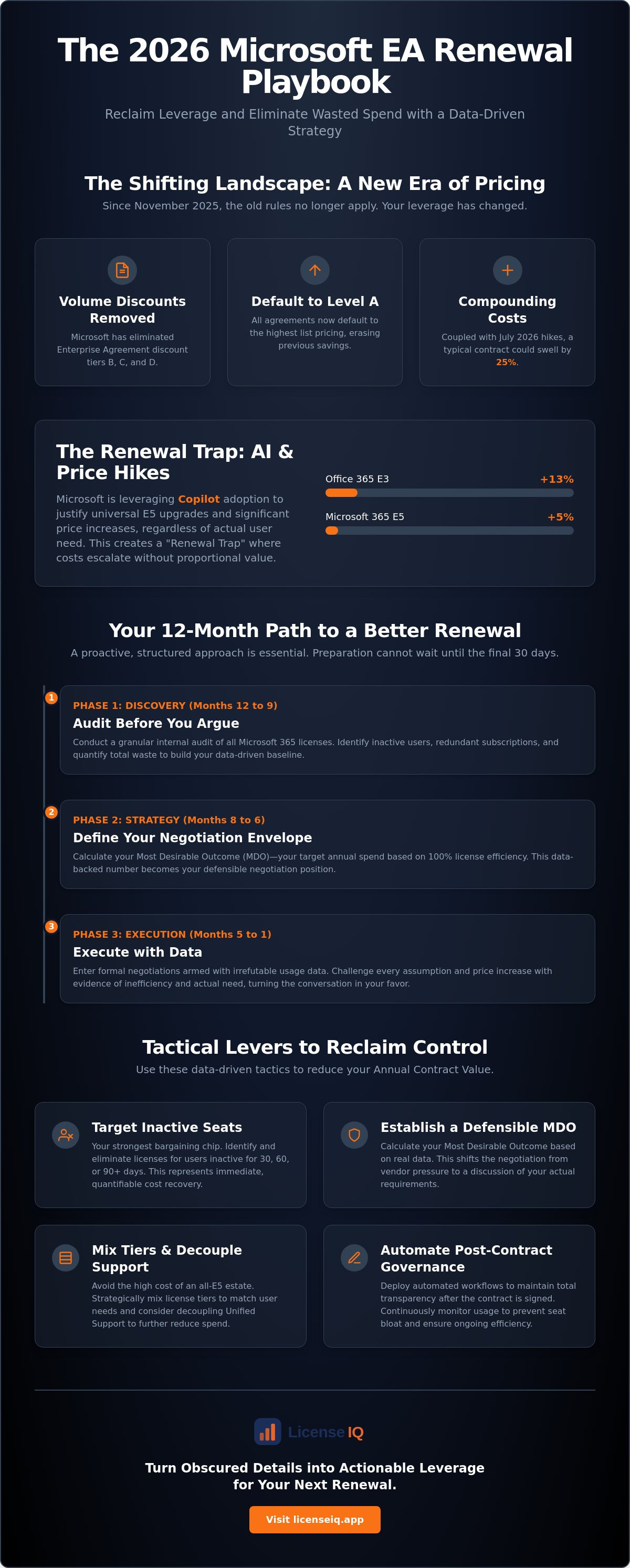
Your volume discount is dead. Since November 2025, Microsoft has eliminated tiers B, C, and D, defaulting all Enterprise Agreements to Level A list pricing. This structural shift means a typical $10 million contract could swell by 25% as the July 1, 2026, price hikes take hold. You're likely feeling the pressure of these compounding costs and the aggressive push toward expensive Copilot tiers. It's nearly impossible to negotiate effectively when you lack granular visibility into actual license usage or fear a surprise audit penalty during renewal talks.
A rigorous microsoft 365 renewal cost analysis is now your only path to reclaiming leverage. We'll show you how to master the 2026 data-driven playbook to reduce your annual contract value and eliminate wasted spend. This guide provides the tactics needed to right-size your license tiers for actual 2026 requirements and establish a defensible data position that Microsoft cannot dispute. We'll break down the specific pricing resets for E5 and Office 365 E3 plans, providing a step-by-step framework to transform organizational disorder into a streamlined, cost-effective infrastructure that protects your corporate resources.
Key Takeaways
- Identify how the 2026 EA landscape, defined by AI-tier saturation and the removal of volume discounts, fundamentally shifts negotiation leverage.
- Perform a granular microsoft 365 renewal cost analysis to quantify license efficiency and use inactive seats as your primary bargaining chip.
- Establish a defensible negotiation envelope by calculating your Most Desirable Outcome based on data rather than vendor pressure.
- Reduce annual contract value by decoupling Unified Support and strategically mixing license tiers to avoid the costs of an all-E5 estate.
- Deploy LicenseIQ and automated governance workflows to maintain total transparency and prevent seat bloat after the contract is signed.
The 2026 Microsoft Enterprise Agreement Landscape
A Microsoft Enterprise Agreement (EA) is a three-year commitment for organizations with 500 or more users. It's no longer a simple procurement exercise. The 2026 landscape is defined by the removal of volume-based discount tiers and an aggressive push for AI-integrated tiers. A comprehensive microsoft 365 renewal cost analysis is now your primary tool for financial oversight. Without it, you're defaulting to list pricing that can increase your annual contract value by up to 25%.
The 2026 renewal cycle is unique. It's characterized by the saturation of Copilot and complex AI-tier pricing. Many organizations fall into the "Renewal Trap." This happens when Microsoft pushes for universal E5 upgrades regardless of your actual user requirements. They claim these upgrades are essential for security or AI readiness. You must shift from a reactive renewal to a proactive optimization event. This requires total transparency into your digital estate to prove granular inefficiency. Proving this waste is the only way to stop the vendor from dictating your costs.
New 2026 Pricing Drivers and AI Impacts
Microsoft 365 Copilot adoption is the strongest lever used to force E5 renewals. By bundling AI capabilities into premium tiers, the vendor justifies price increases like the 13% hike for Office 365 E3 or the 5% increase for E5. Multi-national agreements also face volatile regional price adjustments. Negotiation metrics are evolving; the focus is moving from simple "User-Based" counts to "Value-Based" metrics. You need to demonstrate that the value Microsoft promises isn't being realized by every user group. If a user doesn't use the premium features, they shouldn't carry a premium price tag.
The Standard 12-Month Renewal Timeline
Effective negotiation requires a structured approach. You can't fix a billion-dollar contract in the final 30 days. Preparation must be meticulous and data-driven.
- Phase 1: Discovery (Months 12 to 9). Conduct an internal discovery and usage audit. Identify exactly which Microsoft 365 license types are active and where you have significant waste.
- Phase 2: Strategy (Months 8 to 6). Define your Most Desirable Outcome (MDO). This is your target annual spend based on 100% license efficiency.
- Phase 3: Execution (Months 5 to 1). Enter formal negotiations and perform vendor benchmarking. Use your data to challenge every price increase.
Deploying LicenseIQ early in this timeline allows you to establish a defensible data position. It turns obscured details into actionable leverage, ensuring your resources are monitored by a vigilant system. This proactive stance is the only way to secure a favorable renewal in a high-inflation software market.
Audit Before You Argue: Building Your Data-Driven Baseline
You can't negotiate from a position of uncertainty. Microsoft relies on your lack of visibility to push high-margin SKUs. Establishing a License Health Score transforms your infrastructure from a black box into a transparent asset. This metric quantifies your license efficiency, giving you a single number to defend during procurement meetings. By aligning with Gartner's 5-Phase Approach, your team moves from speculative estimates to a rigorous, data-backed stance.
Inactive users are your strongest bargaining chip. If a user hasn't accessed the environment in 90 days, you don't need to pay for their seat. A precise microsoft 365 renewal cost analysis identifies these gaps, allowing you to reclaim significant annual spend. Documenting this Health Score creates a formal audit trail. It protects your procurement team from vendor pressure and ensures your resources are monitored by a vigilant system.
Eliminating Inactive and Redundant Licenses
Automate the discovery of users who haven't logged in for 30, 60, or 90 days. These accounts represent immediate cost-recovery opportunities. You must also identify license overlap where users hold multiple redundant subscriptions across different tiers. License redundancy occurs when a single user is assigned multiple overlapping subscriptions that provide the same functional capabilities, resulting in unnecessary capital outflow. Removing these overlaps is a quick win that directly impacts your bottom line.
The Automated Governance Advantage
Manual audits are obsolete. They're prone to human error and outdated the moment the spreadsheet is saved. Automated governance workflows replace massive, IT-led spreadsheets with real-time data. You transition from a static "snapshot" to continuous financial accuracy. This level of oversight ensures you're always one step ahead of the vendor. Transitioning to LicenseIQ allows you to scan every user and license in minutes for immediate insights. It's a proactive way to maintain total operational transparency throughout the 2026 renewal cycle.
Defining Your Negotiation Envelope: MDO, LDO, and BATNA
Negotiation is a data submission, not a conversation. To secure a favorable agreement in 2026, you must define your boundaries before the first meeting. A rigorous microsoft 365 renewal cost analysis provides the specific boundaries your procurement team needs to resist vendor pressure. You aren't just asking for a lower price. You're presenting a defensible position based on proven license efficiency. This approach moves the discussion from subjective "value" to objective data.
Your negotiation envelope consists of three critical pillars. The Most Desirable Outcome (MDO) represents your target annual spend. It's calculated by assuming 100% license efficiency across your entire estate. The Least Desirable Outcome (LDO) is your ceiling. It's the maximum price increase you'll absorb before walking away. Finally, your Best Alternative To a Negotiated Agreement (BATNA) is your escape hatch. This might involve moving to the Cloud Solution Provider (CSP) model or significantly reducing license tiers for non-power users. Knowing your BATNA gives you the confidence to say no to unfavorable terms.
Calculating Your Target ACV
Benchmarking your current spend against "Recoverable Waste" is the first step in setting your MDO. Use the insights from your usage audit to identify exactly where capital is leaking. You must also factor in growth projections for the next 36 months. Over-provisioning at the start of a three-year term is a common mistake that leads to millions in wasted spend. Utilize "Step-Up" licenses to manage these costs. Step-Ups allow you to transition users to higher-tier licenses only when the functional need arises, rather than paying for premium features on day one.
Establishing the Walk-Away Position
Your LDO must account for the elimination of volume-based discount tiers. Since former Level B, C, and D customers now face list pricing, your walk-away position should be informed by these 6% to 12% baseline increases. If Microsoft's proposal exceeds these figures without providing equivalent value, consider the CSP model. CSP offers the flexibility to scale seat counts up or down monthly, which is often more cost-effective than a bloated EA. Assess Unified Support fees as a separate lever. These fees are a percentage of your total licensing spend; reducing your license ACV automatically lowers your support costs. Demand non-negotiable contract terms like price caps for future seat additions to protect your budget from mid-term spikes.
Tactical Levers: Support Splitting and License Mixing
Securing a favorable renewal requires moving beyond simple seat counts. You must manipulate the actual structure of the agreement to reclaim capital. The "Split" tactic is a high-impact move where you decouple Unified Support from your Enterprise Agreement. Since Unified Support costs are calculated as a percentage of your total licensing expenditure, a bundled agreement creates a cycle of locked-in inflation. By treating these as separate negotiation events, you prevent the vendor from leveraging your support needs to force higher license tiers.
License mixing is your primary defense against the universal E5 mandate. A 100% E5 estate is rarely the optimal financial choice for any organization. A granular microsoft 365 renewal cost analysis often reveals that a significant portion of your workforce only requires basic productivity tools. Implementing the "F-Series" strategy allows you to move frontline or light-usage workers to F1 or F3 licenses. This shift can reduce individual seat costs significantly while maintaining essential connectivity. You should also negotiate your Azure commitment discounts alongside your M365 seat counts. Bundling these cloud services creates a broader negotiation surface where Microsoft has more room to offer concessions.
The E3 vs. E5 Decision Matrix
Don't pay for security features your team doesn't utilize. Many organizations upgrade to E5 for Advanced Threat Protection or eDiscovery features that remain dormant. Use your usage data to prove that "Security-only" users don't need the full E5 productivity suite. You can often achieve the same security posture by mixing E3 licenses with specific add-on SKUs. Review how to reduce M365 subscription costs to compare specific tier benefits against your actual consumption patterns. This data-backed approach ensures you only pay for the value you extract from the ecosystem.
Timing and Vendor Pressure
Leverage Microsoft’s fiscal year-end on June 30th for maximum discount pressure. Account managers are highly motivated to close deals before this date to meet internal quotas. When they present a "Final Offer," check the coterminous dates of all your services. Coterminous dates ensure all your subscriptions expire at the same time. This gives you a single, powerful point of leverage every three years. Don't let account managers rush you into a sub-optimal agreement through artificial urgency. If the data doesn't support the spend, hold your ground until the terms align with your Most Desirable Outcome.
To identify these specific mixing opportunities in your environment, access your Spend Recovery Dashboard for immediate visibility into license waste.
Automating the Position: Continuous Governance with LicenseIQ
Signing the contract isn't the finish line. It's the starting point for the next three years of financial management. Seat bloat often returns within weeks of a new agreement if oversight isn't persistent. Your microsoft 365 renewal cost analysis must become a continuous process rather than a triennial scramble. Implementing Automated Governance Workflows prevents the slow accumulation of wasted capital. It ensures your environment stays as lean on day 1,000 as it was on day one.
Efficiency requires constant vigilance. You need real-time alerts to stop capital leakage before it compounds across your entire estate. By monitoring usage patterns daily, you ensure your License Health Score remains at its peak throughout the agreement term. This proactive stance transforms your organization from a passive payer into an active participant in its own financial health. You don't wait for the next renewal to find savings. You capture them the moment they appear.
Setting up real-time alerts is vital for maintaining this posture. These alerts should target specific areas of waste:
- Unassigned licenses sitting idle in your tenant.
- Accounts with no login activity for over 30 days.
- Users holding premium E5 licenses who only utilize E3-level features.
- Duplicate licenses assigned to a single identity across different sub-tenants.
From Manual Spreadsheets to AI Intelligence
Traditional IT Asset Management is too slow for modern operations. The LicenseIQ Platform connects to your environment in minutes, providing a clear 35% savings roadmap. This represents a fundamental shift from manual data entry to Automated Software Intelligence. By utilizing the Spend Recovery Dashboard, you provide the CIO with precise executive reporting. It replaces vague estimates with hard data, showing exactly how much capital has been reclaimed and protected from vendor price hikes. This level of transparency is the cornerstone of corporate resource guardianship.
Future-Proofing Your Microsoft Spend
Start planning for your 2029 renewal on day one of your 2026 agreement. Maintaining a "Clean Estate" is the only way to ensure your next negotiation is even more successful. Automating the offboarding process allows you to reclaim licenses instantly when a user leaves the organization. This prevents "zombie" accounts from lingering on your bill for months. Integrate this into your standard operations by following the Office 365 offboarding checklist. Using LicenseIQ to enforce these workflows ensures your resources are always monitored by a precise, vigilant system that is always one step ahead.
Secure Your 2026 Negotiation Position
The 2026 renewal landscape demands a shift from passive procurement to aggressive optimization. You've seen how the removal of volume discounts and the push for AI tiers can inflate your annual contract value. Success requires a defensible position built on granular usage data. By decoupling Unified Support and strategically mixing license tiers, you reclaim the leverage Microsoft attempted to eliminate. A precise microsoft 365 renewal cost analysis ensures you aren't over-provisioning for premium features that your users don't actually need.
Discover your M365 Health Score and recover wasted spend before your renewal to save up to 35% on your M365 subscriptions. Deploy the system today to protect your corporate resources and ensure every dollar spent drives actual operational value.
Frequently Asked Questions
How early should I start preparing for my Microsoft EA renewal?
Start your preparation exactly 12 months before the agreement expires. This timeline allows for three months of deep usage auditing and a preliminary microsoft 365 renewal cost analysis. You need this window to build a defensible data position before formal negotiations begin in the final five months of the term.
Can I reduce my seat count during an Enterprise Agreement renewal?
You can absolutely reduce your seat count during the renewal window. This is the only time you can lower your commitment without financial penalty. While you can't reduce below the 500-user minimum for an Enterprise Agreement, you can eliminate all inactive or redundant licenses to lower your annual contract value.
What is the difference between an EA and a CSP for SMBs in 2026?
The primary difference is commitment flexibility. An EA locks you into a three-year term with fixed pricing, while the Cloud Solution Provider (CSP) model allows for monthly seat adjustments. Since Microsoft eliminated volume-based discount tiers in late 2025, the price gap between EA and CSP has narrowed significantly for many organizations.
How do I prove to Microsoft that my users do not need E5 licenses?
Proving E5 isn't necessary requires granular usage telemetry. You must demonstrate that premium security or compliance features remain untouched by specific user groups. Performing a detailed microsoft 365 renewal cost analysis provides the audit trail needed to justify mixing E3 and F-series licenses instead of a full E5 estate.
What are the risks of splitting Unified Support from my EA?
Splitting Unified Support primarily risks losing the consolidated billing structure. You'll need to manage a separate contract and vendor relationship for support services. However, this decoupling is a vital financial strategy that prevents your support costs from automatically rising when license prices increase during the 2026 price hikes.
How can AI tools like LicenseIQ help with negotiation?
LicenseIQ automates the identification of capital leakage that manual audits miss. It connects to your tenant in minutes to uncover inactive users and license overlaps. This provides your procurement team with a Spend Recovery Dashboard, turning obscured details into actionable negotiation leverage that Microsoft cannot easily dispute.
What is a Health Score in the context of M365 licensing?
A License Health Score is a numerical value that represents your total licensing efficiency. It measures the alignment between your current subscription spend and actual feature utilization. Maintaining a high score ensures your resources are monitored by a vigilant system, preventing seat bloat throughout your three-year agreement cycle.


