

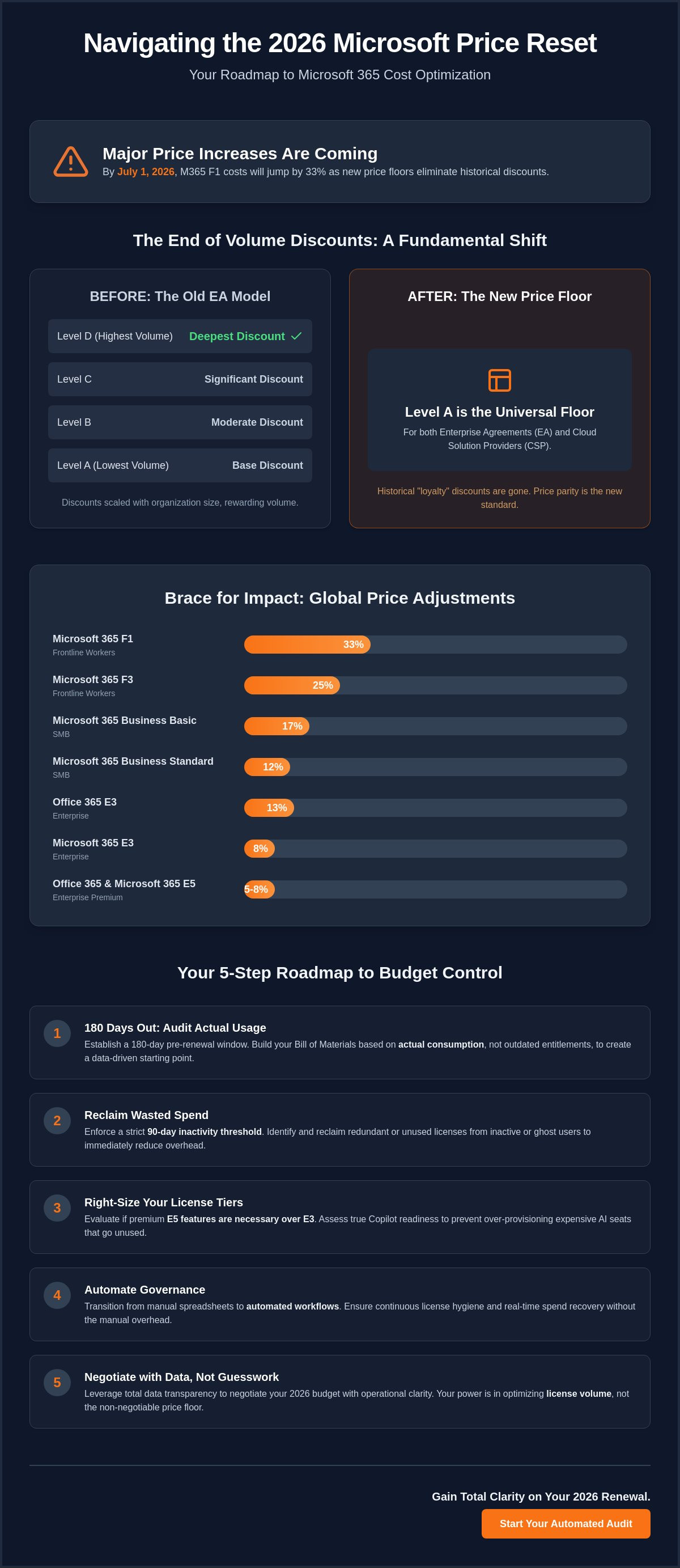
By July 1, 2026, your Microsoft 365 F1 costs will jump by 33% as the new Enterprise Agreement price floor eliminates traditional Level A-D discounts. This isn't just a routine adjustment; it's a fundamental shift toward price parity between EA and CSP programs that removes your historical negotiation leverage. You're likely struggling with forced bundling and zero visibility into whether your users actually need these premium AI features. Mastering microsoft nce cost optimization is now the only way to prevent these compounding increases from shattering your IT budget.
You deserve a renewal process built on data transparency rather than guesswork. We'll show you how to maintain a flat budget despite these list price increases by automating wasted spend discovery and license recovery. This checklist provides a precise roadmap to navigate the 2026 renewal cycle with total oversight. You'll learn how to audit your current utilization, identify underused SKUs, and enter negotiations with the confidence of a digital auditor who knows exactly where every dollar goes. We've mapped out the specific price hikes for every major SKU to ensure your financial health remains secure.
Key Takeaways
- Establish a 180-day pre-renewal window to build a Bill of Materials based on actual consumption rather than outdated entitlements.
- Execute advanced microsoft nce cost optimization by identifying redundant licenses and enforcing a strict 90-day inactivity threshold for reclamation.
- Evaluate the necessity of premium E5 tiers against E3 alternatives and assess Copilot readiness to prevent over-provisioning expensive AI seats.
- Transition from manual audits to automated governance workflows that ensure continuous license hygiene and real-time spend recovery.
- Leverage data transparency to negotiate your 2026 budget with total operational clarity, offsetting the impact of the global price reset.
The 2026 Microsoft EA Landscape: Understanding the Price Reset
The 2026 Microsoft Enterprise Agreement (EA) Price Reset represents a fundamental restructuring of how licenses are sold and managed. It's no longer just about annual adjustments. On July 1, 2026, Microsoft will implement a global price hike that specifically targets the most common M365 and O365 plans. For SMBs, this change is compounded by the shift toward price parity between different purchasing programs. Understanding these shifts is the first step in effective microsoft nce cost optimization. A Microsoft Enterprise Agreement traditionally offered a predictable path for growth, but the new landscape demands a more proactive approach to financial management.
The End of Volume Discounts: Level A is the New Floor
Historically, the EA model rewarded scale. Organizations moved through Levels A, B, C, and D, securing deeper discounts as their seat counts grew. This ended with the policy shift in November 2025. Microsoft has now established Level A as the universal price floor for both EA and Cloud Solution Provider (CSP) programs. This change creates an immediate, invisible cost increase of 9% to 12% for larger organizations that previously relied on tier-based savings. List price is now your starting point. You cannot negotiate the floor; you must optimize the volume of licenses you actually commit to. This policy maturation in 2026 means that your historical "loyalty" discounts have effectively vanished.
July 2026 Global Price Adjustments
The July 2026 adjustments are aggressive and vary significantly by SKU. Frontline workers see the steepest climb, which directly impacts operational budgets for retail, manufacturing, and healthcare sectors. The specific increases include:
- Microsoft 365 F1: 33% increase
- Microsoft 365 F3: 25% increase
- Microsoft 365 Business Basic: 17% increase
- Microsoft 365 Business Standard: 12% increase
- Office 365 E3: 13% increase
- Microsoft 365 E3: 8% increase
- Office 365 and Microsoft 365 E5: 5% to 8% increase
Microsoft justifies these hikes by pointing to the integration of AI features and over 1,100 new capabilities added to the stack. However, the actual value realized by your average user often lags behind these premium price points. Without a focused strategy for microsoft nce cost optimization, you're paying for "value" that remains dormant in your tenant. Forced bundling of AI features into standard SKUs means you're funding Microsoft’s R&D regardless of your specific operational needs. Tools like the LicenseIQ Platform become vital here to identify where these features go unused. Copilot for Business is now available at a 30% discount for those under 300 seats, but the underlying M365 price increases often negate these promotional savings.
Phase 1: The 2026 Usage Audit Checklist
Stop negotiating against a wall of opaque data. Most organizations focus exclusively on lowering the unit price of a license while ignoring the consumption gap. This gap is the delta between what you pay for and what your workforce actually uses. Effective microsoft nce cost optimization begins with a meticulous audit of your tenant. You can't secure a budget for 2026 if you're currently funding ghost accounts and redundant SKUs. Data transparency is your only leverage in a landscape where price floors are non-negotiable.
Identifying Inactive and Ghost Users
A wasted license in a hybrid environment isn't just a deleted account that was never deprovisioned. It's a user who hasn't opened a specific application in months. We recommend a strict 90-day inactivity threshold to identify these targets. Manual reporting through the M365 Admin Center is possible, but it's time-consuming and often lacks the granular detail needed for financial decisions. License reclamation is the process of harvesting these unused seats for future growth instead of purchasing new entitlements.
The 5-Minute Discovery Protocol
Spreadsheets are the enemy of accuracy. Manual audits take weeks and are outdated the moment they're finished. Connecting an AI-native platform provides immediate dollar-value visibility into your tenant. The LicenseIQ Spend Recovery Dashboard acts as your audit engine, scanning for overlapping SKUs where a user might hold both an E3 and a standalone Project license they don't use. This level of oversight is necessary because Microsoft's licensing terms have historically been complex and subject to intense scrutiny, as seen in the Department of Justice's findings on Microsoft regarding market behavior.
Beyond inactivity, you must map Shadow IT. Individual NCE signups often bypass central procurement. This creates fragmented spend hidden from your primary EA. These commitments often carry a 20% premium compared to annual terms. Identifying these hidden costs is essential for microsoft nce cost optimization. Once you've cleared the noise, calculate your License Health Score. This metric benchmarks your current waste levels, giving you a baseline to measure success during the 2026 renewal. If your score is low, you're leaving money on the table. You can check your license health score today to start uncovering these obscured details before your next cycle begins.
Phase 2: License Right-Sizing and Tier Optimization
Identifying inactive users is only the first step in reclaiming your budget. The second, more complex step involves ensuring your active users aren't over-licensed. Microsoft nce cost optimization requires a granular look at user personas to match employees with the minimum viable license that meets their operational needs. Many SMBs default to high-tier SKUs like E5 for the entire organization, effectively subsidizing premium features that only a fraction of the workforce uses. Precision in tier selection is your best defense against the 2026 price floor reset.
Microsoft 365 E3 vs. E5: The 2026 Value Gap
The price gap between E3 and E5 tiers is significant. To justify the E5 premium, your users must actively utilize advanced analytics and security features. For most non-power users, the core productivity suite in E3 is more than sufficient. You should evaluate the necessity of E5-only features like Power BI Pro, Advanced Audit, and Defender for Endpoint on a per-user basis. If your security team relies on government guidance on system hardening, they might require the advanced automated investigation capabilities of E5, but your general administrative staff likely does not. For a deeper dive into these differences, read our analysis on Microsoft 365 E3 vs. E5: Is the Upgrade Worth It?
Leveraging F-Series Licenses for Frontline Savings
Frontline workers represent the largest opportunity for immediate savings. Employees who only require mobile or web-based access to M365 often don't need the full desktop application rights included in E-series licenses. Moving these task-based employees from E3 to F3 can yield 60-70% savings per seat. While F-series plans will see the highest percentage increases in July 2026, their base cost remains a fraction of enterprise tiers. You can find specific SKU details in our Microsoft 365 License Types: The Comprehensive 2026 Reference Guide.
Effective microsoft nce cost optimization also involves assessing Copilot readiness. AI seats are expensive. Over-provisioning Copilot licenses before your data environment is ready for deployment leads to massive budget leaks. We recommend creating a Right-Sizing Matrix that categorizes users into three personas:
- Power Users: E5 + Copilot (Heavy analytics and security focus)
- Knowledge Workers: E3 (Standard productivity and desktop apps)
- Frontline Workers: F1/F3 (Web/Mobile only, task-based access)
Phase 3: The 180-Day Renewal Timeline & Negotiation Strategy
Waiting until your renewal month to review your Microsoft footprint is a guaranteed way to overspend. The 2026 price reset removes the safety net of tiered discounts, making early preparation essential. A structured 180-day timeline allows you to transition from reactive purchasing to a data-driven Bill of Materials (BOM). This BOM should reflect your actual usage patterns rather than your current entitlements. Effective microsoft nce cost optimization requires this lead time to execute necessary "true-downs" before you're locked into new, higher price floors.
The Countdown: 180, 90, and 30 Days Out
Success requires a disciplined approach to the calendar. At the 180-day mark, run your first automated scan using the LicenseIQ Platform. This establishes your baseline License Health Score and uncovers obscured waste. By identifying these gaps early, you have six months to reallocate resources or plan for seat reductions. It's the difference between a panicked estimate and a calculated financial strategy.
At 90 days, focus on hygiene. Execute your employee offboarding workflows to ensure the tenant is clean. This prevents paying for licenses attached to departed staff or inactive project accounts. Finally, at 30 days, finalize your BOM. This is your definitive list of required SKUs. Submit your renewal intent to your reseller with 100% data transparency, leaving no room for "estimated" growth buffers that inflate your costs.
Negotiating from a Position of Data
Aggressive upsells thrive on a lack of visibility. When you present Microsoft or your reseller with a report of actual usage versus provisioned seats, you shift the power dynamic. You aren't just asking for a better price; you're demonstrating that you know exactly what you don't need. In 2026, the most powerful negotiation tool is a report showing exactly how many licenses you do not need.
Many organizations believe the myth that Microsoft won't allow a true-down during a renewal. This is incorrect. While NCE terms restrict mid-term reductions, your renewal window is your contractual opportunity to align your seat count with reality. Whether you stay on an Enterprise Agreement or move to a CSP model to avoid the new Level A floor, your leverage comes from usage data. This level of oversight ensures your 2026 budget remains secure despite the global price hikes. To get started, you can generate your custom usage report and enter your next negotiation with total confidence.
Continuous Governance: Beyond the 2026 Renewal
Your 2026 renewal is a milestone, not the finish line. License sprawl is a silent budget killer that operates between contract cycles, often going unnoticed until the next invoice arrives. Point-in-time audits provide a helpful snapshot, but they fail to capture the daily shifts in workforce requirements. You must transition to automated governance workflows to maintain a lean tenant. This proactive stance ensures you never pay for a seat that isn't actively generating value. Continuous hygiene is the only way to protect your margins against future price fluctuations.
The ROI of Automated License Management
The financial case for automation is undeniable. Industry data indicates that the average M365 tenant contains 35% waste due to inactive accounts and over-provisioned tiers. Relying on manual spreadsheets to manage this complexity is a liability for any modern organization. By mastering the Microsoft 365 license management lifecycle in 2026, you replace guesswork with surgical precision. The cost of an optimization platform is a small fraction of the total recovered spend. For specialized leadership, this isn't just about IT maintenance; it's about rigorous financial hygiene and the elimination of operational disorder.
Effective microsoft nce cost optimization requires a system that monitors your resources with vigilance. Automated workflows can deprovision licenses the moment an employee offboards or downgrade a tier if usage drops below a specific threshold. This eliminates the "set and forget" mentality that leads to budget leaks. You gain the confidence that your resources are being monitored by a precise system that is always one step ahead of the next billing cycle.
Setting Up Your Spend Recovery Dashboard
Achieving total oversight doesn't require months of technical implementation. You can connect an AI-native tool to your tenant in minutes to gain immediate clarity. The Spend Recovery Dashboard provides a real-time view of your financial health, surfacing obscured details that manual audits miss. It utilizes the License Health Score as a primary KPI for both IT and finance leadership. This score tracks unassigned licenses and inactive users, providing a clear benchmark for efficiency. You can recover your wasted M365 spend today with LicenseIQ and start building a more transparent operational environment.
Automated alerts notify your team the moment a license becomes redundant. This keeps your organization in a permanent Renewal-Ready state, avoiding the frantic data collection typical of the 180-day window. Your data remains audit-grade every day of the year. This level of transparency is the cornerstone of sustainable microsoft nce cost optimization. It transforms your IT department from a cost center into an active participant in the company’s financial growth.
Secure Your 2026 Operational Budget Now
Implementing a rigorous strategy for microsoft nce cost optimization transforms your IT department from a passive cost center into a model of financial efficiency. You deserve a clear view of your operational spend without the burden of manual spreadsheets. Our AI-native platform was built specifically for SMB IT leadership to uncover obscured details and eliminate organizational disorder. It's time to replace guesswork with data-driven oversight and precision.
Scan your tenant and get your License Health Score in 5 minutes to identify exactly where your budget is leaking. Most organizations save up to 35% on M365 subscriptions by simply reclaiming what they already own. Secure your resources today and enter your next negotiation with the confidence of a digital auditor who is always one step ahead.
Frequently Asked Questions
How much are Microsoft EA prices increasing in 2026?
Microsoft 365 prices will increase between 5% and 33% effective July 1, 2026, depending on the specific plan. Frontline plans face the steepest adjustments, with Microsoft 365 F1 increasing by 33% and F3 by 25%. Enterprise tiers like M365 E3 and E5 will see smaller hikes of 8% and 5% respectively. These new rates apply to all new and renewing customers on or after the effective date.
What is the difference between an EA True-Up and a True-Down?
An EA True-Up is an annual reconciliation where you pay for additional seats added during the year, while a True-Down is the reduction of your total seat count. Under standard agreement terms, you're typically only permitted to execute a True-Down during your anniversary or renewal window. This makes the renewal period the most critical time for microsoft nce cost optimization to ensure you aren't paying for ghost users.
Can I reduce my seat count during a Microsoft EA renewal in 2026?
Yes, you can reduce your seat count during the renewal window to align your contract with actual usage. This is the only time you can significantly decrease your commitment without financial penalty. You must submit your revised seat counts before the new term begins to avoid being locked into higher volumes for the next three years. Early data collection is essential to identify these reduction opportunities.
What happens to my volume discounts in the new 2026 pricing model?
Traditional volume discounts for Levels A through D are being replaced by a universal price floor to establish parity between EA and CSP programs. This shift effectively eliminates the 9% to 12% discount that larger organizations previously relied on to manage costs. Level A has become the new baseline for almost all renewals starting in 2026. You must now find savings through usage efficiency rather than volume-based negotiation.
Is it better for an SMB to move from an EA to a CSP in 2026?
The choice depends on your need for flexibility versus price stability. An EA allows you to lock in pricing for three years, protecting you from mid-term hikes, but offers limited ability to reduce seats. A CSP provides monthly flexibility but carries a 20% premium for those shorter commitments. Most SMBs with a stable headcount find the EA more cost-effective despite the new price floor.
How do I identify inactive Microsoft 365 users before my renewal?
Identify inactive users by auditing login data against a strict 90-day inactivity threshold for all core applications. This process uncovers licenses assigned to departed employees or project accounts that are no longer required. Automated scanning is the most efficient method for microsoft nce cost optimization as it provides real-time visibility that manual spreadsheets often miss. Clearing these accounts before renewal prevents years of wasted spend.
Will Copilot be mandatory in the 2026 Microsoft Enterprise Agreement?
No, Microsoft Copilot is not a mandatory requirement for the 2026 Enterprise Agreement. It remains an optional add-on, though Microsoft is increasingly bundling AI capabilities into its premium tiers to drive adoption. You should carefully assess user personas before provisioning these expensive seats to ensure the investment yields an actual productivity return. Avoid over-provisioning AI licenses during the renewal cycle without a clear deployment plan.
What is a Microsoft License Health Score?
The License Health Score is a performance metric that benchmarks the efficiency of your tenant by comparing active usage against total paid entitlements. It calculates the percentage of your budget lost to inactive users, unassigned licenses, and redundant SKU overlaps. A high score confirms a lean operation, while a low score indicates significant budget leakage. This score provides IT and finance leadership with immediate clarity on where to recover costs.


