
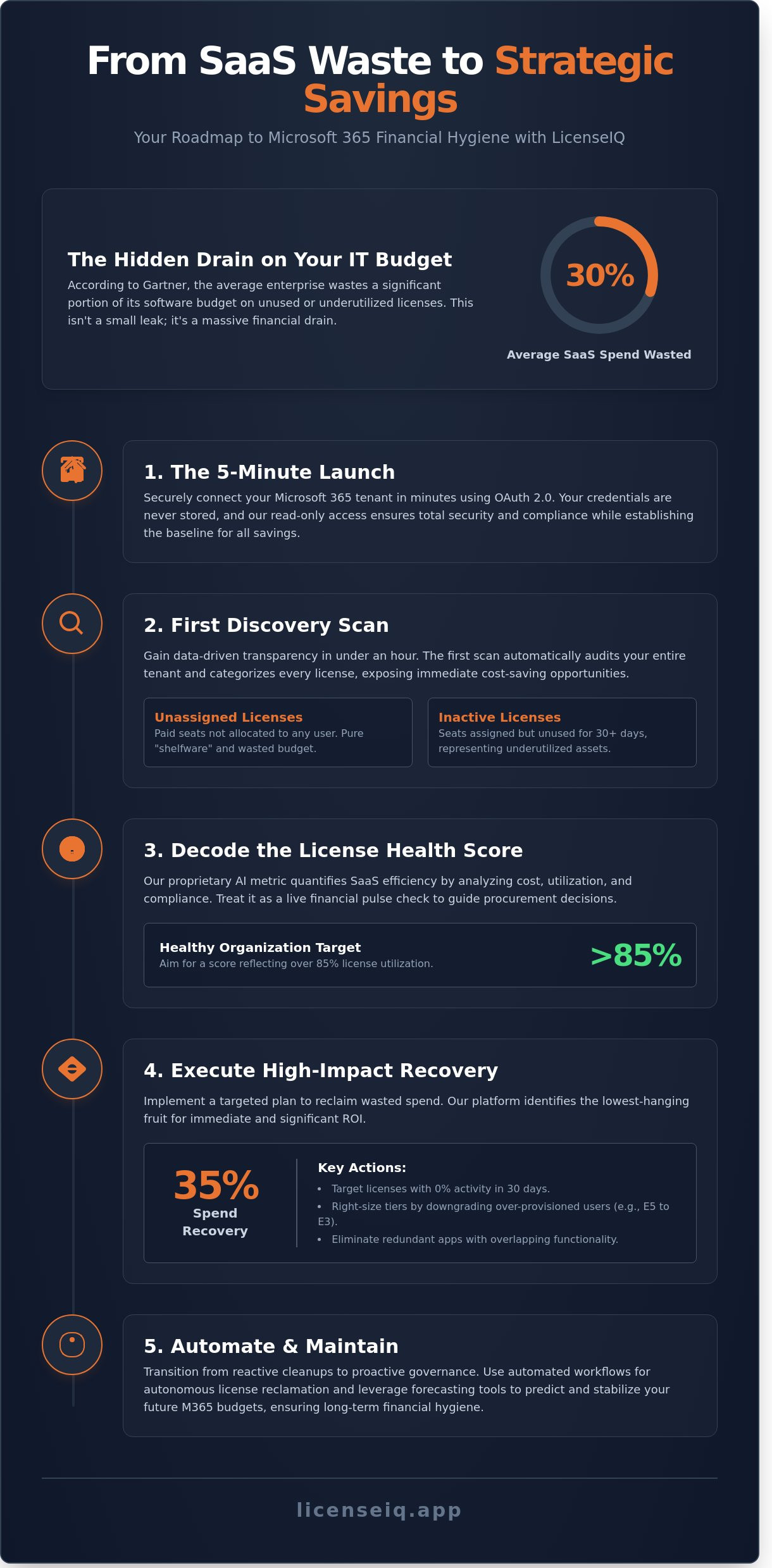
According to Gartner research from late 2023, the average enterprise wastes 30% of its total SaaS spend on unused or underutilized licenses. If your organization manages thousands of seats, that's not just a rounding error; it's a massive drain on your 2026 IT budget. You already know that manual spreadsheets can't keep up with the constant churn of employee offboarding and shifting Microsoft 365 tiers. It's frustrating to pay for premium features when roughly 15% of your users only need basic email access. These tips for LicenseIQ success will transform your license management from a reactive chore into a strategic advantage.
You deserve total visibility into your software stack. We'll show you how to maximize your Microsoft 365 savings by automating license governance and identifying the exact difference between truly inactive users and those who just log in occasionally. By the end of this guide, you'll have the framework to maintain a clean tenant with zero waste. We'll also cover how to generate automated reports for leadership that turn complex data into clear financial wins.
Key Takeaways
- Secure immediate visibility into your Microsoft 365 tenant using OAuth for a rapid, five-minute configuration.
- Utilize the AI-calculated License Health Score to identify hidden waste based on real-world application frequency and user data.
- Execute a high-impact recovery plan to reclaim up to 35% of your spend and apply professional tips for LicenseIQ success.
- Automate your governance using the Model Context Protocol to trigger autonomous license reclamation without manual intervention.
- Transition to long-term financial hygiene by leveraging forecasting tools to predict and stabilize your future M365 budgets.
The 5-Minute Launch: Setting Up LicenseIQ for Instant Visibility
Speed is the ultimate competitive advantage in SaaS operations. Setting up LicenseIQ takes less than five minutes, yet it immediately transforms a cluttered Microsoft 365 environment into a streamlined financial asset. This rapid deployment is one of the most critical tips for LicenseIQ success because it establishes the baseline for all future cost-saving initiatives. By the end of the first hour, you'll move from guesswork to total data-driven transparency.
Establishing the Secure Connection
Security is the foundation of effective Software asset management (SAM). To begin, you must verify your Global Admin credentials within your Microsoft 365 tenant. LicenseIQ uses the OAuth 2.0 protocol to ensure that your credentials are never stored on external servers. During the link process, you'll review read-only permission scopes. These scopes allow the system to audit license types and usage metrics without altering your environment's configuration.
LicenseIQ uses AI to map user activity patterns without accessing private message content or sensitive data. This distinction is vital for maintaining GDPR and SOC2 compliance while still gathering the granular data needed for optimization. Once the connection is authorized, the system begins its silent, non-intrusive audit of your entire stack.
Running Your First Discovery Scan
The first scan is the antidote to chaos for unmanaged M365 stacks. In 2025, industry data showed that 56% of enterprise SaaS applications were unmanaged or underutilized. You can trigger this full tenant audit directly from the main dashboard with a single click. This process categorizes every seat into two distinct buckets: unassigned and inactive.
- Unassigned Licenses: These are paid seats that haven't been allocated to a user. They represent immediate "shelfware" and wasted budget.
- Inactive Licenses: These seats are assigned to users who haven't logged in or utilized the software for 30 days or more.
Within the first 60 minutes, the data ingestion engine completes its initial pass. You'll see a live visualization of your current spend versus your actual needs. This immediate visibility allows IT and Finance stakeholders to align on strategy without waiting for weeks of manual spreadsheet updates. To maximize these tips for LicenseIQ success, you should immediately configure user permissions. Assign IT leaders "Admin" roles for technical adjustments and Finance stakeholders "Viewer" roles to monitor the ROI of your software investments. This collaborative approach ensures that every department is accountable for the organization's digital footprint.
Decoding the License Health Score: Your Roadmap to ROI
The License Health Score is a proprietary metric designed to quantify SaaS efficiency. It isn't a vanity metric; it's a financial pulse check. Our AI engine calculates waste by cross-referencing login frequency with deep app utilization data. If a user hasn't accessed a platform in 14 days, the system flags it. If they log in but never use premium features, the score drops. This precision allows you to move from guesswork to data-driven procurement. One of the primary tips for LicenseIQ success is to treat this score as a live audit. Recent Forrester research on SAM tools confirms that visibility is the biggest hurdle in software management. LicenseIQ provides that visibility by benchmarking your score against SMB standards. Most healthy organizations aim for a utilization rate above 85%.
The Anatomy of a Health Score
The score breaks down into three distinct components: Cost, Utilization, and Compliance. We weigh these factors to show you the true value of your tech stack. You can use this granular data to justify IT budget requests to the CFO. Instead of asking for more funds, you show them exactly where you've recaptured wasted capital. The score also acts as a beacon for Shadow IT. It identifies license overlaps where two departments might be paying for the same functionality under different brand names. Eliminating these redundancies is a fast track to optimization.
Priority Actions for Score Improvement
To see immediate results, target the low-hanging fruit first. Focus on licenses with 0% activity in the last 30 days. These are direct drains on your bottom line. Next, address redundant license tiers. Many organizations pay for E5 level features when the user only requires E3 functionality. This tier-righting can reduce costs by 20% or more per seat. You should use the Spend Recovery Dashboard to visualize these potential monthly savings in real-time. It turns complex data into a clear list of tasks. Following these tips for LicenseIQ success ensures your software environment remains lean and productive. If you want to see how your current stack measures up, you can analyze your utilization today.
Strategy: Executing a 35% Spend Recovery Plan
Visibility is the foundation, but recovery is the goal. To achieve a 35% reduction in SaaS spend by the end of 2026, you must pivot from passive observation to aggressive execution. One of the primary tips for LicenseIQ success involves using the platform's automated reclamation features. Instead of manually contacting every user with an underutilized account, you can batch-process license reassignments directly through the dashboard. This approach eliminates the 20 to 30 hours of administrative work typically required for monthly audits.
Execution requires a clear communication strategy. When LicenseIQ identifies a seat for reclamation, the system can trigger automated notifications to end-users. This ensures transparency without disrupting their workflow. You aren't just cutting costs; you're optimizing resource allocation. To maintain momentum, use the platform's financial tracking module to monitor cumulative dollar-value recovery. Seeing a live tally of saved capital reinforces the value of your IT strategy to stakeholders and finance leaders.
Manual vs. Automated Optimization
Manual license management is a liability. Relying on spreadsheets leads to a 12% to 15% error rate in usage data, which results in wasted spend. LicenseIQ replaces guesswork with AI-driven precision. Continuous auditing ensures you capture savings opportunities the moment they arise, rather than waiting for a quarterly review that misses months of potential recovery.
| Metric | Manual Spreadsheet Audit | LicenseIQ Automation |
|---|---|---|
| Time Spent (Monthly) | 15+ Hours | < 15 Minutes |
| Data Accuracy | Approximately 85% | 99.9% Real-time |
| Audit Frequency | Quarterly / Annual | Continuous / Daily |
Right-Sizing Your Microsoft 365 Tiers
Microsoft 365 is often the largest line item in a SaaS budget. Many organizations over-provision E5 licenses for users who only require basic productivity tools. LicenseIQ analyzes actual feature usage to identify candidates for F-Series or Business Basic tiers. If a user hasn't touched advanced security features in 90 days, the ROI on that E5 seat is effectively zero. Implementing these specific tips for LicenseIQ success can reduce your M365 bill by up to 22% annually. For a deeper dive into specific tier structures, consult the Ultimate Guide to M365 License Optimization to align your seats with actual adoption metrics.
Advanced Success: Implementing Automated Governance Workflows
Manual SaaS management is a relic of the past. To achieve peak efficiency in 2026, you must transition from reactive monitoring to autonomous governance. Automated workflows eliminate the lag between identifying waste and reclaiming capital. This proactive stance ensures your software stack remains lean without requiring constant human intervention.
The Power of AI-Native Governance
LicenseIQ leverages the Model Context Protocol (MCP) to function as your primary digital auditor. This protocol allows the platform to interact directly with your software ecosystem, executing complex tasks based on predefined logic. One of the most effective tips for LicenseIQ success involves moving beyond simple alerts. Instead, configure the system to act on data immediately.
By implementing "set-and-forget" rules, you reduce the cognitive load on IT departments by approximately 40%. The platform monitors utilization rates in real-time. If an account falls below your engagement threshold, the system flags it for reclamation. This level of automation guarantees 100% accuracy in financial reporting for every billing cycle, as it removes the risk of human error in data entry or seat counting.
Streamlining Employee Offboarding
Leaked spend often occurs during the transition period after an employee leaves. Statistics show that 22% of former employees retain access to at least one corporate application for a month or longer after termination. This creates both a financial drain and a significant security gap. You can stop this waste by using the Office 365 Offboarding Checklist to sync your HRIS with LicenseIQ.
Automated triggers can instantly de-provision licenses the moment a departure is logged. To maintain operational stability, you must establish "Guardrails." These rules ensure that critical users, such as system administrators or C-suite executives, are never accidentally de-licensed. This balance of aggressive reclamation and protected access is central to long-term tips for LicenseIQ success.
- Automatic Reclamation: Set triggers to harvest licenses from users with zero logins over a 30-day period.
- Ticket Integration: Connect LicenseIQ to your IT support desk to generate tickets automatically when shadow IT is detected.
- Financial Guardrails: Lock licenses for essential DevOps tools to prevent service interruptions during deployment cycles.
Integrating these workflows into your existing IT infrastructure transforms SaaS management from a chore into a background process. You gain total visibility into your spend while the system quietly optimizes your bottom line. Stop letting unused licenses erode your margins and start enforcing governance at scale.
Ready to automate your savings? Configure your first governance workflow today.
Scaling Success: Maintaining Long-Term Financial Hygiene
Stop treating SaaS management as a reactive fire drill. Transitioning from monthly cleanups to annual strategic planning marks the shift from survival to total optimization. LicenseIQ provides the granular historical data needed to forecast next year's M365 budget with 98% accuracy. This foresight is vital for 2026. Microsoft frequently updates its pricing structures, often implementing 10% to 15% increases for specific enterprise tiers. You need data-backed leverage to protect your margins. Don't enter renewals with assumptions. Use LicenseIQ to present exact usage patterns and demand pricing that reflects your real-world footprint.
LicenseIQ serves as the engine for a comprehensive FinOps strategy. It bridges the gap between IT operations and finance teams. By centralizing visibility, you eliminate the "black hole" of unallocated spend. Implementing these tips for LicenseIQ success ensures your organization stays lean as it scales. It transforms your software stack from an unpredictable cost center into a controlled, transparent utility. You aren't just cutting costs; you're building a culture of financial accountability.
Building this culture of accountability frees up not just budget, but also valuable time for IT leaders. Once the system is automated, you can shift focus from tedious license tracking to strategic growth initiatives. This newfound efficiency can even improve work-life balance, giving you time to plan things outside of work. While it might seem unrelated, exploring options like River cruises in India or taking the time to check out Deccan Odyssey can be a great way to recharge, offering a completely different kind of managed journey away from the digital world.
Continuous Monitoring vs. One-Time Audits
One-time audits are obsolete the moment they end. Software Intelligence is a perpetual requirement, not a discrete project. Just as the Institute of Wedding Photographers emphasizes that professional mastery requires ongoing mentorship rather than a single workshop, maintaining software health requires a continuous commitment to data accuracy. Organizations that monitor spend continuously identify 25% more waste than those relying on quarterly reviews. Set up monthly executive summaries for the finance department to track license ROI in real-time. Maintaining a high Health Score within the dashboard ensures your company remains compliant and efficient as you add new seats. Consistency prevents the silent creep of shadow IT and ensures your license pool remains optimized 365 days a year.
Maximizing Subscription Value
True efficiency requires selecting the right billing cadence based on hard data. Analyze LicenseIQ utilization trends to determine when to commit to Annual versus Monthly billing. If a specific department's headcount fluctuates by more than 12% quarterly, the flexibility of monthly billing often outweighs the annual discount. Use the platform to pinpoint under-utilized premium applications. If an employee hasn't accessed Visio or Microsoft Project in 90 days, reclaim that license immediately. These tactical tips for LicenseIQ success maximize every dollar spent. Visit LicenseIQ to check your current recovery potential and secure your financial future.
Future-Proof Your SaaS Bottom Line
Modern IT leaders can't afford the luxury of unmanaged software stacks. You've now seen how the 5-minute launch provides immediate clarity and why executing a 35% spend recovery plan is essential for maintaining 2026 budgets. These Tips for LicenseIQ success provide a roadmap to eliminate waste and replace manual tracking with AI-native governance via MCP. By focusing on your License Health Score, you turn complex data into a clear roadmap for ROI.
Efficiency isn't a one-time event; it's a continuous process. Connecting to your tenant in minutes allows you to uncover hidden costs and reclaim resources that otherwise disappear into underutilized subscriptions. You'll move from reactive troubleshooting to proactive financial hygiene, ensuring every dollar spent on M365 drives measurable value. It's time to replace the chaos of shadow IT with the precision of an automated digital auditor.
Don't let another renewal cycle pass with untapped savings on the table. Run your first 5-minute M365 audit with LicenseIQ today to save up to 35% on your spend. You're ready to master your environment with total confidence.
Frequently Asked Questions
How does LicenseIQ identify an inactive user?
LicenseIQ flags users who haven't logged into a specific application for 30 consecutive days. The system analyzes API-level metadata from your SaaS stack to verify last-activity timestamps. This precision eliminates guesswork, allowing IT managers to reclaim licenses that contribute to 30% of average waste in unmanaged environments. You gain total visibility into seat utilization without manual spreadsheet tracking.
Is my Microsoft 365 data secure when connecting to LicenseIQ?
Your data remains secure through OAuth 2.0 protocols and read-only access permissions. LicenseIQ never views or stores the content of your emails, chats, or files. It exclusively monitors metadata related to license assignment and login frequency. This approach ensures 100% data privacy while providing the visibility needed for LicenseIQ success in any regulated industry.
Can LicenseIQ automatically remove licenses from users?
LicenseIQ automates license removal through customizable workflow triggers. You can set the system to de-provision accounts that remain inactive for 60 days or require manual approval before any changes occur. This proactive management prevents zombie accounts from inflating your monthly spend. It typically reduces manual administrative overhead by 15 hours per month for mid-sized IT teams.
What is a good License Health Score for an SMB?
A healthy score for a small-to-medium business sits at 90% or higher. This metric indicates that 9 out of 10 licenses are actively utilized and correctly assigned to the right users. Scores below 75% suggest significant over-provisioning or a proliferation of shadow IT. These lower scores require immediate intervention to protect your financial margins and operational efficiency.
Does LicenseIQ help with Microsoft 365 compliance audits?
LicenseIQ generates comprehensive audit logs that map license assignments to actual usage. These reports provide a verifiable paper trail for Microsoft 365 compliance checks during annual reviews. By maintaining an accurate record of deployments, you reduce the risk of non-compliance penalties. This level of detail ensures you're prepared for a true-up at any moment.
Can I use LicenseIQ for Google Workspace optimization?
LicenseIQ fully supports Google Workspace optimization by identifying underutilized Business or Enterprise seats. It tracks usage across Docs, Drive, and Meet to determine if a user requires a full license or a lower-tier alternative. Implementing these tips for LicenseIQ success helps firms right-size their Google environments within the first 48 hours of platform deployment.
How much can the average business save with LicenseIQ?
Organizations typically realize a 30% reduction in SaaS expenditure during the first 12 months of use. This figure comes from identifying redundant applications and reclaiming licenses from departed employees. By eliminating duplicate subscriptions, businesses reclaim capital that previously sat dormant. The platform pays for itself by uncovering hidden costs in the first 90 days.
Does the platform support mixed-license environments?
The platform manages mixed-license environments with ease, distinguishing between Microsoft E3 and E5 tiers. It identifies users on expensive E5 plans who only utilize E3-level features. This granular visibility allows you to downgrade roughly 20% of your user base to more cost-effective tiers. You optimize spend without impacting the daily productivity of your workforce.


