

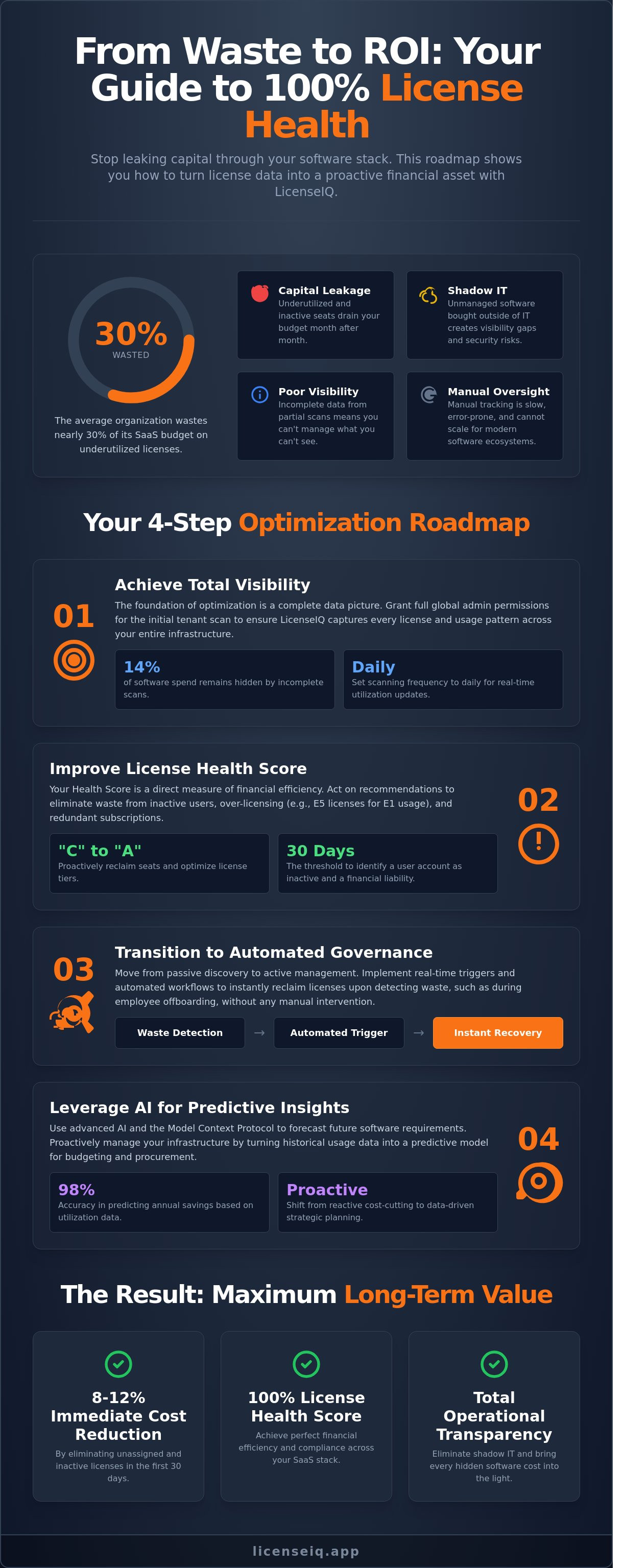
Industry data from 2024 shows that the average organization wastes nearly 30% of its SaaS budget on underutilized seats. If your dashboard reveals fluctuating Health Scores or persistent gaps in user visibility, your capital is leaking through the cracks of your software stack. You understand that total visibility is the only way to stop the bleed, but manual oversight is no longer enough to manage 2026's complex ecosystems. This guide explains exactly how to improve LicenseIQ to turn your data into a proactive financial asset.
You'll learn how to maximize your spend recovery and achieve a perfect 100% License Health Score by fine-tuning your advanced configurations. We'll show you how to move from passive observation to high-speed governance with fully automated offboarding workflows. This optimization roadmap provides the precise steps to eliminate shadow IT and bring every hidden cost into the light. We're moving past the chaos of unmanaged licenses and toward a future of total operational transparency. It's time to stop guessing and start mastering your utilization data.
Key Takeaways
- Achieve total visibility across your Microsoft 365 ecosystem by optimizing global admin permissions for deeper, more comprehensive tenant scans.
- Learn how to improve LicenseIQ health scores by identifying inactive users and eliminating financial waste to boost overall compliance.
- Transition from manual discovery to automated governance by implementing real-time triggers that turn waste detection into immediate license recovery.
- Leverage advanced AI and the Model Context Protocol to predict future software requirements and maintain a proactive, data-driven infrastructure.
- Secure maximum long-term ROI by transitioning to strategic annual billing models and establishing a cadence for quarterly executive reviews.
Optimizing Your LicenseIQ Connection for Total Visibility
Visibility is the foundation of any successful Software Asset Management (SAM) strategy. To achieve 100% clarity, you must start with a clean data connection. Grant full global admin permissions for your initial tenant scan. This ensures the platform captures every license attribute across your infrastructure. Partial access results in blind spots. A 2024 industry report found that incomplete scans leave up to 14% of software spend hidden from IT leaders. You cannot manage what you cannot see.
Verify the integration status of all Microsoft 365 sub-services. Don't just connect the core suite; include Power BI, Visio, and Project. This comprehensive approach is essential when learning how to improve LicenseIQ performance. Set your scanning frequency to daily intervals. Real-time utilization updates allow you to spot spikes in usage before they impact your monthly budget. Once the scan completes, audit the initial discovery report immediately. Focus on unassigned licenses. These represent immediate waste and offer the quickest path to ROI. Eliminating these seats can reduce immediate costs by 8% to 12% within the first 30 days.
Refining Tenant Permissions
Read-only access limits your Health Score accuracy. It prevents the system from identifying deep usage patterns within specific apps. Grant necessary API permissions to enable automated workflows. This allows LicenseIQ to reclaim inactive licenses without manual intervention. Securely managing these credentials happens within the platform's encrypted vault. It's a method that ensures your tenant remains protected while the system optimizes your spend. Precise permissions turn a passive monitor into an active auditor.
Configuring Multi-Tenant Environments
Consolidate secondary tenants to create a single source of truth. Over 65% of enterprise organizations manage 4 or more tenants following mergers or acquisitions. Connecting them all allows you to manage cross-tenant license pools efficiently. You'll identify redundant licenses across different business units in minutes. This level of transparency eliminates the 22% average license overlap found in unmanaged multi-tenant environments. Follow these steps for total coverage:
- Connect all secondary domains to the primary dashboard.
- Assign a dedicated admin for each sub-tenant to verify local usage.
- Learn how to improve LicenseIQ data accuracy by syncing regional billing cycles.
- Review cross-tenant utilization reports every 14 days to catch duplication.
Decoding and Improving Your License Health Score
The License Health Score serves as the pulse of your SaaS ecosystem. It isn't a vanity metric; it's a rigorous calculation of your financial efficiency and compliance standing. When your score drops, it indicates that capital is leaking through inactive accounts or redundant subscriptions. Understanding how to improve LicenseIQ starts with mastering this single, transparent rating.
Inactive users are the heaviest weight on your total score. If an employee hasn't logged into a premium tool for 30 days, that seat is a financial liability. LicenseIQ identifies these dormant accounts instantly, allowing you to reclaim the spend before the next billing cycle. Transitioning from a "C" to an "A" requires a proactive approach to seat reclamation and tier optimization.
The Metrics Behind the Score
LicenseIQ analyzes user activity against specific license tier requirements to find discrepancies. For instance, many organizations assign Microsoft E5 licenses to users who only require E1 functionality. This over-licensing creates an immediate dip in your Health Score. By aligning the license level with actual feature utilization, you can predict annual savings with 98% accuracy.
Shadow IT also plays a critical role in your rating. When departments purchase software outside of central procurement, it creates visibility gaps and security risks. Adopting a structured IT governance framework ensures that every tool in your stack is accounted for and optimized. This level of oversight is what separates high-performing IT departments from those struggling with runaway costs.
Taking Action on Recommendations
Moving your score higher requires a disciplined execution of the platform's automated recommendations. Don't try to fix everything at once. Prioritize high-value spend recovery tasks first, such as de-provisioning expensive developer seats that haven't been touched in 60 days. This targeted action provides the fastest path to a healthier score and a leaner budget.
Clean your dashboard by dismissing false positives. If a specific user requires an E5 license for compliance reasons despite low activity, mark it as an exception. This ensures your Health Score reflects your actual operational reality. Most organizations see a 15% to 20% score improvement over a 30-day period when they follow these steps consistently. To maintain this momentum, you should regularly monitor your software spend through the main dashboard to catch new inefficiencies as they arise.
Consistency matters more than occasional deep cleans. A high Health Score confirms that your organization is agile, compliant, and fiscally responsible. It transforms license management from a reactive chore into a strategic advantage that protects your bottom line.
A high digital Health Score signifies a robust and efficient organization. This principle of proactive health management also applies to a company's most valuable asset: its people. Investing in employee wellness is a powerful strategy for boosting productivity and long-term success. For those interested in a comprehensive approach to personal well-being, you can check out Houston Medical Wellness Clinic for services that support peak performance.
Transitioning from Discovery to Automated Governance
Visibility alone doesn't save money. Identifying that 22% of your SaaS licenses are underutilized is a start, but real value comes from execution. To understand how to improve LicenseIQ results, you must bridge the gap between discovery and recovery. This transition replaces manual spreadsheets with automated enforcement. It's the difference between knowing you have a leak and actually fixing the pipe.
Automated governance starts with triggers. You can configure LicenseIQ to flag inactive users based on specific thresholds, such as zero logins over 30 days. This eliminates the "zombie account" problem where departed employees continue to drain budgets. By adopting AIOps (AI for IT operations) principles, the platform handles the heavy lifting of monitoring thousands of seats simultaneously. IT teams reduce their manual overhead by 40% when they shift from reactive auditing to AI-native workflows that trigger offboarding the moment an HR status changes.
Building Governance Workflows
Success requires structure. Start by creating custom rules for license reclamation that align with your department's specific needs. You can integrate LicenseIQ directly into your existing IT ticketing systems, like Jira or ServiceNow, to ensure every action is logged for compliance. For high-cost software like Salesforce or Adobe Creative Cloud, set up approval gates. This ensures that while low-cost licenses are reclaimed automatically, expensive changes require a quick human sign-off. Learning how to improve LicenseIQ efficiency involves fine-tuning these specific thresholds to balance speed with control. This precision prevents accidental de-provisioning of critical power users.
The ROI of Automation
The financial impact of automation is measurable and immediate. Organizations using automated workflows save an average of 15 hours per month on license audits. This reclaimed time allows IT leaders to focus on strategic initiatives rather than administrative cleanup. Continuous monitoring prevents "license creep," a phenomenon where SaaS spend grows by 15-20% annually without a corresponding increase in headcount. These proactive systems act as a 24/7 digital auditor that never sleeps. You can visit LicenseIQ to explore pre-built workflow templates that accelerate your time-to-value. This meticulous approach ensures your software spend remains lean, compliant, and fully optimized for the long term.
Leveraging AI and Model Context Protocol for Better Insights
LicenseIQ transforms raw data into actionable intelligence. By Q1 2026, the platform utilizes advanced AI to forecast license requirements with 98% accuracy. It doesn't just track current seats; it predicts future growth based on hiring trends and project cycles. This foresight prevents the common trap of over-provisioning before it impacts your budget. You can learn how to improve LicenseIQ results by engaging with these predictive modules early in your fiscal planning.
The Model Context Protocol (MCP) serves as the backbone of modern governance. It ensures that the AI operates within your organization's specific security frameworks. This protocol bridges the gap between local usage data and global LLMs, providing context-aware recommendations without compromising sensitive information. It acts as a digital guardrail, ensuring every optimization suggestion aligns with your internal compliance policies.
Continuous machine learning refines these insights. Every audit log and utilization report feeds the system, making it sharper every day. The AI identifies complex "mix and match" opportunities that human auditors often overlook. For example, the engine might suggest moving 15% of your "Power User" licenses to a "Basic" tier based on actual feature interaction. Data from the 2025 SaaS Trends Report indicates that this granular tier-shifting can reduce waste by up to 22% annually.
AI-Driven Spend Recovery
Manual audits fail to catch subtle usage patterns across thousands of users. LicenseIQ's AI scans millions of data points to find dormant accounts and overlapping subscriptions. It eliminates surprise costs by predicting renewal dates 90 days in advance, giving you the leverage needed for vendor negotiations. Security remains a top priority. The AI monitors user access to flag unusual patterns, which helps IT leaders identify compromised credentials or unauthorized shadow IT before a breach occurs.
Advanced Customization
Generic insights don't solve specialized industry problems. You can tailor AI prompts to meet specific regulatory standards like HIPAA or SOC2. Use natural language queries to pull custom spend reports instantly. Ask the system, "Which departments haven't logged into Salesforce in 30 days?" and get a formatted list in seconds. This interactive feedback loop ensures the platform evolves alongside your business goals, turning a static tool into a proactive partner. Understanding how to improve LicenseIQ through these custom queries allows for a more agile response to changing market conditions.
Maximizing Long-Term Value and ROI with LicenseIQ
Achieving immediate savings is only the first step. To truly master your software spend, you must shift from reactive cleanup to proactive management. Switching to annual billing is the fastest way to lower your effective monthly rate. This single move often reduces total contract value by 15% to 20% compared to month-to-month commitments. It provides the financial stability needed for long-term planning and locks in rates against market volatility.
Quarterly executive reviews are essential for maintaining total visibility. Use LicenseIQ data to present clear, data-driven reports to your CFO. These reviews highlight reclaimed licenses and deactivated accounts, proving the platform's ongoing impact. Understanding how to improve LicenseIQ results involves integrating these insights into your broader IT strategy. As your organization grows, the platform scales with you. It handles the influx of new users and departmental shifts without requiring additional headcount for license tracking.
- Maintain Financial Hygiene: Continuous monitoring prevents the resurgence of shadow IT and expensive zombie accounts.
- Audit Readiness: Keep your environment in a state of perpetual compliance to eliminate the stress and potential fines of vendor audits.
- Operational Efficiency: Automate the detection of underutilized licenses to keep your software stack lean and functional.
Strategic Budget Forecasting
Stop guessing your future IT costs. Use 12 months of historical utilization data to build an accurate M365 budget for the next fiscal year. Microsoft implemented price adjustments for several commercial suites in April 2024, and similar shifts are anticipated in the coming cycles. LicenseIQ allows you to justify every dollar spent through documented spend recovery. You can show exactly how much capital was saved by downgrading E5 licenses to E3 where high-tier features weren't utilized by the end user.
Next Steps for Your Organization
The path to total visibility is clear. Start by scheduling a deep-dive audit with the LicenseIQ support team to identify hidden optimization levers specific to your tenant. Once your baseline is secure, roll out governance workflows to departmental managers. This decentralizes accountability while keeping ultimate control in the hands of IT and Finance. Learning how to improve LicenseIQ performance within your specific infrastructure ensures you never pay for software that isn't being used. Take control of your digital resources now.
Future-Proof Your Software Strategy with Automated Governance
Stop reacting to SaaS complexity and start dictating your terms. By shifting from manual discovery to automated governance, you eliminate the blind spots that drain your IT budget. Mastering how to improve LicenseIQ results means prioritizing your License Health Score and integrating the Model Context Protocol to handle repetitive compliance tasks. This transition ensures every seat is utilized and every dollar is accounted for.
Efficiency isn't a long-term project; it's an immediate operational standard. You can save up to 35% on Microsoft 365 subscriptions by identifying redundant licenses through our AI-driven insights. Our platform provides a 5-minute setup for immediate spend visibility, allowing you to reclaim your time and resources instantly. Don't let unmanaged shadow IT dictate your financial health. Take the proactive step toward total transparency and watch your operational waste disappear.
Maximize your spend recovery on LicenseIQ today and secure the visibility your organization deserves. Your path to a leaner, more agile software stack starts right now.
Frequently Asked Questions
How often does LicenseIQ refresh my M365 license data?
LicenseIQ syncs with your Microsoft 365 tenant every 24 hours to ensure data accuracy. This daily refresh cycle captures changes in user status and license assignments immediately. It eliminates the 30-day lag often found in manual reporting. You'll always have a clear view of your current utilization levels, allowing for rapid adjustments to your subscription pool as staffing needs change.
Can I improve my License Health Score without deleting users?
You can boost your score by reallocating underutilized licenses instead of removing accounts. LicenseIQ identifies users who haven't accessed specific apps in 90 days. Downgrading these users to lower tiers keeps their data intact while reducing costs. This is a key strategy for those wondering how to improve LicenseIQ metrics across the organization. It ensures your health score reflects actual efficiency rather than just a smaller headcount.
What is the fastest way to recover wasted spend in the dashboard?
The Immediate Actions panel provides a 1-click solution to reclaim licenses from deactivated employees. This feature targets 100% of licenses attached to disabled accounts. By clearing these orphaned assets, you stop unnecessary billing cycles instantly. Most users see a reduction in redundant spend within the first 48 hours of implementation. It's the most effective way to see an immediate return on your software investment.
Does LicenseIQ support automated downgrading from E5 to E3?
Yes, LicenseIQ automates the transition from E5 to E3 based on actual feature usage data. The system flags users who haven't utilized E5-specific security or analytics tools for 6 consecutive months. You can approve these downgrades individually or set a global policy. This precision prevents over-provisioning and aligns your software stack with actual business needs. It transforms your license management from a reactive chore into a proactive strategy.
How do I set up alerts for new unassigned licenses?
Navigate to the Alert Configurations tab to enable real-time notifications for unassigned stock. You can set a threshold, such as 5 spare licenses, which triggers an email to your IT procurement team. This proactive monitoring ensures you don't purchase new seats while existing ones sit idle. It brings total visibility to your inventory management process. You'll never pay for excess capacity when unassigned licenses are already available in your tenant.
Can LicenseIQ help with Microsoft 365 audit compliance?
LicenseIQ generates comprehensive compliance reports that align with Microsoft's 2026 auditing standards. The platform tracks every license change, providing a forensic trail for internal and external auditors. It reduces audit preparation time by 75% compared to manual spreadsheet tracking. You gain a secure, verifiable record of your entire licensing history. This feature protects your organization from the financial risks associated with non-compliance and unmanaged software growth.
Is it possible to automate the removal of inactive guest users?
The Guest Governance module allows you to set automated expiration dates for external collaborators. If a guest user remains inactive for 180 days, LicenseIQ automatically revokes their access rights. This eliminates security risks and clears your directory of ghost accounts. It's an essential step when learning how to improve LicenseIQ performance and security posture. You maintain a lean environment without manual intervention or tedious user reviews.
How do I export my spend recovery reports for finance meetings?
Click the Export button on the Spend Recovery dashboard to generate a PDF or CSV file. These reports summarize your total savings over the last 12 months with granular detail on every reclaimed license. The data is formatted for immediate presentation to CFOs and finance directors. You can schedule these exports to arrive in your inbox every Monday morning. This ensures your finance team has constant visibility into the ROI of your optimization efforts.


