

By 2026, 60% of organizations will waste over 30% of their Microsoft 365 budget on unused E5 features and inactive seats. Your finance team likely knows the frustration of staring at outdated spreadsheets while shadow IT costs continue to climb. Static audits are a relic of the past. To survive the complexity of modern SaaS, you need automated license governance. This AI-native strategy transforms your software stack from a black hole of expenses into a transparent, high-yield asset.
Managing the gap between E3 and E5 tiers shouldn't feel like a guessing game. You deserve real-time visibility into your license health rather than waiting for an annual review to discover thousands in wasted spend. This guide reveals how to implement a strategy that recovers up to 35% of your Microsoft 365 spend instantly through automated reclamation. We'll explore the transition from manual tracking to a vigilant, AI-driven system that ensures you only pay for what your team actually uses.
Key Takeaways
- Eliminate "ghost users" and budget-draining inactive accounts that traditional manual spreadsheets fail to detect.
- Implement automated license governance to replace weeks of manual audits with AI-native workflows that optimize spend in minutes.
- Gain instant visibility into your SaaS stack by connecting your tenant and generating a comprehensive License Health Score.
- Streamline your financial operations by identifying and recovering up to 35% of wasted Microsoft 365 expenditure.
- Shift from reactive auditing to proactive optimization using a real-time Spend Recovery Dashboard to maintain long-term compliance.
The Financial Failure of Manual License Management
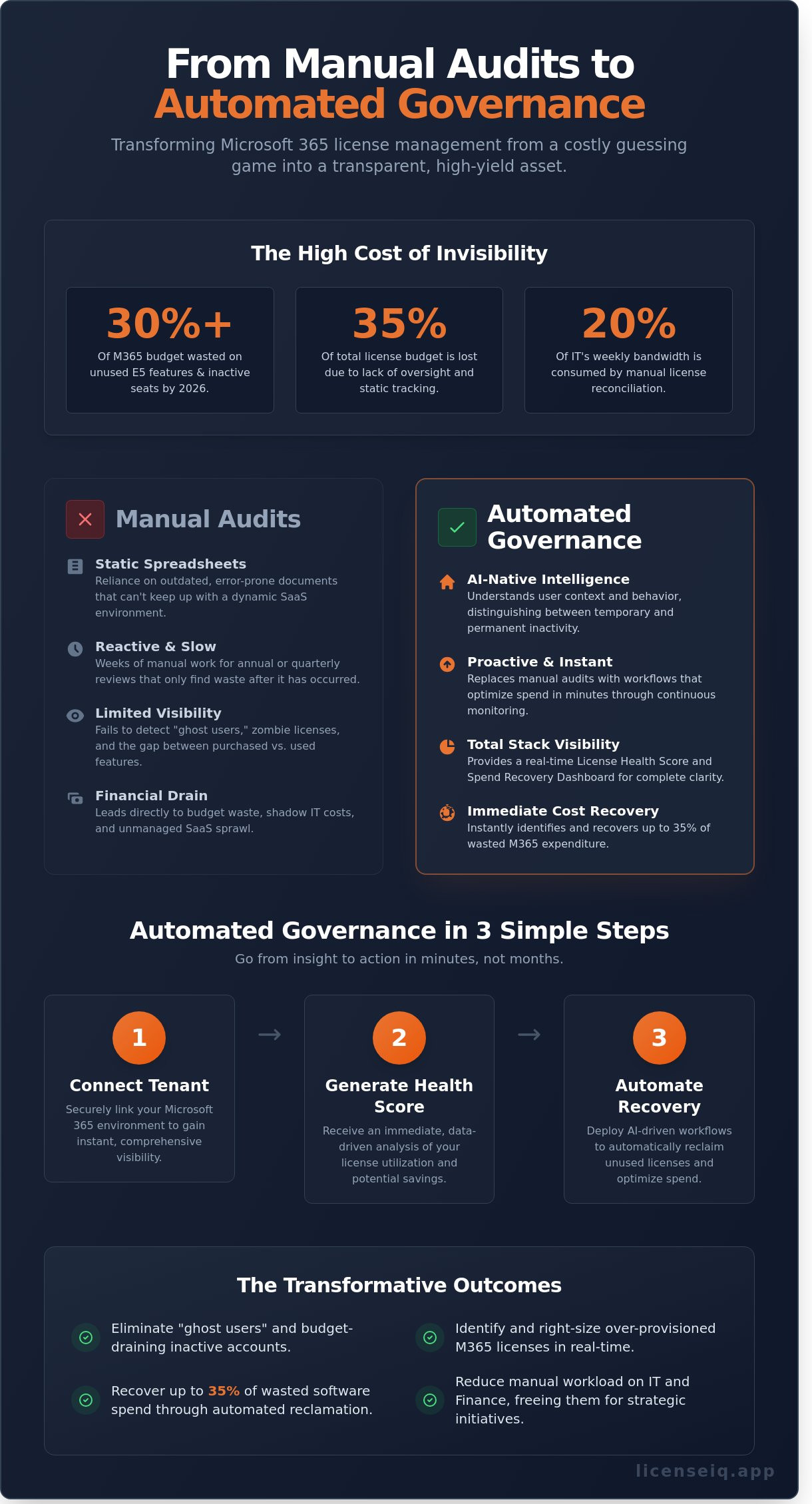
Manual spreadsheets are the primary driver of SaaS sprawl in 2026. They're static documents trying to track a hyper-dynamic environment. Most companies still rely on outdated logs while their software stacks expand unchecked. This lack of oversight leads to a 35% waste of the total license budget. Organizations require modern Software asset management (SAM) strategies that evolve beyond basic inventory. Transitioning to automated license governance isn't just an upgrade; it's a financial necessity for survival.
Microsoft 365 tiering adds another layer of hidden complexity that humans can't track effectively. It's impossible to manually monitor whether a user truly needs an E5 license or if an F3 suffices based on their weekly feature usage. The data changes too fast for monthly audits to catch. Companies lose thousands of dollars because they pay for premium features that remain untouched. Moving from reactive auditing to proactive, automated license governance stops this drain immediately.
The High Cost of Invisibility
Zombie licenses are silent budget killers. These recurring costs for inactive accounts drain SMB budgets without a trace. Unmanaged offboarding creates massive financial leaks when former employees retain active seats for months after their departure. IT teams currently waste 20% of their weekly bandwidth on manual reconciliation. This manual burden prevents staff from focusing on high-value initiatives. Visibility is the only cure for these hidden security and financial risks.
Why Traditional ITAM Fails SMBs
Legacy IT Asset Management (ITAM) tools weren't built for lean, modern teams. They're often too complex and require dedicated specialists to operate. A massive gap exists between simply owning a license and actually using it. Traditional tools show you the purchase, but they don't show the utility. LicenseIQ acts as the antidote to this manual chaos. It provides the precision needed to close the gap between spend and value. By automating the discovery of underutilized seats, it ensures your software stack remains lean and cost-effective.
- Eliminate "Ghost Users" that inflate monthly invoices.
- Identify over-provisioned M365 accounts in real-time.
- Recover up to 35% of wasted software spend through automated reclamation.
- Reduce the manual workload on IT and Finance departments.
What is Automated License Governance?
Automated license governance is the shift from manual oversight to AI-native workflows that monitor and optimize SaaS subscriptions autonomously. Traditional management relies on rule-based scripts that execute rigid commands. These legacy systems lack the nuance to handle complex user behaviors. In contrast, AI-native intelligence understands the context behind the data. It distinguishes between a user who is temporarily inactive and one who has permanently abandoned a tool.
The emergence of the Model Context Protocol (MCP) has revolutionized this space. It provides a standardized way for AI models to access live data across your entire software stack securely. This technology enables "Software Intelligence," turning license management into a strategic business function. Organizations no longer wait for annual reviews to find waste. They use continuous monitoring to ensure every seat delivers value. Industry data shows that companies transitioning from point-in-time audits to continuous governance see an immediate 30% reduction in wasted spend. Adopting the principles found in the NIST IT Asset Management Guide ensures these processes remain secure and compliant while maximizing cost recovery.
The Mechanics of AI-Driven Optimization
Precision begins with real-time scanning of environments like M365 tenants. The system analyzes granular user activity beyond simple login timestamps. Machine learning algorithms process this data to predict future license requirements with 98% accuracy. When the system detects an underutilized seat, it initiates automated reclamation. It revokes the license and reassigns it to a new user in the queue. This eliminates the need for purchasing new seats when existing ones are dormant. You can audit your current utilization to see where these gaps exist.
Key Features of a Governance Workflow
Modern workflows prioritize entitlement management and strict policy enforcement. The system acts as a digital auditor, ensuring users only access the specific tiers they need. This proactive approach to automated license governance replaces the chaos of unmanaged stacks with total visibility. Key features include:
- Automated offboarding triggers: Immediate license revocation occurs when an employee record is updated in the HRIS, preventing "zombie" accounts.
- Real-time health alerts: Notifications fire when license utilization drops below a 95% efficiency threshold, allowing for instant correction.
- Predictive scaling: The system identifies when to downgrade users from premium tiers to basic versions based on actual feature usage patterns.
By treating software as a dynamic asset, automated license governance ensures that financial health remains a priority. It's a meticulous method for protecting corporate resources and eliminating the hidden costs of shadow IT.
Manual Audits vs. Automated Governance Workflows
Manual license management is a relic of the past. Organizations relying on spreadsheets for SaaS oversight lose an average of 30% of their software budget to waste and unused seats. A manual audit for a 500-person firm typically consumes 40 to 60 hours of IT labor. In contrast, automated license governance completes the same task in under five minutes. This speed isn't just a convenience; it's a financial necessity in a fast-moving market.
Accuracy remains the biggest hurdle for manual tracking. Human error leads to "ghost" licenses and forgotten subscriptions that drain resources month after month. Automation removes the guesswork by pulling data directly from vendor APIs. It scales effortlessly as your headcount grows. Whether you manage 50 or 5,000 users, the workload remains constant. The shift toward automated license governance is the only way to maintain total control without inflating your administrative headcount.
Security risks also multiply with manual processes. Industry research shows that 20% of former employees still have access to corporate SaaS accounts 30 days after termination. Automated workflows close this window of risk instantly. They trigger de-provisioning the moment an employee leaves, ensuring your data stays protected and your compliance remains intact.
Spend Recovery vs. Simple Tracking
Tracking tells you who has a license. Recovery tells you how to save money. Most firms over-provision by mixing expensive M365 E5 licenses with E3 tiers where they aren't needed. Our system calculates a unique Health Score for your tenant to identify these redundancies immediately. To see how this works in practice, read our M365 License Optimization Guide for a deeper strategy on reclaiming your budget and eliminating overlap.
Actionable Insights vs. Static Reports
Static reports are historical documents that gather dust. They show what happened last month, not what you should do today. Modern governance provides a dollar-value recommendation engine. It translates complex usage data into clear financial directives. Finance teams don't need to wait for IT reports to see potential savings. They get the clarity required to make instant, data-driven decisions that impact the bottom line. It's about moving from passive observation to active resource management.
This shift towards strategic financial management is also why many professionals are turning to advanced education to sharpen their analytical skills. For those looking to deepen their expertise, the Financial Modelling University offers specialized courses that complement this data-driven approach.
Beyond financial analysis, the ability to oversee complex organizational transitions is a critical skill for modern managers; you can learn more about Woloyem to discover how their training helps professionals master project and service management.
Implementing Automated Governance in 3 Simple Steps
Transitioning to automated license governance shouldn't be a multi-month project. Most IT teams lose 200+ hours annually to manual audits and spreadsheet reconciliation. You can reclaim that time today by shifting from reactive cleanup to proactive, AI-native management.
Step 1: The 5-Minute Audit
Connect your M365 tenant using secure OAuth protocols. This integration process finishes in under 300 seconds and requires no local installation. The engine immediately scans your entire environment, analyzing login timestamps, feature utilization, and entitlement data. This initial baseline scan generates your first License Health Score. It spotlights immediate low-hanging fruit, such as accounts for departed employees or unassigned premium seats that cost your organization thousands of dollars each month.
Step 2: Defining Your Governance Policies
Precision requires setting specific thresholds to eliminate guesswork. A standard 30-day inactivity trigger identifies dormant users for automatic license reclamation. You can also map users to specific tiers based on their actual behavior. If an employee has an E5 license but hasn't used Power BI or advanced security features in 90 days, the system recommends a downgrade to E1 or E3. Automation handles the approval requests, ensuring IT stays in control without the manual burden of chasing department heads for permission.
Step 3: Spend Recovery and Continuous Monitoring
Once your policies are live, you can execute recovery workflows to right-size tiers and harvest unused seats with a single click. The impact is visible instantly. Use the spend recovery dashboard to translate technical data into financial wins for stakeholders, showing the exact dollar amount saved in real-time. Continuous monitoring prevents waste from returning to your stack. The system acts as a digital auditor, scanning your environment 24/7 to ensure every dollar spent aligns with actual usage. Organizations using this automated license governance strategy typically reduce their annual SaaS spend by 27% within the first 90 days.
Your path to total visibility starts here. Get your License Health Score from LicenseIQ today.
LicenseIQ: The Engine for Automated M365 Governance
LicenseIQ transforms how businesses handle their software footprint. Most organizations overspend on Microsoft 365 by 35% because of inactive accounts and redundant subscription tiers. Our platform implements automated license governance to eliminate this waste instantly. It isn't just a monitoring tool; it's a proactive recovery engine designed for the 2026 digital economy.
The Spend Recovery Dashboard provides total visibility into your financial leaks. You see your savings in real-time as the system identifies underutilized seats. Instead of digging through complex spreadsheets, you get a clean, actionable view of reclaimed capital. This transparency ensures every dollar in your IT budget serves a specific purpose. You can stop guessing about your software ROI and start measuring it.
We simplify complex SaaS environments into a single metric: the Health Score. This score measures your overall efficiency by analyzing license allocation against actual user activity. A high score confirms your licenses match your usage perfectly. A low score triggers an immediate audit to find savings. It's the fastest way for finance leaders to verify operational health without manual intervention.
Built for the Modern SMB
LicenseIQ targets the specific needs of small and mid-sized businesses. You don't need an IT degree to master the interface. While enterprise tools are often bloated and require months of configuration, our platform deploys in minutes. We focus heavily on the Microsoft 365 ecosystem. This specialization allows us to catch the subtle sprawl that generalist tools miss. You get continuous protection against hidden costs and shadow IT.
Proven ROI and Financial Accuracy
Our users see results fast. In recent deployments, companies recovered their first $1,000 in under ten minutes. This isn't just about cutting costs; it's about precision. Beyond the numbers, automated license governance bolsters your security posture. Automated offboarding ensures that former employees lose access the moment they leave the company. This closes security gaps while stopping the billing clock. You gain financial accuracy and peace of mind simultaneously.
A comprehensive security strategy also involves managing the company's external digital footprint. For key personnel, a thorough offboarding process should include services that remove personal information from internet, protecting the organization from potential social engineering threats long after an employee has departed.
- Recover your first $1,000 in minutes.
- Reduce M365 spend by 35% on average.
- Monitor health with a single, intuitive metric.
- Eliminate manual auditing forever.
The era of passive SaaS management is over. Stop letting unused licenses drain your margins. Start your automated governance journey today and reclaim your IT budget.
Secure Your Financial Future with AI-Driven Optimization
The era of manual SaaS audits is over. Relying on spreadsheets to manage complex cloud ecosystems leads to significant financial leakage and security risks. By 2026, organizations that fail to adopt automated license governance will continue to lose substantial portions of their IT budgets to underutilized seats and shadow IT. Transitioning to an AI-native strategy ensures total visibility into every subscription, replacing reactive guesswork with proactive optimization.
LicenseIQ eliminates the chaos of unmanaged stacks by providing the transparency your finance and IT teams require. You can stop overpaying for unused features and start reclaiming your resources today. Our system identifies waste with precision, allowing you to reallocate capital toward growth initiatives rather than dormant software licenses. It's the most efficient way to maintain a lean, high-performing software environment.
For businesses looking to extend these efficiencies across their entire IT landscape, it is beneficial to explore AI & Business Automation through specialized managed services that align technology with strategic goals.
For organizations seeking localized expertise to navigate these digital shifts, Cornerstone Business Solutions offers bespoke technology strategies and managed IT support tailored for the 2026 business landscape.
Once these immediate software costs are under control, the next logical step is to apply similar principles of efficiency to core business operations. For many small and medium-sized firms, this involves implementing a unified enterprise information system. Companies like Versino CZ, s.r.o. specialize in SAP Business One implementace, helping businesses integrate everything from finance to logistics into a single, optimized platform.
For larger organizations utilizing different platforms, PS WebSolution provides specialized automation for PeopleSoft, helping teams decipher and manage complex regional tax requirements with ease.
Of course, optimizing internal processes is just the first step. For strategic guidance on how to leverage these savings to overcome broader business challenges, consulting firms like Top7 can help map out the next phase of growth.
For those interested in staying ahead of the curve with emerging business technologies, visit this digital resource for in-depth analysis and strategic advice.
Once capital is reclaimed from internal operations, the logical next step is reinvesting it into growth initiatives. Applying the same data-driven precision to customer acquisition is critical, which is where programmatic advertising excels. A specialized agency like Specificity Inc. can ensure those recovered funds are channeled into high-ROI marketing campaigns, turning IT savings into new revenue.
In the legal sector, this focus on efficient acquisition is just as critical; Retainer Engine provides law firms with the intake systems necessary to convert those marketing-driven leads into active clients.
Beyond advertising, maintaining a unified brand image across all digital touchpoints is vital; OS.labs specializes in organizing a brand's online presence into a coherent system that ensures consistency and impact.
For organizations managing high-volume publishing schedules, you can discover Editivo to see how AI-driven content automation maintains brand voice while accelerating the editorial cycle.
This focus on financial automation extends beyond internal software management to the sales channel itself. For companies managing complex distribution networks, it's equally important to explore Ship & Debit automation to prevent revenue leakage and streamline partner payments.
Similarly, for specialized service providers in the outdoor home improvement industry, Patio Link offers a dedicated management solution that optimizes the workflow for patio and blinds companies, ensuring that operational efficiency extends to every corner of the business.
For businesses aiming to further monetize their customer base by offering embedded financial services, you can visit Gemba to discover how banking-as-a-service infrastructure can be integrated into your existing platform.
For businesses ready to invest those savings into modern growth strategies, you can visit Influencer to connect with top creators for your next marketing campaign.
When producing these campaigns, ensuring your audio content is properly licensed is essential; platforms like legismusic.com offer a streamlined way for creators to find royalty-free music that aligns with professional brand standards.
Once digital spending is optimized, savvy finance leaders often look to diversify with alternative assets. For those exploring tangible investment opportunities, it's now possible to buy whisky cask for investment, turning reclaimed capital into a different kind of high-yield asset.
This principle of asset diagnostics extends to tangible goods as well. For instance, before investing in a used electric vehicle, a test baterije električnega vozila (electric vehicle battery test) is crucial for verifying the asset's true long-term value.
This forward-thinking approach also applies to human capital. Investing in the next generation of tech talent is a crucial strategy for long-term innovation, with specialized programs like 8200PRO preparing candidates for the very elite units that often produce future industry leaders. To further strengthen your workforce through professional development, you can discover Trainetics Academy and their comprehensive educational programs designed for organizational success.
This principle of applying structured governance to manage unruly behavior extends beyond the digital realm. In a modern, pet-friendly office, for example, ensuring every team member is well-behaved is crucial, a challenge that services like I Wuff You Dog Training address with expert behavioral programs.
Reinvesting those savings can also mean boosting team morale through unique corporate events; for a truly memorable experience that will leave your team amazed, you can learn more.
As budgets are optimized, many forward-thinking companies are also reinvesting in employee wellness and professional confidence programs. For those looking to offer premium aesthetic treatments as part of a high-value perks package, you can discover Skintegrity MedSpa and their range of advanced skin and body solutions.
Similarly, for organizations prioritizing physical health and recovery through cutting-edge technology, you can learn more about Optima Physical Therapy, which uses AI-powered tools to deliver concierge care and specialized physical rehabilitation.
Furthermore, a holistic approach to employee well-being includes access to specialized behavioral health services. For organizations looking to provide comprehensive support for substance use and mental health, you can discover The Heights Treatment and their range of outpatient recovery programs.
For employees focused on metabolic health and weight management, My NuEra Rx offers direct access to compounded medications like Tirzepatide and Semaglutide, providing a modern solution for long-term physical wellness.
Beyond wellness programs, tangible recognition remains a powerful motivator; working with reputable corporate reward suppliers UK allows businesses to source high-quality gifts that celebrate milestones and reinforce a culture of excellence.
This philosophy of outsourcing complex, manual tasks to specialized experts applies to the home as well; for busy professionals, The Lice Chicks, Inc. provides professional in-home lice removal, ensuring that family health disruptions don't derail workplace productivity.
This need for structured management also extends to personal estate planning and document security; IronClad Family provides families with a secure digital vault to organize and protect their vital assets and records.
In addition to managing health and wellness, ensuring the integrity of your team and tenants is a cornerstone of organizational stability. You can learn more about Instant Background Checks to access rapid, reliable screening services for both employers and landlords.
These operational savings can also be redirected towards capital expenditures, such as developing a new corporate campus or expanding an existing facility. Such projects often involve complex planning permissions where transport and traffic assessments are critical. Engaging specialists like ML Traffic Engineers can be essential for navigating these requirements and securing project approval.
Furthermore, for organizations expanding their physical footprint, ensuring due diligence in property acquisition is vital. Utilizing a specialist provider like Local Authority Search Network Ltd (Mynlis) for conveyancing searches and reports ensures that property investments in England and Wales are backed by accurate, comprehensive data.
Maintaining these physical assets requires the same level of professional oversight as your digital ones. For organizations that prioritize a safe and sanitary environment, advanceindustrial.org provides specialized commercial and healthcare-grade cleaning services that ensure facility standards match the efficiency of their IT operations.
Recover your wasted M365 spend with LicenseIQ. Save up to 35% on M365 subscriptions using AI-native intelligence for real-time recovery. The platform connects in under 5 minutes, giving you immediate control over your digital resources. Take the first step toward total spend visibility today.
Frequently Asked Questions
What exactly is automated license governance?
Automated license governance is a policy-driven framework that uses AI to monitor, manage, and optimize software licenses in real-time. It eliminates manual oversight by automatically identifying underutilized assets and reclaiming them based on predefined business rules. This proactive approach ensures your SaaS stack remains lean and fully compliant. It transforms license management from a reactive chore into a continuous, data-driven operation.
How much can my company save with automated M365 governance?
Companies typically recover 30% of their Microsoft 365 spend within the first 90 days of implementation. Gartner reports that organizations without automated license governance overspend on software by an average of 25% annually. By reclaiming inactive licenses and downgrading over-provisioned users, you stop the financial leak caused by shelfware. These savings provide immediate capital for higher-priority IT initiatives.
Is it safe to automate license revocation for my employees?
Automation is safe when governed by precise activity thresholds and multi-step approval workflows. LicenseIQ uses granular usage data to ensure no active user loses access. You set the parameters, such as 30 days of zero logins, before the system triggers a reclamation alert. This provides a safety net that prevents accidental disruptions while maintaining total operational control. It's a precise system designed for enterprise stability.
Does LicenseIQ replace my existing Microsoft 365 admin center?
LicenseIQ doesn't replace the Microsoft 365 admin center; it augments it with an intelligence layer that native tools lack. While the admin center provides basic management, LicenseIQ delivers the deep analytics and automation required for cost recovery. It integrates via API to execute actions directly within your tenant. You gain a centralized command center that simplifies complex licensing tasks across your entire organization.
How long does it take to see results from automated governance?
You'll see total visibility into your license waste within 24 hours of connecting your environment. Realized financial recovery typically begins after the first 30-day monitoring cycle finishes. By day 60, most organizations have successfully automated the reclamation of hundreds of dormant accounts. This rapid time-to-value ensures your ROI is visible before the next quarterly budget review. It's the fastest way to stabilize your IT budget.
What is a License Health Score and why does it matter?
A License Health Score is a proprietary metric from 0 to 100 that quantifies the efficiency of your software spend. It calculates the ratio of assigned licenses to actual feature utilization across your workforce. A low score indicates high waste and potential security risks from shadow IT. Monitoring this score allows finance leaders to track optimization progress and maintain a lean SaaS profile.
Can automated governance help with M365 E3 to E5 upgrades?
Automated governance identifies exactly which users require E5 security features and which can remain on E3 based on actual tool usage. Forrester research indicates that 40% of E5 users don't utilize the advanced features they pay for. LicenseIQ analyzes behavior to prevent over-provisioning during upgrades. This ensures you only pay for high-tier licenses where they provide measurable business value. It's about precision, not just volume.
What happens to user data when a license is reclaimed?
User data remains protected according to your organization's configured Microsoft 365 retention policies. Reclaiming a license doesn't mean deleting a mailbox or wiping a OneDrive account immediately. LicenseIQ works within your existing compliance framework to ensure data integrity is maintained during the offboarding or downgrading process. You recover the cost without risking the loss of critical corporate information. Your data stays secure while your budget gets leaner.


