

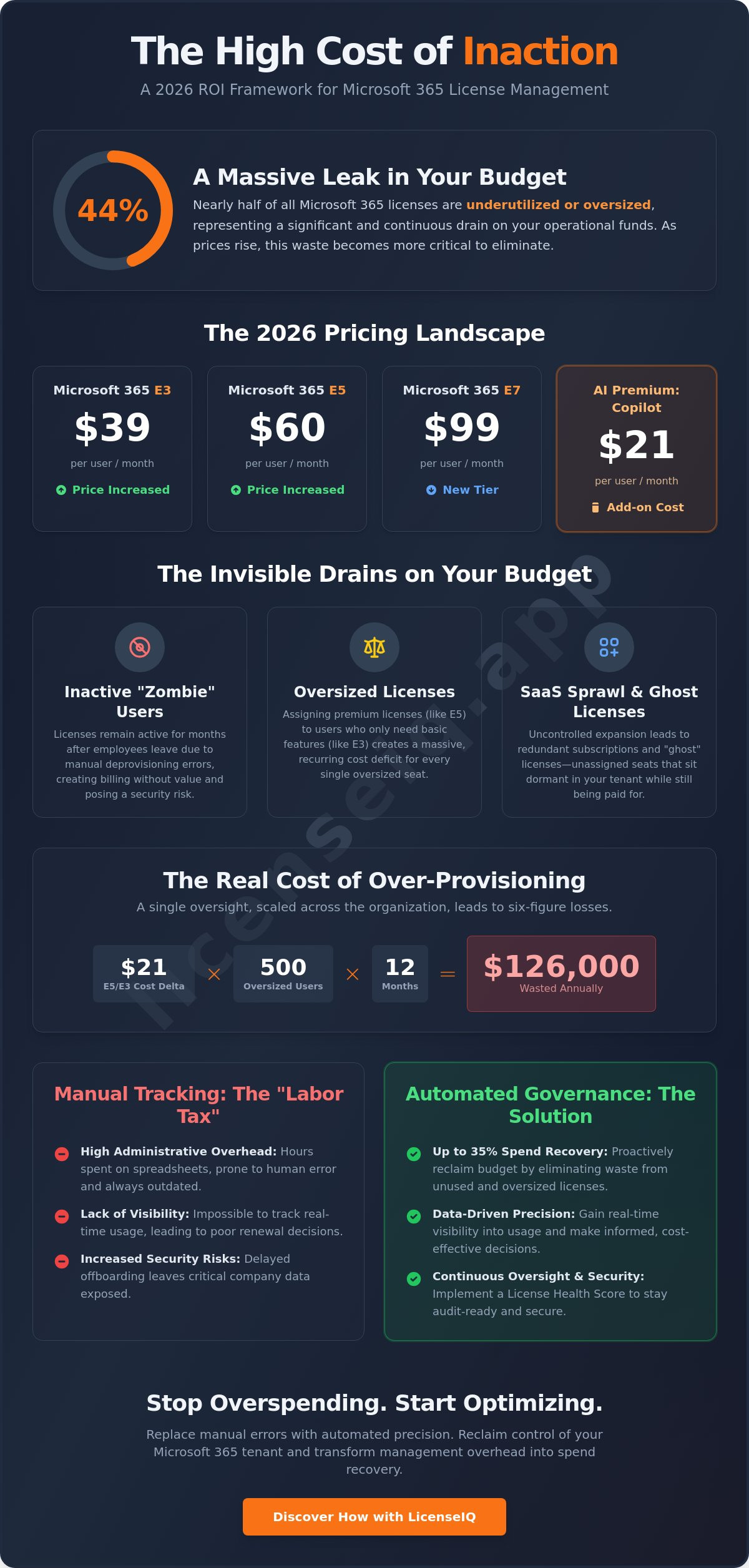
Approximately 44% of Microsoft 365 licenses are currently underutilized or oversized, representing a massive leak in your operational budget. As the July 2026 price increases take effect, with Microsoft 365 E3 rising to $39 and E5 reaching $60 per user, the cost of inaction is higher than ever. Many leaders assume manual tracking is the most cost-effective approach. However, hidden administrative labor and overlooked license sprawl often make "free" oversight the most expensive option. Understanding the true landscape of microsoft 365 license management pricing requires looking beyond the subscription fee to the efficiency of your governance system.
You've likely experienced the frustration of paying for inactive users or struggling with visibility during manual audits. It's a common pain point for specialized leadership trying to maintain fiscal health in a complex digital environment. This article provides a 2026 ROI framework to help you reclaim control over your tenant. You'll discover how to transform management overhead into 35% spend recovery by replacing manual errors with automated precision. We will analyze the specific costs of license governance and provide a clear roadmap to reduce your monthly Microsoft spend while maximizing every seat's value.
Key Takeaways
- Analyze the 2026 price adjustments for Enterprise and Business tiers, including the financial impact of new AI and Copilot add-ons.
- Identify the primary drivers of license sprawl and learn to eliminate recurring waste from inactive users and redundant subscriptions.
- Quantify the "Labor Tax" of manual spreadsheet tracking and compare it to the precision and speed of automated governance workflows.
- Use a data-driven ROI framework to evaluate microsoft 365 license management pricing and project a potential 35% spend recovery for your organization.
- Implement a License Health Score to maintain continuous oversight and ensure your tenant remains audit-ready and financially optimized.
Microsoft 365 License Tiers and Pricing in 2026
The July 2026 price updates have fundamentally altered the financial landscape for Microsoft 365 tenants. Effective budgeting now requires a surgical understanding of the new tier structures and the AI tax embedded in modern workflows. While the sticker price provides a baseline, your strategy for microsoft 365 license management pricing must account for the 44% of licenses that typically remain underutilized or oversized across the average enterprise. Organizations must choose between various Microsoft 365 license tiers based on headcount, security requirements, and automation needs.
Enterprise vs. Business Tier Pricing
For organizations exceeding 300 users, the shift from E3 to E5 is now a $21 per user monthly delta. Microsoft 365 E3 costs have risen to $39, while E5 has reached $60. The introduction of the Microsoft 365 E7 tier at $99 per user targets organizations requiring maximum compliance and advanced threat protection. In the SMB sector, Business Premium remains the value leader at $22. It offers a stable price point amidst the 12% to 16% increases seen in the Basic and Standard tiers. Choosing between annual commitments and monthly flexibility is a critical decision. Annual plans lock in lower rates but often lead to paying for ghost users during staff turnover. Monthly plans offer the agility to scale down immediately; this often offsets the higher per-user cost through rapid waste elimination.
The 2026 AI Premium: Copilot and Agent Pricing
AI integration is no longer a luxury; it's a core component of the 2026 pricing model. Microsoft 365 Copilot for Business is now standardized at $21 per user per month. This add-on can quickly double the cost of a Business Basic or Standard seat. The emergence of the Agent 365 control plane has added another layer of complexity to IT budgeting. These AI agents shift license requirements by automating tasks that previously required dedicated user seats, yet they require their own governance to prevent cost overruns. Evaluating the ROI of these premium AI licenses is essential. Organizations must move beyond the sticker price and use tools like the LicenseIQ Platform to ensure that expensive AI-integrated licenses are actually being used by the employees who receive them. Without this oversight, AI adoption becomes a drain on resources rather than a productivity multiplier.
The Hidden Costs of Inefficient License Management
While the 2026 price hikes are highly visible, the most significant drain on your budget is often invisible. Inefficient processes create a stealth tax on your IT operations that compounds every month. Approximately 44% of Microsoft 365 licenses are currently underutilized or oversized. This waste directly inflates your microsoft 365 license management pricing model without providing any operational gain. Leaders who ignore these obscured details aren't just overpaying; they're subsidizing organizational disorder.
Inactive users are the most common source of wasted spend. Employees leave, but their licenses often remain active for months due to manual oversight. This creates zombie accounts that continue to bill your organization at the highest rates. Over-provisioning is equally damaging. Assigning an E5 license to a user who only needs E3 features creates a $21 per month deficit for every single seat. Across 500 users, this oversight costs $126,000 annually. Your microsoft 365 license management pricing strategy must identify these discrepancies before they impact your quarterly fiscal health.
SaaS Sprawl and Ghost Licenses
SaaS sprawl occurs when an organization’s software ecosystem expands beyond the IT department’s ability to monitor or control it. In 2026, this lack of oversight is a primary driver of financial waste. Statistics show that nearly half of all assigned licenses are not being used to their full potential. Ghost licenses are unassigned seats that sit dormant in your tenant. These often accumulate during rapid hiring cycles when IT teams buy licenses in bulk but fail to assign every seat. Individual departments also frequently purchase specialized add-ons or redundant subscriptions. This level of inefficient license management drains capital that should be fueling growth.
Security Risks of Poor License Governance
Financial waste isn't the only risk. Offboarding failures leave your data exposed to external threats. When an employee departs, their access must be revoked immediately to prevent unauthorized entry. A zombie account is a wide-open door for credential harvesting and lateral movement within your network. The financial penalty of a data breach in 2026 far outweighs any subscription savings. Implementing a rigorous Office 365 offboarding checklist ensures that access is severed and licenses are reclaimed instantly. This maintains your security posture while protecting your bottom line.
Common hidden costs include:
- Unassigned licenses purchased for future use that remain dormant for over 90 days.
- Redundant Copilot add-ons assigned to users who haven't activated the service.
- Premium security features paid for but never configured or deployed.
- Licenses assigned to shared mailboxes that don't require paid tiers.
Maintaining visibility doesn't have to be a manual burden. You can use a Spend Recovery Dashboard to identify these hidden costs and reclaim your budget in minutes.
Manual Tracking vs. Automated Management Software
Most organizations default to manual tracking because they believe it's the most cost-effective approach. This is a strategic error. Determining the total microsoft 365 license management pricing requires a calculation of both license fees and the internal labor required for oversight. When you factor in the "Labor Tax" of manual audits, the "free" spreadsheet becomes a significant financial liability. Manual processes are reactive, error-prone, and incapable of keeping pace with the dynamic nature of modern SaaS tenants.
The Real Cost of "Free" Spreadsheets
Manual license reconciliation is a massive time sink for IT departments. A business with 500 users often spends dozens of hours per quarter pulling usage reports, cross-referencing HR data, and manually reclaiming seats. This administrative burden distracts your most expensive technical talent from strategic initiatives. Opportunity cost is high. While your team hunts for ghost users in a spreadsheet, they aren't improving security architecture or driving digital transformation. Furthermore, manual audits are outdated the moment they're completed. In the time it takes to finalize a report, new hires have joined and more licenses have been over-provisioned. Human error is inevitable in these environments. Missed reclamation opportunities directly inflate your microsoft 365 license management pricing without providing any operational value.
Automated Governance Pricing Models
Automated platforms shift the paradigm from reactive cleanup to continuous optimization. Unlike manual audits, Automated Governance Workflows provide real-time oversight. Pricing for these platforms typically follows two structures: per-user monthly fees or flat-fee models. For many SMBs, a flat-fee model offers the most predictable ROI. It eliminates the "success tax" where you pay more as your company grows. The LicenseIQ Platform provides a distinct advantage through the License Health Score. This single metric offers immediate clarity on your financial hygiene, replacing the need for quarterly manual snapshots. When comparing the cost of a specialized platform against the salary hours of your IT team, the payback period is often measured in weeks, not months. Automated systems don't just find waste; they prevent it from occurring in the first place. This proactive stance ensures your resources are always monitored by a vigilant system, providing the security and confidence that manual tracking simply cannot match.
Key advantages of automation include:
- Elimination of human error in license reclamation.
- Real-time visibility into inactive users and oversized tiers.
- Automated offboarding to prevent "zombie" account security risks.
- Predictable management costs that don't scale with headcount.
Building a Business Case for License Management Tools
Securing budget for specialized tools requires a shift from technical jargon to financial outcomes. You must present the microsoft 365 license management pricing not as an added expense, but as a mechanism for spend recovery. By bridging the gap between IT operations and Finance, often referred to as FinOps, you transform license oversight into a strategic asset. A well-constructed business case focuses on one core metric: the speed and scale of recovered capital. Every dollar reclaimed from a redundant subscription is a dollar that can be reinvested in innovation.
Calculating Spend Recovery ROI
Data from 2026 indicates that organizations can project a 35% reduction in subscription costs through active governance. Visualizing these savings is the first step toward CFO approval. The Spend Recovery Dashboard allows you to identify "low-hanging fruit" such as unassigned Copilot seats or redundant E5 licenses. Instead of presenting vague estimates, you can provide hard data on exactly how much capital is leaking from your tenant. This transparency builds trust with financial leadership. It proves that the investment in management software is self-funding. When you demonstrate that identifying just ten unused E5 seats covers the monthly platform cost, the decision becomes a financial necessity.
Automated Governance Workflows
Efficiency in 2026 relies on reducing friction in high-velocity environments. Automated Governance Workflows eliminate the manual delays associated with employee offboarding and role changes. By leveraging the Model Context Protocol, these systems can integrate directly with your existing technical stack to execute reclamation tasks without human intervention. This move from point-in-time audits to continuous monitoring ensures that your License Health Score remains high. For a deeper dive into these strategies, consult our Microsoft 365 license optimization guide. It details how to maintain a lean tenant without manual effort.
The payback period for these tools is remarkably short. Most organizations achieve total cost neutrality within the first 60 days. This rapid ROI is driven by the immediate elimination of license sprawl and the reduction of IT labor hours. You aren't just buying software; you're installing a digital auditor that works 24/7 to protect your corporate resources. Vigilant monitoring prevents waste from re-accumulating, ensuring that your financial health is managed with precision. To see your potential savings in real-time, connect your tenant to the LicenseIQ Platform today.
LicenseIQ: Automating Governance to Recover M365 Spend
Connecting to your tenant shouldn't require weeks of consulting or deep technical integration. The LicenseIQ Platform is designed for immediate impact. It allows you to perform a comprehensive audit in under five minutes. By replacing manual data collection with a vigilant, automated system, you gain instant clarity into your microsoft 365 license management pricing structure. This isn't just a reporting tool; it's an active participant in your company's fiscal health. It uncovers obscured details that manual spreadsheets simply cannot capture, providing the security of total operational transparency.
The cornerstone of this framework is the License Health Score. This single metric acts as a pulse check for your financial hygiene. It aggregates complex data points into a clear, actionable score that tells you exactly how much waste exists in your environment. You no longer have to guess which tiers are oversized or which users are inactive. Every recommendation comes with a specific dollar-value attachment. This allows you to prioritize reclamation tasks based on their direct impact on your bottom line. It's the most efficient way to manage the rising costs of 2026 without increasing your IT team's workload.
The AI-Native Advantage
LicenseIQ leverages an AI-native engine to discover hidden license sprawl that traditional tools miss. It doesn't just look at login dates; it analyzes usage patterns across the entire suite to determine if a user truly requires a premium tier. This ensures continuous financial accuracy without the need for manual intervention. These Automated Governance Workflows are specifically optimized for SMBs that need enterprise-grade oversight without enterprise-grade complexity. You receive real-time spend recovery insights that allow you to act before the next billing cycle begins. It's a proactive approach to cost control that keeps your organization one step ahead of subscription inflation.
Getting Started with LicenseIQ
The path to a leaner tenant starts with a simple setup process. Within minutes of connecting your tenant, the Spend Recovery Dashboard populates with every available saving opportunity. You can immediately begin reclaiming wasted spend by following the step-by-step recommendations provided by the system. This structured flow minimizes cognitive load, making complex administrative tasks feel straightforward and manageable. Whether you're dealing with "zombie" accounts from previous hiring cycles or redundant Copilot add-ons, you'll have the data-driven evidence needed to optimize your spend. Don't let your resources leak away through inefficient oversight. Audit your Microsoft 365 tenant for free at LicenseIQ and secure your organization's financial future today.
Secure Your 2026 Spend Recovery
The 2026 landscape leaves no room for administrative waste. Manual audits are a liability that drain technical resources and overlook critical license sprawl. By shifting to automated governance, you replace reactive cleanup with continuous financial hygiene. Understanding the true impact of microsoft 365 license management pricing means accounting for both subscription fees and the internal cost of management labor. This shift ensures your resources are always monitored by a vigilant system.
Organizations that leverage AI-native software intelligence can identify underutilized seats and redundant tiers in real-time. This proactive stance secures your tenant against price inflation while ensuring every user has exactly what they need. You can transform your overhead into a competitive advantage by reclaiming capital for strategic growth. Transparency is the cornerstone of a healthy tenant. Our platform connects to your environment in minutes to provide the total clarity required for expert leadership.
Discover your Spend Recovery Score with LicenseIQ and save up to 35% on your M365 subscriptions. Take control of your digital resources and build a more resilient, efficient organization today.
Frequently Asked Questions
How much does Microsoft 365 license management software typically cost?
The cost structure for management software varies based on the depth of automation and the size of your tenant. Most platforms utilize either a per-user monthly fee or a flat-fee model designed to provide predictable ROI. When evaluating microsoft 365 license management pricing, look for models that don't penalize your company's growth with a "success tax" on every new hire. The primary goal is to ensure the software pays for itself through the elimination of license sprawl.
Can I manage Microsoft 365 licenses for free using the admin center?
You can use native usage reports within the Microsoft 365 Admin Center for basic oversight, but this approach isn't truly free. It requires significant IT labor hours to manually cross-reference data and reclaim seats. Native tools lack dollar-value recovery recommendations and automated workflows. This creates a "Labor Tax" that often exceeds the cost of a specialized management platform.
What is the average ROI of a SaaS spend management tool?
Organizations implementing structured governance can achieve a significant return on investment. A Forrester Consulting study found that organizations moving to premium tiers like Microsoft 365 E5 can see an ROI of 123% with a payback period of 10 months. Automated tools accelerate this by identifying the 44% of licenses that are typically underutilized or oversized across the average enterprise.
How do I identify inactive Microsoft 365 users to save money?
You identify inactive users by monitoring sign-in activity and application usage over a specific period, typically 90 days. While you can pull these reports manually, it's more efficient to use a Spend Recovery Dashboard that flags these accounts automatically. This real-time visibility allows you to sever access and reclaim the license immediately after an employee departs, preventing the accumulation of "zombie" accounts.
Is there a difference between license management and license optimization pricing?
Yes, license management focuses on the administrative tasks of assigning and revoking seats. License optimization is a fiscal strategy focused on maximizing the value of every dollar spent. Optimization pricing models are often built around the value of recovered waste. This ensures your microsoft 365 license management pricing reflects the actual financial health and efficiency of your organization.
Does LicenseIQ sell Microsoft 365 licenses directly?
No, LicenseIQ does not sell or resell Microsoft licenses. The platform is an independent governance solution designed to provide oversight and spend recovery insights. It acts as a digital auditor for your tenant, ensuring you only pay for the licenses your team actually uses. This independence ensures that recommendations are based solely on your organization's financial hygiene rather than sales quotas.
How long does it take to see savings after implementing a management tool?
Savings are often visible within minutes of connecting your tenant to an automated platform. Most organizations identify immediate reclamation opportunities, such as unassigned seats or redundant add-ons, during the initial five-minute audit. Total cost neutrality is typically achieved within the first 60 days as automated workflows begin to eliminate recurring waste and reduce IT administrative hours.
What are the tiered pricing options for SMB license governance?
SMB governance options generally include tiered monthly subscriptions or discounted annual plans. Tiered models allow smaller organizations to access enterprise-grade automation without a massive upfront investment. Look for platforms that offer a License Health Score to maintain continuous visibility. This ensures your governance costs remain predictable and aligned with your overall spend recovery goals.


