

In Gartner’s August 2025 survey, 56% of CFOs ranked enterprise-wide cost optimization among their top five priorities for 2026. Yet a savings proposal still needs to earn approval. Getting executive buy-in for it cost reduction initiatives means showing that the opportunity is credible, risks are managed, and savings support business priorities.
Executives are right to ask whether projected savings are achievable and material. They also need to know that cuts won’t weaken service quality, security, or employee experience. When IT and finance use different baselines or definitions of savings, even a strong proposal can stall.
Build a concise case that answers those concerns. Connect savings to business outcomes, document assumptions and safeguards, assign clear ownership, and agree on how results will be measured. The goal is a confident decision without trading operational resilience for short-term savings.
Key Takeaways
- Frame savings as a business decision, not just a technical change, to make getting executive buy-in for it cost reduction initiatives easier.
- Set a dated financial baseline and distinguish potential savings from approved, realized, and ongoing costs.
- Pair each material risk with a safeguard, accountable owner, monitoring measure, and escalation path.
- Make the proposal decision-ready by stating the recommendation, evidence, risks, owner, and next review up front.
- LicenseIQ can provide evidence for a Microsoft 365 license review. Its free one-time scan costs $0 and requires no credit-card information. The connection is read-only and never modifies, deletes, or creates anything in the tenant. Customer data stays in Microsoft’s cloud, emails, files, and Teams messages aren’t accessed, and AI analysis doesn’t use customer data for training.
Why IT Cost Reduction Initiatives Need an Executive Case
A list of unused licenses, underused systems, or overlapping contracts may reveal an opportunity, but it doesn’t explain why leaders should approve action. Getting executive buy-in for it cost reduction initiatives means showing what the organization gains, what must be protected, and who will be accountable for results.
Executives assess strategic fit, financial credibility, continuity, and accountability. They need to know whether a proposal supports priorities such as budget resilience or strategic capacity, whether its assumptions can be validated, and whether employees and customers will still receive the services they depend on. They also need a clear owner and a way to review progress. Cost reduction strategies work best when they fit the organization’s goals and operating needs.
Indiscriminate cuts can remove resources that support service quality, security, or essential controls. A well-defined initiative targets specific waste or inefficiency while spelling out what must remain intact. State both the intended improvement and its guardrails.
Executive buy-in means approval to proceed, active sponsorship, assigned ownership, and a scheduled review of results. Without all four, an initiative can receive verbal support but lack the authority, coordination, or follow-through to deliver.
Translate technical savings into executive priorities
Lead with the operational outcome, not a tool name or configuration change. For example, describe reducing spend on unused software access while preserving the capabilities teams rely on. Then connect that outcome to each executive’s remit: finance may prioritize budget predictability, operations may focus on continuity, and a business-unit leader may value employee productivity.
Explain what improves, what stays protected, and how you’ll assess the result. Put technical detail in the supporting evidence so it can answer questions without obscuring the business case.
Define the decision and the sponsor you need
State exactly what approval you’re seeking. Is it permission to gather evidence, run a limited pilot, implement a defined change, or establish ongoing governance? Each request involves a different level of commitment. Clarify what approval enables and what decision will follow once the evidence is reviewed.
Map the decision to the people who must carry it forward:
- Executive sponsor: Provides authority and keeps the initiative aligned with business priorities.
- Budget owner: Assesses financial impact and how savings will be treated.
- Operational owner: Protects service delivery and coordinates implementation.
- Affected stakeholders: Identify dependencies, user impacts, and practical constraints.
Close with a concrete next step, such as reviewing the evidence and deciding whether to proceed. That turns a broad request for support into a bounded decision with visible ownership.
Build a Credible Financial Case for IT Cost Reduction
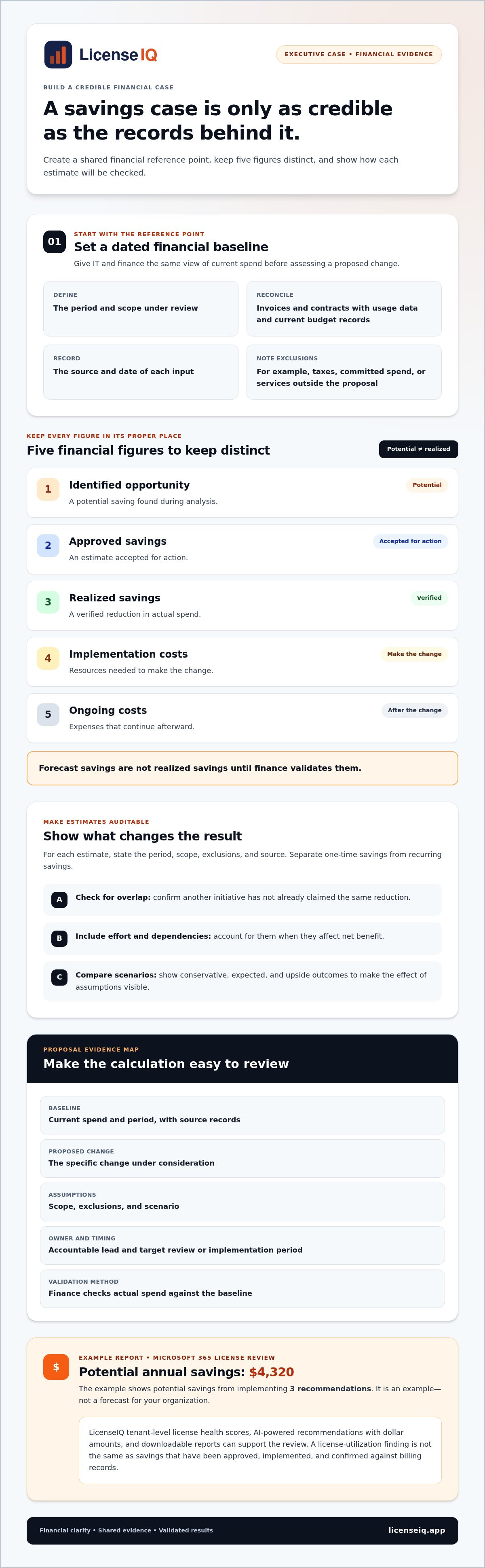
A savings estimate is only as credible as the records behind it. Start with a dated baseline that defines the period and scope under review. Reconcile invoices and contracts with usage data and current budget records. Record the source and date of each input, and note exclusions such as taxes, committed spend, or services outside the proposal. This gives finance and IT a shared reference point.
Keep five figures distinct: an identified opportunity is a potential saving found in analysis; approved savings are estimates accepted for action; realized savings are verified reductions in actual spend; implementation costs are resources needed to make the change; and ongoing costs are expenses that continue afterward. Forecast savings are not realized savings until finance validates them.
Calculate savings without overstating the opportunity
For each estimate, document the period, scope, exclusions, and source. Separate one-time savings from recurring savings, and check whether another initiative already claims the same reduction. Include implementation effort and dependencies when they affect net benefit. Use conservative, expected, and upside scenarios to show how assumptions change the result, rather than presenting the most favorable estimate as the likely outcome.
A comparison table makes the proposal easier to audit and challenge constructively:
| Baseline | Proposed change | Assumptions | Owner | Timing | Validation method |
|---|---|---|---|---|---|
| Current spend and period, with source records | Specific change under consideration | Scope, exclusions, and scenario | Accountable lead | Target review or implementation period | Finance checks actual spend against baseline |
For example, a Microsoft 365 review should distinguish a license-utilization finding from a saving that has been approved, implemented, and confirmed against billing records. LicenseIQ provides tenant-level license health scores, AI-powered recommendations with dollar amounts, and downloadable reports that can support that discussion. An example report shows $4,320 in potential annual savings from implementing 3 recommendations. Treat that as an example, not a forecast for your organization.
LicenseIQ’s free one-time scan costs $0 and requires no credit-card information. The connection is read-only and never modifies, deletes, or creates anything in the tenant. Customer data never leaves Microsoft’s cloud; emails, files, and Teams messages aren’t accessed, and AI analysis doesn’t use customer data for training.
Make the cost of inaction specific
Show what continues if no decision is made: current spend, identified exposure, or operational inefficiency. Explain which assumptions drive each scenario and what evidence would change the estimate. The M365 subscription cost reduction playbook can help frame a Microsoft 365 review. LicenseIQ’s evidence can inform the business case; decision-makers retain control over any changes.
Address the Risks That Can Block Executive Approval
Cost savings must not compromise security, continuity, or employee capability. Before proposing a change, identify affected users, workflows, data dependencies, and service-level expectations. A reduction that looks sound in a spreadsheet may create operational friction if it removes access or capacity that teams rely on.
For each material risk, document a safeguard, accountable owner, monitoring measure, and escalation path. If a proposed license change could affect a business workflow, for example, the operational owner can identify impacted users, monitor support issues after an approved change, and escalate disruption to the designated decision-maker. Review gates and rollback planning are governance steps, not guarantees of protection.
- Security: Record the control at risk, the security owner, and how the control will be checked.
- Continuity: Identify dependent services, the operational owner, and the signal that triggers escalation.
- Employee capability: Map affected teams and essential workflows, then monitor user impact through the agreed channel.
Answer concerns about service quality and security
Separate discovery from implementation. Reviewing usage data or gathering read-only evidence can inform a decision without changing the environment. Changes to access, configurations, or service delivery require the appropriate technical, finance, or security approval before action. Define who grants each approval and what evidence they need. This prevents analysis from being mistaken for authorization to implement.
For Microsoft 365 evidence gathering, LicenseIQ uses a read-only connection and never modifies, deletes, or creates anything in the tenant. Customer data never leaves Microsoft’s cloud; emails, files, and Teams messages aren’t accessed. AI analysis doesn’t use customer data for training.
Prove value through bounded evidence
Set boundaries before a proof of value begins. Specify its scope, duration, success measures, accountable owner, and decision date. Define which tenant or license population is under review, what evidence will be assessed, and who will decide whether to advance a recommendation. The review should answer a specific question, not quietly expand into implementation.
A read-only Microsoft 365 scan can provide evidence for that review. LicenseIQ’s free one-time scan costs $0 and requires no credit-card information. The full scan takes 5 minutes, and health-score calculation takes under 60 seconds. Reports and dollar-value recommendations can inform executive judgment, but the analysis itself doesn’t implement savings. Route any subsequent changes through the agreed approval process.
The Microsoft 365 license analysis platform can surface utilization insights without changing tenant settings. That gives the decision team a bounded input while keeping implementation authority with the organization.
Turn the Business Case into a Decision-Ready Proposal
Executives should see the decision required without searching through a technical deck. Put the recommendation and decision deadline first, then use a one-page brief to explain why it matters, what evidence supports it, and what proceeding requires. Keep configuration details, data extracts, and calculation notes in a short appendix. This gives leaders a clear path to decide while preserving the detail needed for review.
Present the recommendation in a clear sequence
Build the brief around six elements: the decision requested, business case, supporting evidence, material risks and safeguards, accountable owner, and next review. Summarize the current problem, proposed action, expected value, and principal risk in plain language. Label assumptions that still need validation, and state the resources, dependencies, or cross-functional decisions required. End with the decision owner, requested date, and next checkpoint.
- Decision: Approve discovery, a defined pilot, implementation, or ongoing governance.
- Business case and evidence: State the operational outcome and summarize the records or analysis supporting it.
- Risks and ownership: Identify key safeguards, accountable leads, and required approvals.
- Next checkpoint: Name the review date and the evidence that will inform the next decision.
For Microsoft 365 proposals, the Microsoft 365 license optimization guide offers background for explaining license utilization and spend recovery in business terms. Use technical material to support the recommendation, not bury it.
Adapt the conversation to executive stakeholders
Keep the recommendation consistent, but make its relevance clear to each decision-maker. Finance leaders need traceable assumptions, budget treatment, and a defined savings validation method. IT and security leaders need dependencies, access boundaries, service impact, and named owners. Business leaders need to understand effects on employees or customers and the trade-offs involved. This makes getting executive buy-in for it cost reduction initiatives a decision about outcomes, not just technical mechanics.
Before the meeting, confirm the resources and cross-functional input the proposal depends on. Identify who can approve budget treatment, technical changes, security review, and operational readiness. If Microsoft 365 evidence would strengthen the brief, LicenseIQ offers a free one-time scan that costs $0 and requires no credit-card information. The connection is read-only and never modifies, deletes, or creates anything in the tenant. Customer data never leaves Microsoft’s cloud; emails, files, and Teams messages aren’t accessed, and AI analysis doesn’t use customer data for training. The scan informs the decision; authorized customer decisions determine any changes.
Prepare a direct closing ask: “Approve this defined review by [date], with [owner] responsible for bringing the evidence and recommendation to the next checkpoint.” To gather Microsoft 365 license evidence for a proposal, run a read-only LicenseIQ scan.
After Approval, Govern Savings and Make the Next Step Easy
Approval starts the work; it doesn’t prove savings have been delivered. Put governance in place before implementation begins. Assign a named owner for implementation, finance validation, operational monitoring, and executive updates. One person may hold more than one role, but accountability should remain explicit. Set review dates that fit the initiative’s scope and pace, then compare actual results with the approved estimate using the agreed baseline.
Track realized savings without losing operational context
Report financial results alongside service performance. Track the baseline, actual spend, validated savings, exceptions, and relevant service indicators together. That context helps leaders see whether a lower bill reflects genuine efficiency or a change that affected business operations.
Keep an evidence trail connecting each recommendation to its approval, action, and finance review. If realized savings differ materially from the estimate, record the variance, identify the assumption or dependency behind it, and escalate it to the accountable owner. Revisit the business case before expanding the initiative. Don’t treat an early result as permission to apply the same change elsewhere without review.
Choose review intervals based on the initiative. A change with immediate operational effects may need closer monitoring at first; a longer-term contract or governance effort may call for reviews aligned with its milestones. Agree on the cadence with the owners and state what evidence each review will examine. The goal is steady oversight, not a one-size-fits-all schedule.
- Implementation owner: Records actions taken and unresolved dependencies.
- Finance validator: Reconciles actual spend to the baseline and classifies realized savings.
- Operational owner: Monitors service indicators, user impact, and exceptions.
- Executive sponsor: Reviews material variances and decides whether to continue, adjust, or expand.
Choose a low-friction next step
For Microsoft 365 license questions, LicenseIQ provides license-utilization health scores and dollar-value recommendations to inform a cost review. Its one-time scan takes 5 minutes, costs $0, and requires no credit-card information. The scan provides evidence, not implementation. Your organization decides whether to act on a recommendation.
If Microsoft 365 license usage is part of your approved review, start a free Microsoft 365 license scan to gather evidence for the next decision checkpoint. This control loop, from recommendation to validation and review, turns getting executive buy-in for it cost reduction initiatives into accountable follow-through.
Make the Next Decision with Clear Evidence
The next step doesn’t need to be a broad commitment. Start with a focused question your leadership team needs answered, then bring back evidence to inform the decision. For Microsoft 365, a license review can identify where utilization and potential savings deserve a closer look.
The connection is read-only: LicenseIQ never modifies, deletes, or creates anything in the tenant. The full scan takes 5 minutes, and health-score calculation takes under 60 seconds. Use the findings as input for executive judgment, not as a substitute for approval. Your organization controls any subsequent changes.
Getting executive buy-in for it cost reduction initiatives is an ongoing discipline. Each well-governed review gives leaders a clearer basis for deciding what to fund, protect, or improve next. Start your free, read-only Microsoft 365 scan and bring concrete license evidence into your next cost-reduction discussion.
Frequently Asked Questions
How do you get executive buy-in for an IT cost reduction initiative?
Start with a decision executives can make, connect it to a business priority, and support it with evidence. For getting executive buy-in for it cost reduction initiatives, tailor the case to each leader’s role: finance needs confidence in budget impact, while operational leaders need clarity on service and employee effects. Ask for a defined next step, such as authorizing a review, and name who will bring findings back for a decision.
What should an IT cost reduction business case include?
Include the current problem, proposed action, expected business value, evidence, key assumptions, risks, resource needs, and accountable owners. Add a short financial model that separates potential from verified savings, and explain how finance will validate results. For example, a software review should identify which user groups are in scope and what service needs must remain supported. Close with the specific approval requested and the next decision point.
How can IT leaders prove cost savings before implementation?
Before implementation, leaders can substantiate a potential opportunity, but they can’t present it as realized savings. Use invoices, contract terms, usage records, and budget data to estimate what could change, then label assumptions and exclusions. A review of Microsoft 365 license utilization can identify candidates for investigation. Confirm any actual reduction after authorized changes by comparing finance records with the agreed baseline and accounting for costs that continue.
How do you address executive concerns about risk when cutting IT costs?
Show how the proposal will detect and manage risk before changes are made. Identify affected workflows and users, then assign owners to security, service continuity, and employee impact. If a change could affect access for a team, for example, define who approves it, what service signal will be monitored, and where an issue is escalated. Treat review gates and rollback planning as controls to manage risk, not guarantees that disruption can’t occur.
Can a Microsoft 365 license scan help build an executive cost-reduction case?
Yes. LicenseIQ scans a Microsoft 365 tenant and provides license-utilization health scores, AI-powered recommendations, dollar-value insights, and downloadable reports to inform an executive discussion. Its free one-time scan costs $0 and requires no credit-card information. Customer data stays within Microsoft’s cloud; emails, files, and Teams messages aren’t accessed, and AI analysis doesn’t use customer data for training.
How often should executives review an IT cost reduction initiative?
Set review dates to match the initiative’s pace, risk, and expected timing of financial evidence. A change with immediate user impact may warrant an early operational check, while a contract-related initiative may be reviewed around relevant milestones. At each checkpoint, compare actual spend with the baseline, check service indicators, and explain material variances. Adjust the cadence if risks, assumptions, or scope change rather than relying on a universal schedule.


