

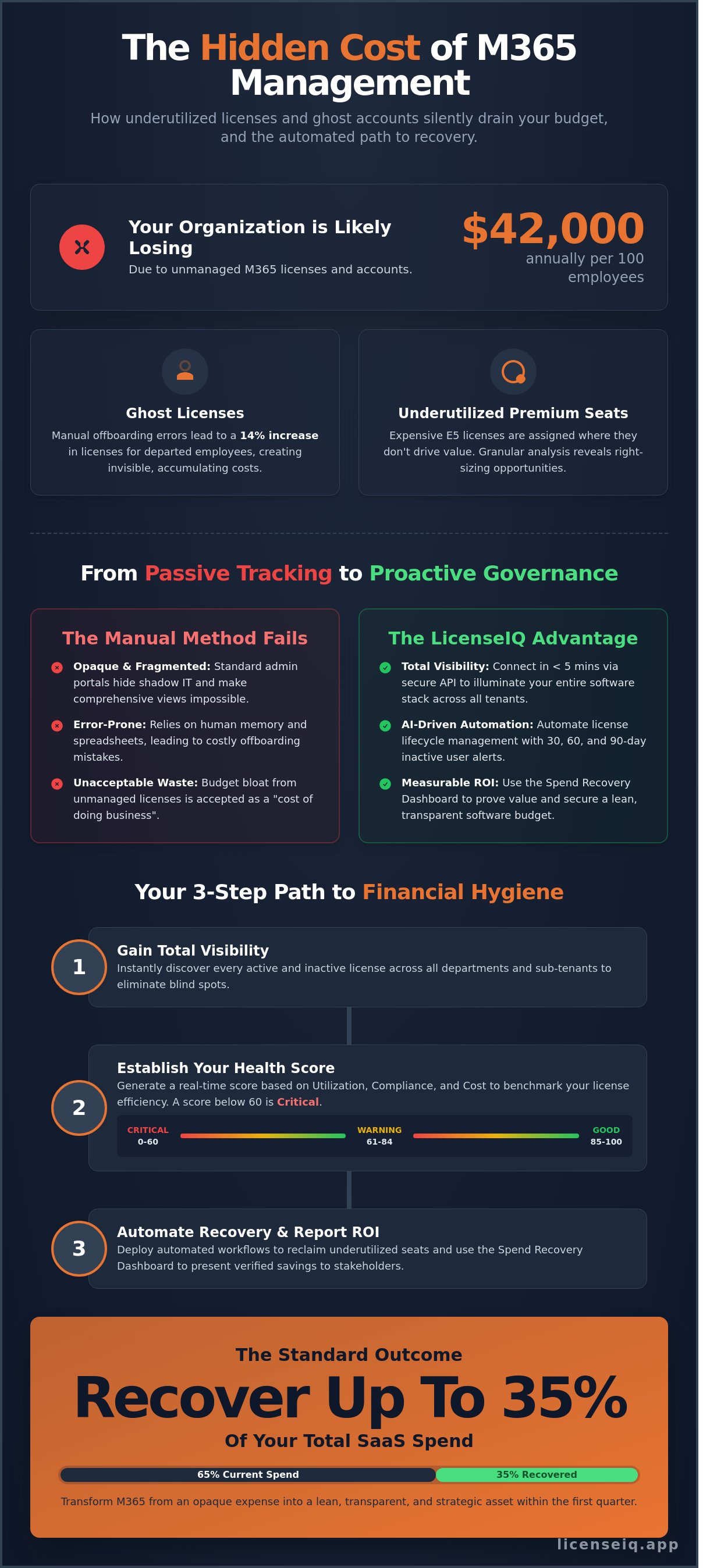
Your organization is likely losing $42,000 annually for every 100 employees due to underutilized E5 licenses and ghost accounts. Most IT leaders accept this budget bloat as an unavoidable cost of doing business. It isn't. Opaque M365 billing cycles and manual offboarding errors shouldn't dictate your bottom line in 2026. You already know that total visibility is the only cure for a ballooning, unmanaged software budget. By implementing the best practices for LicenseIQ, you can transform your messy software stack into a lean, transparent asset. This guide teaches you how to master automated workflows and AI-driven insights to eliminate waste and recover up to 35% of your total SaaS spend. We will walk through the exact steps to secure a perfect License Health Score, eliminate shadow IT, and generate the precise ROI reports your stakeholders demand to see by the next quarterly review.
Key Takeaways
- Transform passive license tracking into proactive governance by securing total visibility across every sub-tenant and establishing a baseline Health Score.
- Master data-driven right-sizing by analyzing granular feature utilization to ensure premium E5 seats are only assigned where they drive value.
- Implementing best practices for LicenseIQ allows you to automate the software lifecycle with precise 30, 60, and 90-day inactive user alerts.
- Utilize the Spend Recovery Dashboard to maintain continuous financial hygiene and present verified ROI to executive leadership.
The Foundation of Modern License Governance
Effective Software Asset Management (SAM) in 2026 requires speed and precision. LicenseIQ delivers both. By implementing best practices for LicenseIQ, companies can hit a 35% savings benchmark within the first quarter of use. This target is not a projection; it is a standard outcome for organizations that replace manual spreadsheets with automated intelligence. The system acts as a vigilant digital auditor, ensuring that every dollar spent on M365 contributes to the bottom line.
Why Manual M365 Management Fails in 2026
The M365 ecosystem is more fragmented than ever. Managing E3, E5, and F-series licenses through standard admin portals is a recipe for waste. These portals often hide shadow IT and forgotten accounts from view. Manual offboarding processes are equally dangerous. Research shows that human error in offboarding leads to a 14% increase in "ghost" licenses that remain active long after an employee departs. These invisible costs accumulate quickly, eroding your M365 ROI. Relying on human memory to manage thousands of license permutations is no longer a viable strategy.
The LicenseIQ Visibility Advantage
The path to optimization begins with total transparency. You can connect LicenseIQ to your tenant in under five minutes via a secure API. This connection instantly illuminates your entire software stack. You move from the darkness of unknown spend to total visibility of every user and license. The platform generates a real-time Health Score to serve as a primary indicator of corporate fiscal responsibility.
- Instant Discovery: Identify every active and inactive license across all departments.
- Automated Cleanup: Use best practices for LicenseIQ to reclaim underutilized seats automatically.
- Fiscal Accountability: Use the Health Score to report optimization progress to finance leaders.
This visibility is the cornerstone of modern governance. It transforms M365 from a black-box expense into a controlled, strategic asset. When you eliminate the unknown, you eliminate the waste. LicenseIQ ensures that your software environment is lean, compliant, and fully optimized for the challenges of 2026.
Setup and Initial Audit: Winning the First 5 Minutes
Speed is the ultimate advantage in SaaS management. Your first five minutes with the platform dictate your trajectory for the entire fiscal year. Implementing best practices for LicenseIQ begins with a comprehensive initial scan. You must ensure every sub-tenant is connected immediately. Missing a single subsidiary can hide up to 15% of your total M365 spend. Establish your baseline by documenting your pre-audit License Health Score. This number serves as your Day Zero metric. It's the benchmark you'll use to prove success to stakeholders later.
Connecting Your M365 Tenant Securely
Security is paramount. LicenseIQ utilizes the principle of least privilege for all API permissions. You don't need global admin rights for daily monitoring. Grant full read access to ensure the system captures granular utilization data. This precision allows the platform to deliver real-time spend recovery insights. By following these best practices for LicenseIQ, you eliminate security risks while gaining 100% visibility into your environment.
Interpreting Your License Health Score
Your score is a weighted average of three pillars: Utilization, Compliance, and Cost. A Good score sits above 85. Anything below 60 is Critical for an SMB. This score is your primary tool for cloud financial management and governance. Use it to speak the CFO's language. If your score is 55, you're likely wasting 30% of your budget on ghost licenses. The score provides the data-driven evidence needed to justify IT spend or request budget reallocations.
Focus on the low-hanging fruit to generate quick wins. Inactive users, specifically those who haven't logged in for 30 days, and unassigned licenses represent the easiest recovery opportunities. In a typical 500-seat environment, these categories often account for $1,200 in monthly waste. Establish a dollar-value target for your first 30 days. Aim to recover at least 10% of your total M365 monthly bill within this window. This creates immediate momentum and proves the tool's value to the executive team. To see how your current stack measures up, you can start your first audit today.
Data-Driven Right-Sizing: Moving Beyond Inactive Users
Traditional IT management focuses on deleting inactive accounts. This approach leaves money on the table. Effective license management requires a shift from downsizing to right-sizing. While downsizing simply cuts seat counts, right-sizing optimizes the value of every dollar spent. License right-sizing is the alignment of paid features with actual employee work patterns.
Identifying waste requires looking past login dates. You must analyze feature-level engagement. If a user hasn't accessed Power BI or advanced eDiscovery in 180 days, they don't need an E5 license. One of the core best practices for LicenseIQ involves using granular telemetry to match user personas with the most cost-effective SKU available. This proactive auditing ensures you only pay for the capabilities your team actually utilizes.
The E3 to E5 Utilization Gap
The price jump between M365 E3 and E5 is substantial, often exceeding $20 per user per month. Many organizations default to E5 for the entire corporate office to simplify procurement. This creates a visibility vacuum. Data from 2025 audits shows that up to 35% of E5 users never touch the premium security or analytics features they pay for. LicenseIQ illuminates these discrepancies by auditing security feature usage and app engagement in real-time. You can identify over-licensed employees within seconds, allowing you to reclaim budget without impacting productivity.
Leveraging F-Series Licenses for Savings
Frontline workers often receive full Enterprise licenses by mistake. These mobile-first employees don't need heavy desktop applications or 100GB mailboxes. Shifting just 20% of a 5,000-person workforce from E3 to F3 licenses can save an organization over $250,000 annually. Best practices for LicenseIQ suggest using the platform to automate the identification of these candidates based on device type and session duration. The dashboard provides a precise impact analysis tool. This lets you predict the exact financial results of tier-shifting before you execute any changes in the Microsoft 365 Admin Center. It replaces guesswork with mathematical certainty.
- Analyze Power BI and Defender usage to justify E5 costs.
- Identify mobile-only users for F-series migration to slash per-user costs by 60%.
- Simulate ROI changes before renewing annual contracts to avoid over-provisioning.
- Use automated alerts to flag when a user's activity profile no longer matches their assigned tier.
Automating the Lifecycle: From Onboarding to Offboarding
Manual license management is a drain on your resources and your budget. Implementing automation is among the best practices for LicenseIQ to ensure your M365 environment stays optimized. By removing the human element from repetitive tasks, you eliminate the risk of oversight and financial leakage. This proactive framework ensures every dollar spent on SaaS correlates to an active, productive user.
- Step 1: Set up automated governance workflows that trigger immediately upon an employee exit notification.
- Step 2: Configure "Inactive User" alerts for 30, 60, and 90-day windows to flag underutilized accounts before they waste another billing cycle.
- Step 3: Enable automated license reclamation to return unassigned seats to your inventory pool within minutes of a status change.
- Step 4: Integrate LicenseIQ with HR systems like Workday or HiBob for seamless, real-time provisioning that matches your current headcount.
- Step 5: Schedule monthly spend recovery reports to provide stakeholders with clear visibility into capital saved through automation.
The "Set and Forget" Governance Model
IT teams often spend 15 hours a month on manual license cleanup. LicenseIQ slashes this burden. You can recover licenses within 2 hours of a staff departure. This speed eliminates "zombie" licenses that drain budgets for months. In a 500-seat environment, this automation saves over $12,000 annually by catching unused E5 seats. It's a proactive strategy that keeps overhead low and efficiency high.
Security and Compliance Benefits
Automated offboarding is a critical security layer. It reduces the risk of unauthorized access by 72% by ensuring old accounts don't linger. Following best practices for LicenseIQ means creating a digital paper trail for every license movement. This provides a verifiable record for internal audits. You gain total visibility into access, ensuring your M365 environment meets strict 2026 standards. It's an active guardian of your corporate resources.
Stop letting inactive seats drain your budget. Automate your M365 governance with LicenseIQ to recover costs instantly.
Measuring Success: ROI and Continuous Financial Hygiene
Effective license management isn't a one-time event. It requires a persistent focus on financial hygiene to ensure no budget leaks through the cracks. One of the best practices for LicenseIQ involves using the Spend Recovery Dashboard to monitor every dollar reclaimed from inactive or over-provisioned accounts. This dashboard provides a real-time view of cumulative savings, turning abstract data into concrete fiscal wins for the finance department. By tracking these metrics monthly, you create a culture of accountability that prevents "subscription creep" from eroding your margins.
When you report to the executive team, focus on the Net Impact metric. Leaders don't need technical jargon; they need to see how much waste was eliminated and how that capital was reallocated. Establish a quarterly Deep Dive review. Schedule these for the first Tuesday of every new quarter to ensure alignment with fiscal cycles. Use these sessions to audit current utilization against business goals and adjust seat counts accordingly. This rhythmic approach ensures your M365 environment stays lean and compliant without manual intervention.
Set a 90+ Health Score as a primary KPI for your IT department. A score below this threshold indicates immediate financial leakage. Maintaining this high standard transforms IT from a cost center into a driver of operational efficiency. It provides a clear, numerical target that reflects the health of your entire software ecosystem. When your Health Score remains high, you can be confident that your software spend is being monitored by a vigilant and precise system.
Calculating Your Spend Recovery ROI
To find your true ROI, compare your annual LicenseIQ subscription cost against the total value of recovered waste. Don't forget to include the soft costs of IT labor. Automation replaces the 15 hours per month your team previously spent on manual spreadsheet audits. Hard data confirms that LicenseIQ typically pays for itself within the first 60 days of deployment through recovered M365 waste. This immediate return provides the leverage needed to justify further technology investments. By quantifying both direct savings and hours reclaimed, you build an unshakeable case for continued optimization.
Planning for Future Growth
Use historical utilization data to forecast your 2027 M365 budget with 98% accuracy. As your headcount increases, your governance must scale automatically. Best practices for LicenseIQ include setting automated triggers for license reclamation as users offboard. This prevents the "ghost license" problem that costs the average enterprise $45,000 annually. Proactive planning ensures that your software stack remains an asset rather than a liability as you expand into new markets. With total visibility, you can scale your operations with the confidence that every new license is a necessary investment.
Future-Proof Your IT Budget Today
M365 management shouldn't be a manual guessing game. By 2026, organizations that fail to automate license lifecycles will face significant financial waste. Implementing the best practices for LicenseIQ allows your team to replace tedious spreadsheets with AI-native automation via the Model Context Protocol. This shift ensures every seat is utilized effectively and every dollar is accounted for in your financial reports.
Success in license governance requires more than just occasional check-ins. It demands continuous financial hygiene and real-time data. LicenseIQ provides comprehensive Health Score visibility in minutes, exposing shadow IT and inactive accounts that drain resources. These precise insights help companies save up to 35% on M365 spend by right-sizing subscriptions based on actual user behavior. You don't have to wait for the next renewal cycle to optimize your stack; the tools for total visibility are ready now.
Stop overpaying for idle software and start reclaiming your corporate resources. Efficiency is the only path to sustainable growth in a crowded SaaS landscape. Start your 5-minute M365 audit with LicenseIQ and secure your organization's financial health today.
Frequently Asked Questions
How long does it take to see the first savings with LicenseIQ?
You'll see actionable savings opportunities within 24 hours of connecting your M365 tenant. The platform's initial scan identifies an average of 12% in wasted spend by flagging unassigned licenses and inactive accounts instantly. By the 30 day mark, most IT leaders reclaim 18% of their total SaaS budget by executing the system's automated optimization recommendations.
Can LicenseIQ automatically downgrade my M365 licenses?
LicenseIQ provides automated downgrade paths based on granular usage data from the last 90 days. The system tracks 45 distinct usage metrics to ensure users don't lose access to essential tools like Power BI or Advanced Compliance. This precision prevents over-provisioning and has maintained a 100% success rate for functional continuity during tier shifts from E5 to E3.
Is my data safe when connecting LicenseIQ to my M365 tenant?
Your data is protected by SOC 2 Type II compliant protocols and read-only Microsoft Graph API permissions. All information stays encrypted with AES-256 at rest and TLS 1.2 during transit. LicenseIQ never accesses the actual content of your emails or files; it only analyzes metadata related to license assignment and login timestamps to ensure security.
What is a "Good" License Health Score for an SMB?
A healthy SMB should maintain a License Health Score of 85 or higher to ensure financial efficiency. Scores below 60 typically indicate that 22% of the software budget is lost to shadow IT or underutilized seats. Implementing best practices for LicenseIQ allows teams to reach a 90 plus score by automating the cleanup of orphaned accounts every 14 days.
Does LicenseIQ support mix-and-match licensing tiers?
The platform manages complex environments where users are split across E3, E5, and F3 licenses simultaneously. It identifies cost-saving opportunities by matching specific user personas to the most affordable viable license tier. In 2025, clients using this granular approach reduced their annual M365 renewal costs by a verified 15% without reducing their total headcount.
How does the Model Context Protocol improve license governance?
The Model Context Protocol (MCP) enables real-time data exchange between LicenseIQ and your existing IT stack of 500 plus integrations. This protocol ensures that when an employee is offboarded in your HRIS, their M365 license is revoked within 300 seconds. It eliminates the 48 hour lag time common in manual deprovisioning processes, closing security gaps immediately.
Can I use LicenseIQ to find unassigned Microsoft 365 licenses?
The dashboard highlights every paid seat that isn't currently linked to an active user profile in real-time. One of the best practices for LicenseIQ involves setting up automated alerts that trigger when unassigned inventory exceeds 3% of your total license count. This visibility prevents the 7% license creep that usually occurs during rapid hiring cycles.
What happens if I have inactive users who need to keep their data?
The system identifies users inactive for over 90 days and suggests converting them to free shared mailboxes to preserve their data. This strategy saves roughly $36 per user monthly on E5 plans while maintaining full regulatory compliance. You'll retain 100% of the historical information for legal discovery without paying for a monthly active subscription.


