

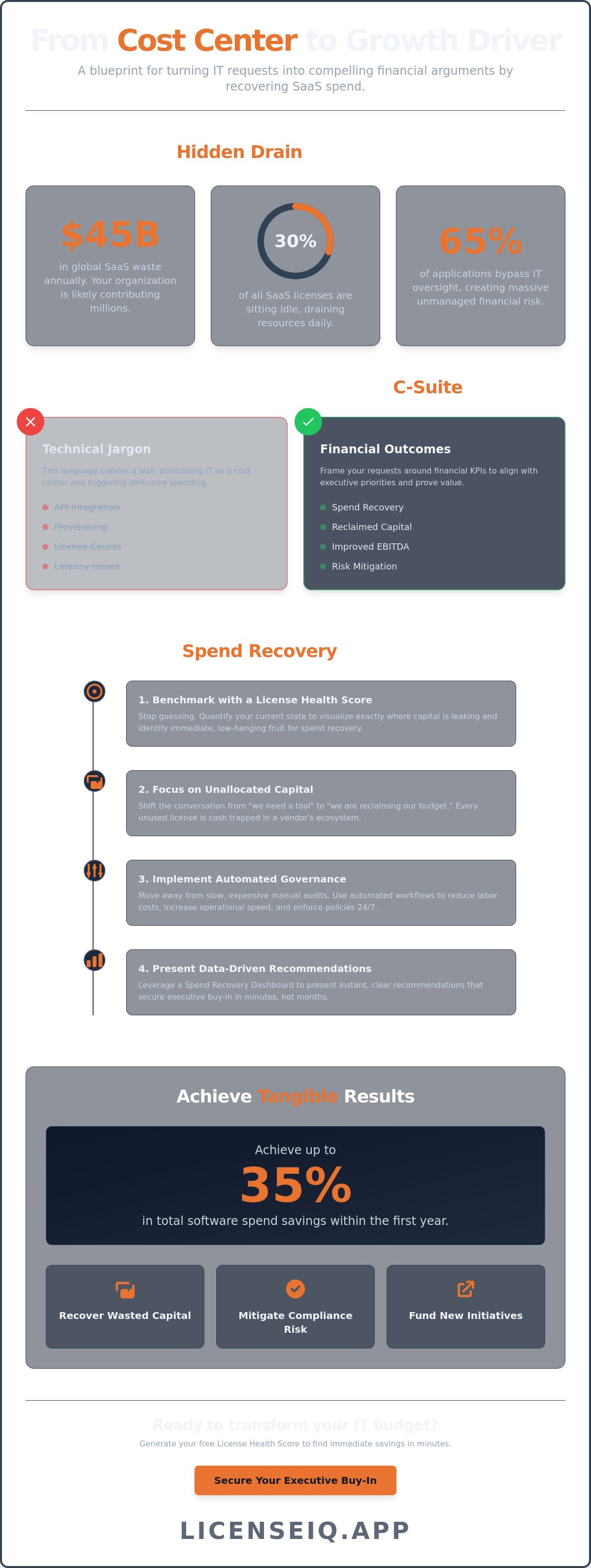
Nearly 30% of all SaaS licenses in your organization are likely sitting idle, contributing to a staggering $45 billion in global waste this year. When you present a budget for new infrastructure, the C-suite often sees a cost center rather than a growth driver. It's exhausting to watch essential tools get cut because you can't translate technical necessity into the language of the balance sheet. You know the value of your stack, but the board only sees an ever-expanding line item.
Building a business case for saas optimization tool requires moving beyond technical feature lists to focus on hard financial outcomes. You need to prove that you aren't just spending money, but actively recovering it from the 65% of applications that currently bypass IT oversight. This article provides the 2026 Spend Recovery Framework, a blueprint designed to turn technical requests into compelling financial arguments. You'll learn how to quantify the value of automated governance, eliminate budget friction, and finally secure your seat as a strategic partner in your organization's financial health.
Key Takeaways
- Bridge the communication gap by translating technical debt into financial KPIs that resonate with the C-suite.
- Master building a business case for saas optimization tool by focusing on recovering unallocated capital rather than just license counts.
- Utilize the License Health Score to benchmark your current state and identify immediate, low-hanging fruit for spend recovery.
- Shift from manual audit liabilities to Automated Governance Workflows to reduce labor costs and increase operational speed.
- Leverage the Spend Recovery Dashboard to present instant, data-driven recommendations that secure executive buy-in in minutes.
The Communication Gap: Why Executives Say 'No' to IT Spend
Executives view IT through the lens of the balance sheet. To them, your department is often a cost center. This perception creates a trap where every request for new tooling is treated as an expense to be minimized. When you ask for budget, you aren't just fighting for a tool; you're fighting a pre-existing bias. You must break this cycle to gain the resources your team needs.
Technical jargon reinforces this wall. Terms like "API integration," "latency," or "provisioning" don't translate to financial value. Instead, they trigger defensive spending. The 2026 reality is one of massive SaaS sprawl. With the average organization managing over 300 applications, subscription fatigue has set in. When leadership says "no," they usually aren't rejecting the technology's merit. They're asking for clarity on how that technology impacts the bottom line. When you focus on building a business case for saas optimization tool, you're essentially providing the financial transparency that executives crave.
The Psychology of the CFO in 2026
Modern CFOs have pivoted from growth-at-all-costs to efficiency-first operations. They prioritize capital preservation. If your proposal sounds like "governance," it sounds like a new administrative burden. If it sounds like "spend recovery," it sounds like revenue. Building a business case for saas optimization tool succeeds when you align with this shift. You must frame the tool as a mechanism to reclaim wasted capital rather than a way to manage technical debt. They want to see how you are protecting the organization's resources from the $45 billion in global SaaS waste reported this year.
Identifying Your Own Technical Communication Blind Spots
The biggest mistake in IT pitching is explaining the process instead of the impact. Don't explain how the software scans for idle accounts. Explain that it identifies significant monthly waste. You need to present the Total Cost of Ownership (TCO) of your current unmanaged stack versus the optimized state. Audit your pitch for non-technical readability. If a business manager can't understand the benefit in 30 seconds, the pitch will fail. Your elevator pitch should be: "We are currently losing 30% of our SaaS budget to unused licenses. This tool recovers that capital automatically, allowing us to fund new initiatives without increasing the total IT budget." This direct approach is why platforms like LicenseIQ focus on immediate financial visibility and results.
Translating Technical Debt into Financial Opportunity
Stop reporting on license counts. Executives find these metrics hollow. Instead, focus on unallocated capital. Every unused seat represents cash trapped in a vendor's ecosystem that could be fueling your company's growth. When building a business case for saas optimization tool, your primary objective is to show how technical oversight converts into liquid capital. This shift in language moves the conversation from "we need a new tool" to "we are reclaiming our budget."
Mapping technical features to business Key Performance Indicators (KPIs) is essential for building a compelling business case that survives board-level scrutiny. Don't talk about "automated provisioning." Talk about "reducing operational overhead" and "improving EBITDA." Shadow IT is no longer just a security headache; it's a massive financial liability. With organizations spending an average of $55.7 million annually on SaaS, the 65% of applications operating outside IT oversight represent millions in unmanaged risk. Optimizing your M365 environment isn't just about tidying up; it's a strategic risk mitigation move to ensure 2026 compliance with SOC 2 and ISO 27001 standards.
The ROI of License Hygiene
Inactive users create a "Ghost Seat tax" that quietly drains your department's resources. Distinguish clearly between simple cost savings and proactive spend recovery. Cost savings are a one-time event; spend recovery is a continuous financial strategy. Organizations that prioritize building a business case for saas optimization tool can achieve up to 35% in total software spend savings within the first year. You can begin identifying these immediate wins by generating a License Health Score to visualize exactly where your capital is leaking.
Risk Mitigation: The Hidden Executive Motivator
Financial waste isn't the only cost of poor license management. Improper offboarding creates massive security gaps. A single orphaned account can lead to a data breach that costs millions in fines and lost reputation. Automation eliminates the human error inherent in manual financial reporting and administrative audits. Use a structured Office 365 Offboarding Checklist 2026 to ensure every departure triggers a secure and financially sound workflow. By presenting automation as a guardian of corporate resources, you appeal to the executive's fundamental need for security and predictability.
Building the Business Case: The Spend Recovery Framework
Winning executive approval requires a structured, data-driven approach. You can't rely on intuition or anecdotal evidence when asking for significant budget allocations. Success in building a business case for saas optimization tool depends on your ability to quantify obscured waste and present it as a recoverable asset. Follow this five-step framework to transform your technical needs into a financial imperative that aligns with corporate fiscal goals.
- Step 1: Benchmark the current state. Generate a License Health Score to establish an objective baseline. This metric provides a high-level snapshot of your current efficiency levels and identifies where oversight is lacking.
- Step 2: Quantify the low-hanging fruit. Identify inactive licenses and duplicate subscriptions immediately. These represent the fastest path to spend recovery and provide the "quick wins" CFOs appreciate.
- Step 3: Forecast annual savings. Project these findings across your entire software stack using 2026 subscription rates. Executives need to see the cumulative financial impact over a full fiscal year to justify the investment.
- Step 4: Present the Cost of Inaction (COI). Calculate the specific dollar amount lost every month the decision is delayed. This creates the necessary urgency for approval by highlighting ongoing capital leakage.
- Step 5: Propose the automated solution. Position a platform like LicenseIQ as the permanent mechanism for maintaining these savings. Contrast the one-time cost of the tool against the recurring revenue recovered.
Visualizing Waste: The Power of the Spend Recovery Dashboard
A single dashboard is worth a thousand spreadsheets. Executives lack the time to parse rows of raw data or complex technical logs. The Spend Recovery Dashboard uses a Red-Yellow-Green reporting method to provide instant context. Green indicates optimized tiers. Yellow signals underutilized assets. Red highlights critical waste. This visual clarity allows non-technical stakeholders to grasp the situation in seconds. By using the License Health Score as a primary metric, you eliminate ambiguity and focus the conversation on financial health rather than technical complexity.
The Cost of Inaction (COI) Formula
Urgency is the catalyst for budget approval. To create it, you must define the Cost of Inaction (COI). Calculate your monthly burn by totaling the cost of all unassigned or inactive licenses identified during your initial audit. If your organization is losing a specific dollar amount every month to "ghost seats," that is the heavy price of waiting. Frame the tool's cost as a small fraction of this recovered waste. When the COI exceeds the investment within the first few months, the decision to proceed becomes a financial necessity rather than a technical luxury. This logical progression is the cornerstone of building a business case for saas optimization tool that wins in the boardroom.
Overcoming the 'Status Quo' Objection with Automated Governance
The "status quo" is your most formidable competitor. Executives often believe that manual spreadsheets and internal administrative teams are sufficient for tracking software. This is a legacy mindset that fails in the 2026 operational environment. With the average organization now managing 305 SaaS applications, static tracking is no longer just inefficient. It's a liability. Building a business case for saas optimization tool requires you to demonstrate that manual oversight is a primary driver of financial waste and security vulnerability.
Automated Governance Workflows act as a 24/7 digital auditor. Unlike a human team, these workflows never sleep and don't suffer from "subscription fatigue." They provide the constant oversight necessary to manage the 65% of SaaS applications that typically bypass IT departments. When leadership argues that manual tracking is "free," you must be prepared to show them the true cost of that labor. You can learn more about managing these complex environments in our guide to Mastering the Microsoft 365 License Management Lifecycle in 2026.
Manual vs. Automated: The Hidden Labor Tax
A manual audit is never free. It carries a heavy "labor tax" that drains your most valuable resources. Calculating the engineering hours required to pull logs, reconcile CSV files, and cross-reference user activity usually reveals a cost of thousands of dollars per audit cycle. This is a massive opportunity cost. Every hour a senior architect spends on a license spreadsheet is an hour not spent on product innovation or infrastructure security. Furthermore, point-in-time audits are obsolete the moment they are completed. Continuous governance ensures your License Health Score remains optimized every day of the year, preventing the "Ghost Seat tax" from accumulating between quarterly reviews.
Future-Proofing with AI-Native Intelligence
The 2026 shift toward AI-native platforms has changed the rules of FinOps. Modern tools now utilize the Model Context Protocol (MCP) to enable smarter, faster decision-making across disparate data silos. This intelligence goes beyond simple seat counting. AI now predicts license requirements months before a renewal window opens. It analyzes usage patterns to suggest the most cost-effective tiering for your specific workforce. Building a business case for saas optimization tool means positioning the investment as a foundation for company-wide scalability. You are replacing a reactive, error-prone process with a proactive system that scales without increasing headcount. It's an investment in operational transparency that protects the organization’s financial health.
Stop wasting engineering hours on manual audits. Deploy Automated Governance Workflows with LicenseIQ today.
LicenseIQ: Securing Executive Buy-In with a 5-Minute Audit
Executives value time above all other resources. Long trial periods and complex deployments often kill momentum before a project even begins. LicenseIQ solves this by connecting to your environment in under five minutes. It provides an immediate License Health Score that benchmarks your efficiency against 2026 industry standards. When building a business case for saas optimization tool, the ability to present real-time data from your own stack is a game-changer. You move past hypothetical scenarios and present documented evidence of capital leakage.
The Spend Recovery Dashboard is the core of this strategy. It presents dollar-value recommendations instantly, removing the need for a technical degree to interpret the findings. Leadership can see exactly where unallocated capital is trapped. By following the actionable insights provided, organizations frequently reach a path to 35% total software savings. This isn't just optimization. It's a direct contribution to the company's bottom line. The dashboard provides the transparency required to transform IT from a cost center into a strategic partner.
The 5-Minute Proof of Concept (PoC)
Traditional software evaluation cycles are obsolete. In a high-velocity SaaS environment, you need instant insight. The 5-minute PoC model allows you to generate a comprehensive report before your next budget meeting. Use the LicenseIQ Health Score to provide immediate context for non-technical stakeholders. If your score is low, the financial justification for the tool is already made. You can Get your M365 Health Check at LicenseIQ to visualize your current waste levels. This proactive audit positions you as a vigilant guardian of corporate resources rather than a passive administrator.
Next Steps: From Justification to Implementation
Summarize your pitch with direct financial logic. "Our current manual tracking has obscured a specific monthly loss. This tool recovers that capital starting today." Closing the deal involves handling the final price objection with ROI data. When the cost of the LicenseIQ Platform is significantly lower than the waste discovered in five minutes, the decision becomes a financial necessity. You aren't defending a technical expense. You are proposing a spend recovery strategy that pays for itself.
The transition to full implementation is rapid. Once the board sees the clarity provided by the Spend Recovery Dashboard, the value proposition is undeniable. You've successfully shifted the narrative from technical debt to financial opportunity. Take control of your software stack and start your 5-minute Microsoft 365 audit today.
Reclaiming Your Budget: The Path to Strategic IT Leadership
Success in the 2026 SaaS landscape requires a permanent shift from technical maintenance to financial oversight. By adopting the Spend Recovery Framework, you've moved past the cost center trap and positioned your department as a driver of capital efficiency. You now possess the methodology to quantify inactive licenses and prove the monthly cost of inaction with hard data. This transition ensures that your technical requirements are viewed as strategic financial assets by the board.
Building a business case for saas optimization tool is no longer a complex, months-long administrative project. You can demonstrate immediate value by leveraging AI-native automated governance that monitors your resource health 24/7. Organizations using these specialized tools regularly uncover an average of 35% in hidden savings. This level of transparency eliminates budget friction and secures your seat as a vital guardian of corporate resources.
Take the first step toward total organizational clarity today. Discover your Spend Recovery Score in 5 minutes by connecting directly to your M365 environment. It's time to stop managing software waste and start leading your organization with data-driven confidence.
Frequently Asked Questions
What is the best way to justify IT spend to a CFO?
Focus on spend recovery and EBITDA impact rather than technical features. CFOs prioritize capital preservation and efficiency first operations. Present your IT request as a mechanism for reclaiming unallocated capital from your existing software stack.
How do I explain technical SaaS terms to a non-technical board?
Replace technical specifications with financial outcomes. Instead of discussing API integrations or provisioning latency, talk about operational overhead and the "Ghost Seat tax." Use a Spend Recovery Dashboard to provide the visual clarity they need to make rapid decisions.
What is the Cost of Inaction in IT budgeting?
The Cost of Inaction (COI) represents the specific monthly burn of unassigned or inactive licenses. It quantifies exactly how much capital the organization loses every month a decision is delayed. Use this figure when building a business case for saas optimization tool to create a sense of urgency in the boardroom.
How can I prove ROI on Microsoft 365 license optimization?
Compare your License Health Score before and after implementing automated oversight. The ROI is the total dollar value of reclaimed seats and downgraded tiers minus the cost of the optimization platform. Automated reporting provides the objective data required for this financial proof.
Why is manual license tracking considered a business risk in 2026?
Manual tracking cannot keep pace with the 305 average SaaS applications found in modern organizations. It typically leaves 65% of software spend unmanaged and outside IT oversight. This creates significant financial leakage and security vulnerabilities during employee offboarding.
What are the most common executive objections to new IT tools?
Executives often believe manual processes are sufficient or cite budget constraints. Counter these objections by calculating the hidden labor tax of manual audits. Prove that the "status quo" is actually more expensive than the automated solution due to ongoing waste.
How does automated governance reduce software waste?
Automated Governance Workflows monitor user activity 24/7 to identify idle accounts. They instantly trigger reclamation processes when inactivity thresholds are met. This proactive approach ensures your software environment remains lean without requiring constant manual intervention.
Can I really save 35% on Microsoft 365 subscriptions?
Yes, organizations frequently discover that 30% of their licenses are unused or incorrectly tiered. building a business case for saas optimization tool allows you to identify these specific savings through deep usage analytics. These reclaimed funds can then be redirected to higher priority strategic initiatives.


